
Stuck thinking, “What project should I build next?” You’re not alone.
Many learners understand the basics but struggle to develop a strong data science project. They often choose very simple topics or copy common projects that don’t stand out.
This leads to frustration, a weak portfolio, and fewer chances of getting noticed by recruiters. Without unique and practical projects, your skills often go unseen.
But don’t worry, the right Data Science Project Ideas can completely change your learning and career path.
In this blog, you’ll explore beginner to advanced project ideas, learn how to choose the right one for your level, and discover tips to turn your ideas into real, portfolio-ready projects that grab attention.
Why Projects Are Important for Learning Data Science
Projects are important for learning data science because they help turn theoretical concepts into practical skills, improve problem-solving ability, and build confidence through real-world experience. Below is the importance of projects in data science learning:
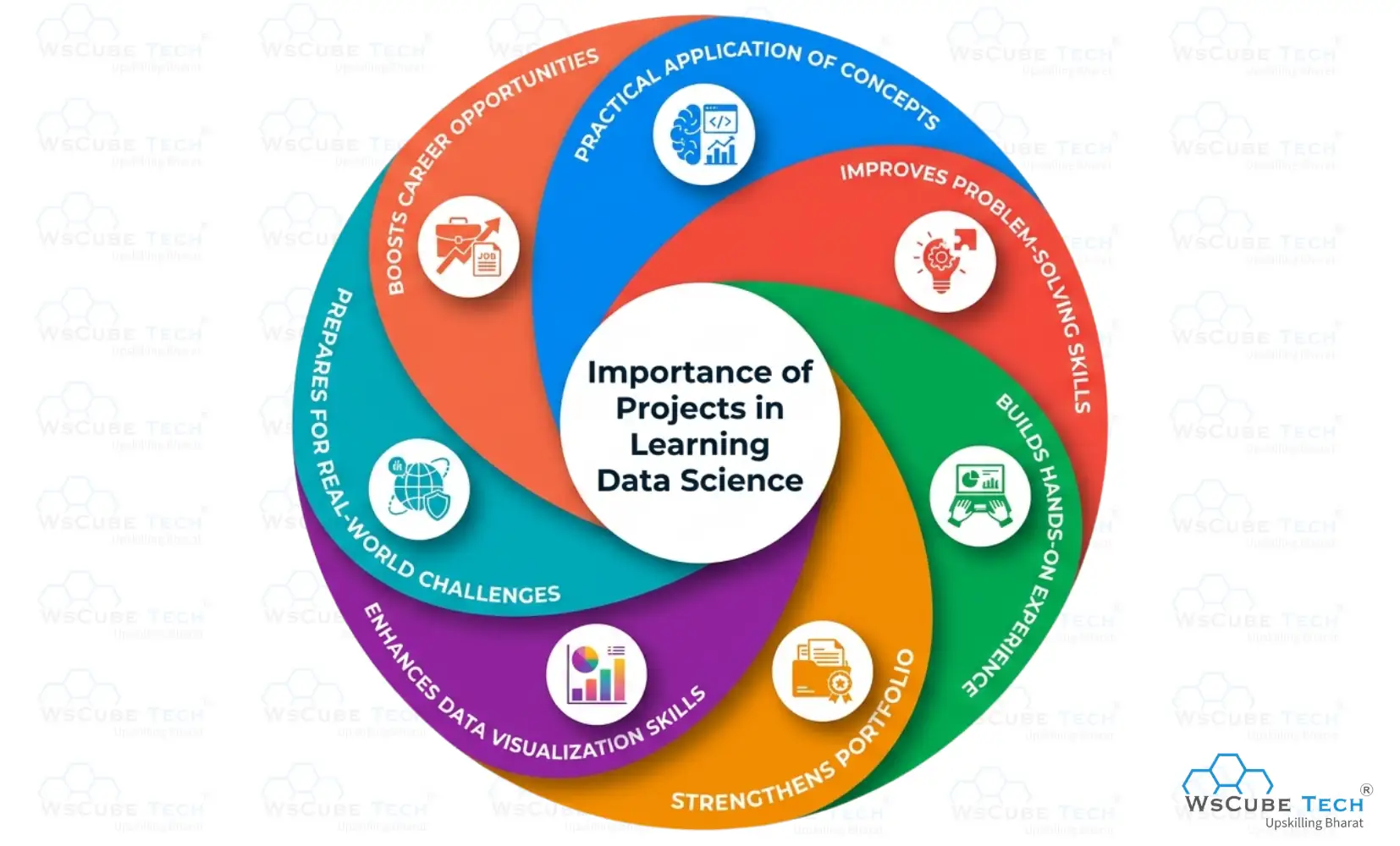
- Practical Application of Concepts: Projects help learners apply concepts like data cleaning, visualization, machine learning, and model evaluation in real-world scenarios, making theoretical knowledge easier to understand and remember for long-term learning.
- Improves Problem-Solving Skills: Working on projects develops logical and analytical thinking by helping learners identify problems, select appropriate methods, and find effective, data-driven solutions step by step.
- Builds Hands-On Experience: Projects provide practical exposure to tools such as Python, SQL, Pandas, NumPy, and machine learning libraries, which is essential for building confidence and developing industry-ready skills.
- Strengthens Portfolio: A well-structured project portfolio showcases your skills, knowledge, and practical expertise, helping you stand out during internships, placements, and job applications in the data science field.
- Enhances Data Visualization Skills: Through projects, learners understand how to present data insights using charts, graphs, and dashboards, making complex information easier to interpret and communicate.
- Prepares for Real-World Challenges: Projects simulate real business problems, helping learners understand data collection, preprocessing, model building, and performance analysis in practical situations.
- Boosts Career Opportunities: Completing projects increases your confidence and encourages you to experiment with new ideas, techniques, and approaches, helping you grow and think creatively as a data science professional.
Recommended Professional Certificates
Data Analytics Course with Gen AI
Data Science Course with Internship & Placement Support
Data Science Projects for Beginners (With Source Code)
Below are the best data science project ideas for beginners that help build practical skills, strengthen core concepts, and gain hands-on experience with real-world datasets:
1. Iris Flower Classification
The Iris Flower Classification project is one of the most popular beginner-friendly data science projects. In this project, we use machine learning to classify iris flowers into three species, Setosa, Versicolor, and Virginica, based on features like sepal length, sepal width, petal length, and petal width. It is a great project for understanding the basics of classification models and predictive analysis.
How It Works
- The Iris dataset is loaded into the project.
- Data is explored and cleaned if needed.
- Important flower features are selected.
- The dataset is divided into training and testing sets.
- A classification algorithm is applied.
- The model predicts the flower species.
- Accuracy is evaluated using test data.
Skills You Practice
- Data preprocessing
- Data visualization
- Classification algorithms
- Model training and testing
- Accuracy evaluation
- Python and machine learning basics
Source Code: Iris Flower Classification
2. Titanic Survival Prediction
The Titanic Survival Prediction project is a beginner-friendly machine learning project where we predict whether a passenger survived or not based on details such as age, gender, ticket class, and fare. This project helps learners understand classification models, data preprocessing, and predictive analysis using real-world datasets.
How It Works
- The Titanic dataset is loaded into the project.
- Missing values and unnecessary columns are handled.
- Important features such as age, gender, and class are selected.
- The data is split into learning and testing parts.
- A classification algorithm is used to train the model.
- The model predicts passenger survival.
- Accuracy is evaluated using test data.
Skills You Practice
- Data cleaning and preprocessing
- Handling missing values
- Feature selection
- Classification algorithms
- Model training and testing
- Accuracy evaluation
Source Code: Titanic Survival Prediction
3. House Price Prediction
The House Price Prediction project focuses on predicting property prices based on features such as area, location, number of bedrooms and bathrooms, and other details. It helps you understand regression models, feature selection, and price forecasting using real-world housing data.
How It Works
- The housing dataset is loaded into the project.
- Missing values and unnecessary columns are handled.
- Important features such as area, location, and rooms are selected.
- The dataset is split for model training and testing.
- A regression algorithm is used to train the model.
- The model predicts house prices.
- Accuracy is evaluated using test data.
Skills You Practice
- Data cleaning and preprocessing
- Feature selection
- Regression algorithms
- Model training and testing
- Price prediction
- Accuracy evaluation
Source Code: House Price Prediction
4. Student Performance Analysis
The Student Performance Analysis project is a beginner-friendly data science project that helps analyze students academic performance based on factors such as study hours, attendance, marks, and subject scores. This project helps learners understand data analysis, visualization, and how different factors affect student results.
How It Works
- The student dataset is loaded into the project.
- Missing values and unnecessary columns are handled.
- Important factors such as marks, attendance, and study hours are selected.
- The data is split into training and testing sets.
- An analysis or prediction model is applied.
- The model evaluates student performance.
- Accuracy is evaluated using test data.
Skills You Practice
- Data cleaning and preprocessing
- Data analysis
- Data visualization
- Feature selection
- Model training and testing
- Performance evaluation
Source Code: Student Performance Analysis
5. Sales Data Analysis
The Sales Data Analysis project is a beginner-friendly data science project that helps analyze sales trends, customer behavior, and product performance using real-world sales data. This project helps learners understand how to extract useful insights, identify patterns, and support business decisions through data analysis.
How It Works
- The sales dataset is loaded into the project.
- Missing values and unnecessary columns are handled.
- Important fields such as sales amount, product category, and date are selected.
- The data is cleaned and organized for analysis.
- Charts and graphs are used to visualize sales trends.
- Insights are generated to understand business performance.
- Results are evaluated based on the analysis.
Skills You Practice
- Data cleaning and preprocessing
- Data analysis
- Data visualization
- Trend analysis
- Business insight generation
- Reporting and interpretation
Source Code: Sales Data Analysis
6. Movie Recommendation System
The Movie Recommendation System project suggests movies to users based on their interests, ratings, or viewing history. It helps you understand recommendation algorithms, similarity techniques, and how personalized suggestions work in real-world applications, improving user experience and engagement.
How It Works
- The movie dataset is loaded into the project.
- User ratings and movie details are processed.
- Important features such as genre, ratings, and user preferences are selected.
- Similarity techniques or recommendation algorithms are applied.
- The system compares movies based on selected features.
- Personalized movie suggestions are generated.
- Results are evaluated based on recommendation accuracy.
Skills You Practice
- Data preprocessing
- Recommendation systems
- Similarity analysis
- User preference modeling
- Data visualization
- Result evaluation
Source Code: Movie Recommendation System
7. Spam Email Detection
The Spam Email Detection project helps identify whether an email is spam or genuine. It uses text data and machine learning techniques to classify emails based on their content, keywords, and patterns, helping you understand text classification and predictive modeling.
How It Works
- The email dataset is loaded into the project.
- Text data is cleaned and preprocessed.
- Important words and patterns are extracted from emails.
- The data is arranged into training and testing sets.
- A classification algorithm is used to train the model.
- The model determines whether an email is spam or not.
- Accuracy is evaluated using test data.
Skills You Practice
- Text preprocessing
- Data cleaning
- Classification algorithms
- Feature extraction
- Model training and testing
- Accuracy evaluation
Source Code: Spam Email Detection
8. Weather Forecast Prediction
The Weather Forecast Prediction project is a beginner-friendly data science project that predicts future weather conditions, such as temperature, rainfall, humidity, and wind speed, using historical weather data. This project helps learners understand predictive analysis, time-based data patterns, and forecasting models.
How It Works
- The weather dataset is loaded into the project.
- Missing values and unnecessary columns are handled.
- Important features such as temperature, humidity, and rainfall are selected.
- The data is arranged into training and testing sets.
- A prediction model is used to train the system.
- The model forecasts future weather conditions.
- Accuracy is evaluated using test data.
Skills You Practice
- Data cleaning and preprocessing
- Time-series analysis
- Forecasting models
- Feature selection
- Model training and testing
- Accuracy evaluation
Source Code: Weather Forecast Prediction
9. Diabetes Prediction
The Diabetes Prediction project helps predict whether a person is likely to have diabetes based on health-related factors such as glucose level, blood pressure, BMI, age, and insulin level. It helps you understand predictive analysis and classification models using healthcare datasets.
How It Works
- The diabetes dataset is loaded into the project.
- Missing values and unnecessary columns are handled.
- Important health factors are selected.
- The data is separated for training and testing.
- A classification model is used to train the system.
- The model predicts the likelihood of diabetes.
- Accuracy is evaluated using test data.
Skills You Practice
- Data cleaning and preprocessing
- Healthcare data analysis
- Classification algorithms
- Feature selection
- Model training and testing
- Accuracy evaluation
Source Code: Diabetes Prediction
10. Stock Price Trend Analysis
The Stock Price Trend Analysis project helps analyze stock market price movements using historical data. It focuses on identifying trends, patterns, and changes over time, helping you understand time-based data analysis and basic market-forecasting concepts while improving your decision-making skills.
How It Works
- The stock price dataset is loaded into the project.
- Missing values and unnecessary columns are handled.
- Important fields such as opening price, closing price, and volume are selected.
- The data is separated for analysis and validation.
- Trend analysis techniques are applied.
- Charts and graphs are used to visualize price movements.
- Results are evaluated based on trend patterns.
Skills You Practice
- Data cleaning and preprocessing
- Time-series analysis
- Trend analysis
- Data visualization
- Pattern recognition
- Result evaluation
Source Code: Stock Price Trend Analysis
11. Customer Segmentation
The Customer Segmentation project helps group customers based on factors such as age, spending habits, purchase history, and income. It helps you understand clustering techniques and how businesses use data to identify different customer groups for better decision-making.
How It Works
- The customer dataset is loaded into the project.
- Missing values and unnecessary columns are handled.
- Important features such as age, income, and spending score are selected.
- The data is prepared for clustering analysis.
- A clustering method is used to group customers with similar characteristics.
- Customer segments are created based on patterns.
- Results are evaluated through cluster visualization.
Skills You Practice
- Data cleaning and preprocessing
- Clustering algorithms
- Pattern recognition
- Customer behavior analysis
- Data visualization
- Result evaluation
Source Code: Customer Segmentation
12. Chatbot using Python
The Chatbot using Python project helps create a simple chatbot that can interact with users and respond to basic questions based on predefined rules or simple logic. It helps learners understand Python programming, text processing, and basic natural language interaction.
How It Works
- The user input dataset or predefined responses are loaded into the project.
- Text input is cleaned and preprocessed.
- Important keywords and patterns are identified.
- The logic is prepared for handling user queries.
- A rule-based or simple NLP model is applied.
- The chatbot generates responses based on the input.
- Results are tested for accuracy and interaction flow.
Skills You Practice
- Python programming
- Text preprocessing
- Basic NLP
- Conditional logic
- User interaction flow
- Problem-solving
Source Code: Chatbot using Python
If you enjoyed these data science project ideas for beginners, take the next step with our structured online Data Analytics Course, where you will learn Excel, SQL, and Power BI, and more, step by step.
Upcoming Masterclass
Attend our live classes led by experienced and desiccated instructors of Wscube Tech.



Intermediate Data Science Projects (With Source Code)
After completing basic data science projects, you can move to intermediate data science projects with source code to improve practical skills, strengthen concepts, and gain hands-on experience with real-world datasets:
1. Credit Card Fraud Detection
The Credit Card Fraud Detection project is an intermediate-level data science project that helps identify fraudulent transactions using transaction patterns, amount, time, and user behavior data. This project helps learners understand anomaly detection, classification models, and fraud analysis in real-world financial datasets.
How It Works
- The transaction dataset is loaded into the project.
- Missing values and irrelevant columns are handled.
- Important features such as transaction amount, time, and behavior patterns are selected.
- The data is prepared for model training and testing.
- A classification or anomaly detection model is applied.
- The system identifies fraudulent transactions.
- Results are evaluated using performance metrics.
Skills You Practice
- Data cleaning and preprocessing
- Fraud detection techniques
- Classification algorithms
- Anomaly detection
- Pattern recognition
- Performance evaluation
Source Code: Credit Card Fraud Detection
2. Loan Approval Prediction
The Loan Approval Prediction project predicts whether a loan application will be approved based on factors such as income, credit score, employment status, and loan amount. It helps you understand predictive modeling and decision-based classification using financial data.
How It Works
- The loan dataset is loaded into the project.
- Missing values and unnecessary columns are handled.
- Important features such as income, credit history, and loan amount are selected.
- The data is prepared for model training and evaluation.
- A classification model is applied.
- The system predicts loan approval status.
- Results are evaluated using performance metrics.
Skills You Practice
- Data cleaning and preprocessing
- Financial data analysis
- Classification algorithms
- Feature selection
- Model training and evaluation
- Performance analysis
Source Code: Loan Approval Prediction
3. Employee Attrition Prediction
The Employee Attrition Prediction project that helps predict whether an employee is likely to leave the company based on factors such as salary, job role, work experience, and job satisfaction. This project helps learners understand predictive modeling and workforce analytics using real-world HR data.
How It Works
- The employee dataset is loaded into the project.
- Missing values and unnecessary columns are handled.
- Important features such as salary, experience, and job satisfaction are selected.
- The data is prepared for model training and evaluation.
- A classification model is applied.
- The system predicts employee attrition.
- Results are evaluated using performance metrics.
Skills You Practice
- Data cleaning and preprocessing
- HR data analysis
- Classification algorithms
- Feature selection
- Predictive modeling
- Performance evaluation
Source Code: Employee Attrition Prediction
4. Customer Churn Prediction
The Customer Churn Prediction project helps identify if a customer is likely to stop using a service based on factors such as usage history, subscription type, complaints, and behavior patterns. It helps you understand predictive modeling and customer retention analysis while improving business decision-making and customer experience.
How It Works
- The customer dataset is loaded into the project.
- Missing values and unnecessary columns are handled.
- Important features such as usage history, subscription plan, and complaints are selected.
- The data is prepared for model training and evaluation.
- A classification model is applied.
- The system predicts customer churn.
- Results are evaluated using performance metrics.
Skills You Practice
- Data cleaning and preprocessing
- Customer behavior analysis
- Classification algorithms
- Feature selection
- Predictive modeling
- Performance evaluation
Source Code: Customer Churn Prediction
5. Sentiment Analysis on Reviews
The Sentiment Analysis on Reviews project helps analyze whether customer reviews are positive, negative, or neutral based on their text. It helps you understand natural language processing, text classification, and opinion mining using real-world review data.
How It Works
- The review dataset is loaded into the project.
- Text data is cleaned and preprocessed.
- Important words and phrases are extracted from the reviews.
- The data is prepared for model training and evaluation.
- A text classification model is applied.
- The system predicts the sentiment of each review.
- Results are evaluated using performance metrics.
Skills You Practice
- Text preprocessing
- Natural language processing
- Sentiment analysis
- Text classification
- Predictive modeling
- Performance evaluation
Source Code: Sentiment Analysis on Reviews
6. Demand Forecasting System
The Demand Forecasting System project helps estimate future product demand using historical sales data, seasonal trends, and customer purchasing patterns. It helps you understand forecasting models, trend analysis, and data-driven business decision-making using real-world datasets.
How It Works
- The sales and demand dataset is loaded into the project.
- Missing values and unnecessary columns are handled.
- Important features such as date, product sales, and seasonal trends are selected.
- The data is prepared for model training and validation.
- A forecasting model is applied.
- The system predicts future demand.
- Results are evaluated using performance metrics.
Skills You Practice
- Data cleaning and preprocessing
- Time-series analysis
- Forecasting models
- Trend analysis
- Business data analysis
- Performance evaluation
Source Code: Demand Forecasting System
7. Traffic Sign Recognition
The Traffic Sign Recognition project is an intermediate-level data science project that helps identify and classify traffic signs from images using machine learning and computer vision techniques. This project helps learners understand image classification, pattern recognition, and real-world AI applications in transportation systems.
How It Works
- The traffic sign image dataset is loaded into the project.
- Images are cleaned, resized, and preprocessed.
- Important visual features are extracted from the images.
- The data is prepared for model training and testing.
- An image classification model is applied.
- The system recognizes and classifies traffic signs.
- Results are evaluated using performance metrics.
Skills You Practice
- Image preprocessing
- Computer vision
- Image classification
- Pattern recognition
- Model training and testing
- Performance evaluation
Source Code: Traffic Sign Recognition
8. News Classification System
The News Classification System project helps categorize news articles into topics such as sports, politics, business, and technology based on their text content. It helps you understand natural language processing, text classification, and content categorization using real-world datasets.
How It Works
- The news dataset is loaded into the project.
- Text data is cleaned and preprocessed.
- Important words and phrases are extracted from the articles.
- The data is prepared for model training and evaluation.
- A text classification model is applied.
- The system assigns each article to the correct category.
- Results are evaluated using performance metrics.
Skills You Practice
- Text preprocessing
- Natural language processing
- Text classification
- Feature extraction
- Predictive modeling
- Performance evaluation
Source Code: News Classification System
9. Face Mask Detection
The Face Mask Detection project helps identify whether a person is wearing a mask or not using image processing and machine learning techniques. It is a practical project for learning computer vision and image classification with real-world use cases.
How It Works
- The image dataset is loaded into the project.
- Images are cleaned, resized, and preprocessed.
- Important visual features are extracted.
- The data is prepared for training and evaluation.
- An image classification model is applied.
- The system detects the presence of a face mask.
- Results are evaluated using performance metrics.
Skills You Practice
- Image preprocessing
- Computer vision
- Image classification
- Pattern recognition
- Model training and evaluation
- Performance analysis
Source Code: Face Mask Detection
10. Heart Disease Prediction
The Heart Disease Prediction project helps predict the likelihood of heart disease based on health-related factors such as age, blood pressure, cholesterol level, heart rate, and medical history. It helps learners understand predictive analysis, healthcare data processing, and classification models using real-world medical datasets.
How It Works
- The medical dataset is loaded into the project.
- Missing values and unnecessary columns are handled.
- Important health factors are selected.
- The data is prepared for training and evaluation.
- A classification model is applied.
- The system predicts the risk of heart disease.
- Results are evaluated using performance metrics.
Skills You Practice
- Data cleaning and preprocessing
- Healthcare data analysis
- Classification algorithms
- Feature selection
- Predictive modeling
- Performance evaluation
Source Code: Heart Disease Prediction
Read More Guides Related to Data Science
Data Science Projects for Experts (With Source Code)
Below are advanced data science projects for experts that help tackle complex problems, enhance modeling skills, and provide hands-on experience with large-scale, real-world datasets:
1. Real-Time Chatbot with NLP
The Real-Time Chatbot with NLP project helps build an intelligent chatbot that can understand user queries and respond in real time using Natural Language Processing techniques. This project helps learners understand text processing, intent recognition, language models, and AI-based conversational systems used in real-world applications.
How It Works
- The text conversation dataset is loaded into the project.
- Text data is cleaned and preprocessed.
- Important keywords, intents, and entities are extracted.
- The data is prepared for model training and testing.
- An NLP or deep learning model is applied.
- The chatbot generates responses in real time.
- Results are evaluated using performance metrics.
Skills You Practice
- Natural language processing
- Text preprocessing
- Intent recognition
- Deep learning models
- Conversational AI
- Performance evaluation
Source Code: Real-Time Chatbot with NLP
2. Image Caption Generator
The Image Caption Generator project helps generate meaningful text descriptions for images using deep learning and computer vision techniques. It helps learners understand how AI combines image processing and Natural Language Processing to convert visual content into human-readable captions.
How It Works
- The image dataset with captions is loaded into the project.
- Images are cleaned, resized, and preprocessed.
- Important visual features are extracted using a CNN model.
- Text captions are cleaned and tokenized.
- The data is prepared for model training and evaluation.
- A deep learning model is applied to generate captions.
- The system predicts a suitable caption for each image.
- Results are evaluated using performance metrics.
Skills You Practice
- Image preprocessing
- Computer vision
- Natural language processing
- Deep learning models
- Feature extraction
- Model evaluation
Source Code: Image Caption Generator
3. Fake News Detection System
The Fake News Detection System project helps identify whether a news article is real or fake based on its text content, writing style, and important keywords. It helps learners understand natural language processing, text classification, and misinformation detection using real-world datasets.
How It Works
- The news article dataset is loaded into the project.
- Text data is cleaned and preprocessed.
- Important words, phrases, and writing patterns are extracted.
- The data is prepared for model training and evaluation.
- A text classification model is applied.
- The system predicts whether the news is real or fake.
- The outcomes are assessed using performance metrics.
Skills You Practice
- Text preprocessing
- Natural language processing
- Text classification
- Feature extraction
- Predictive modeling
- Performance evaluation
Source Code: Fake News Detection System
4. Stock Market Prediction Using LSTM
The Stock Market Prediction Using LSTM project helps predict future stock prices using historical market data and deep learning techniques. It uses Long Short-Term Memory (LSTM) networks to analyze time-series data and identify patterns in stock price movements. This project helps learners understand time-series forecasting, deep learning models, and financial data analysis used in real-world trading systems.
How It Works
- The historical stock market dataset is loaded into the project.
- Missing values and irrelevant data are handled.
- Important features such as open, close, high, low, and volume are selected.
- The data is normalized and prepared for time-series modeling.
- An LSTM deep learning model is applied.
- The system predicts future stock prices based on past trends.
- Results are evaluated using performance metrics.
Skills You Practice
- Time-series analysis
- Deep learning (LSTM)
- Data preprocessing
- Financial data analysis
- Forecasting models
- Model evaluation
Source Code: Stock Market Prediction Using LSTM
5. Recommendation Engine Using Deep Learning
The Recommendation Engine Using Deep Learning project helps suggest relevant products, movies, courses, or content based on user preferences, past behavior, and interaction history. It helps learners understand recommendation systems, deep learning models, and personalized user experience used in real-world platforms like e-commerce, OTT apps, and social media.
How It Works
- The user interaction dataset is loaded into the project.
- Missing values and unnecessary columns are handled.
- Important features such as user history, ratings, and preferences are selected.
- The data is prepared for model training and evaluation.
- A deep learning recommendation model is applied.
- The system predicts personalized recommendations for users.
- Results are evaluated using performance metrics.
Skills You Practice
- Data preprocessing
- Deep learning models
- Recommendation systems
- User behavior analysis
- Predictive modeling
- Performance evaluation
Source Code: Recommendation Engine Using Deep Learning
6. Predictive Maintenance System
The Predictive Maintenance System project helps predict when machines or equipment are likely to fail based on sensor readings, usage patterns, temperature, vibration, and maintenance history. It helps learners understand predictive analytics, anomaly detection, and machine learning applications in industrial and IoT environments.
How It Works
- The equipment and sensor dataset is loaded into the project.
- Missing values and unnecessary columns are handled.
- Important features such as temperature, vibration, pressure, and runtime are selected.
- The data is prepared for model training and evaluation.
- A machine learning or deep learning model is applied.
- The system predicts possible equipment failure or maintenance needs.
- Results are evaluated using performance metrics.
Skills You Practice
- Data cleaning and preprocessing
- Time-series analysis
- Anomaly detection
- Predictive modeling
- Industrial data analysis
- Performance evaluation
Source Code: Predictive Maintenance System
7. AI-Based Resume Screening
The AI-Based Resume Screening project automatically analyzes resumes and shortlists candidates based on skills, experience, education, and job role requirements. It helps learners understand natural language processing, text classification, and AI-driven recruitment systems used in modern HR and hiring platforms.
How It Works
- The resume dataset is loaded into the project.
- Text data is cleaned and preprocessed.
- Important details such as skills, experience, education, and keywords are extracted.
- The data is prepared for model training and evaluation.
- An NLP or machine learning model is applied.
- The system matches resumes with job requirements and shortlists suitable candidates.
- Results are evaluated using performance metrics.
Skills You Practice
- Text preprocessing
- Natural language processing
- Feature extraction
- Classification models
- Predictive modeling
- Performance evaluation
Source Code: AI-Based Resume Screening
8. Medical Image Analysis
The Medical Image Analysis project helps analyze medical images such as X-rays, MRI scans, CT scans, and ultrasound images to detect diseases or abnormalities. It helps learners understand computer vision, deep learning, and healthcare AI applications using real-world medical datasets.
How It Works
- The medical image dataset is loaded into the project.
- Images are cleaned, resized, and preprocessed.
- Important visual features are extracted from the images.
- The data is prepared for model training and testing.
- A deep learning or image classification model is applied.
- The system detects diseases or abnormalities from the images.
- Results are evaluated using performance metrics.
Skills You Practice
- Image preprocessing
- Computer vision
- Deep learning models
- Pattern recognition
- Healthcare data analysis
- Model evaluation
Source Code: Medical Image Analysis
9. Autonomous Driving Object Detection
The Autonomous Driving Object Detection project detects vehicles, pedestrians, traffic signs, lanes, and other road objects in images or video streams using computer vision and deep learning techniques. It helps learners understand real-time object detection, image processing, and AI applications used in self-driving car systems.
How It Works
- The road image or video dataset is loaded into the project.
- Images and frames are cleaned, resized, and preprocessed.
- Important visual features and road objects are identified.
- The data is prepared for model training and testing.
- An object detection model such as YOLO or CNN-based deep learning model is applied.
- The system detects and classifies road objects in real time.
- Results are evaluated using performance metrics.
Skills You Practice
- Computer vision
- Object detection
- Deep learning models
- Image preprocessing
- Real-time analytics
- Model evaluation
Source Code: Autonomous Driving Object Detection
10. Speech Recognition System
The Speech Recognition System project helps convert spoken language into text using machine learning, deep learning, and natural language processing techniques. It helps learners understand audio processing, speech-to-text models, and AI applications used in voice assistants, transcription tools, and smart devices.
How It Works
- The audio or speech dataset is loaded into the project.
- Audio files are cleaned and preprocessed to remove noise.
- Important audio features such as MFCCs and frequency patterns are extracted.
- The data is prepared for model training and testing.
- A deep learning or speech recognition model is applied.
- The system converts spoken words into text output.
- Results are evaluated using performance metrics.
Skills You Practice
- Audio preprocessing
- Speech recognition
- Deep learning models
- Natural language processing
- Feature extraction
- Model evaluation
Source Code: Speech Recognition System
Explore Our Data Related Courses
| Data Analytics Course | Live Internship + 100% Job Support |
| Business Analytics Course | Live Internship + 100% Job Support |
| Data Science Course | Live Internship + 100% Job Support |
How to Choose Data Science Projects Based on Your Skill Level?
Choose data science projects that match your current knowledge, tools, and goals for steady growth. Below is the step-by-step guide to help you decide wisely:
- Beginner-Level Projects: Start with simple projects such as data cleaning, visualization, and basic prediction models using Excel, Python, or SQL. These projects help build confidence and strengthen your understanding of core data science concepts and workflows.
- Intermediate Level Projects: Move to projects involving machine learning algorithms, feature engineering, and model evaluation. Working on recommendation systems, sales forecasting, or customer segmentation helps strengthen data science skills, improve problem-solving ability, and build practical industry-level experience.
- Advanced Level Projects: Choose complex projects such as deep learning, NLP, computer vision, or real-time analytics systems. These projects enhance your expertise in handling large datasets, advanced models, and deployment-focused data science solutions.
- Choose Based on Career Goals: Select projects aligned with your target role, such as analyst, data scientist, or ML engineer. This helps you build a relevant portfolio and strengthen your data science career by effectively showcasing job-ready skills.
Also Read: Data Scientist Roadmap: A Guide for Beginners
Best Tips to Build a Strong Data Science Portfolio
Below are practical tips to help you build a strong portfolio with impactful data science projects that showcase your skills, growth, and expertise:
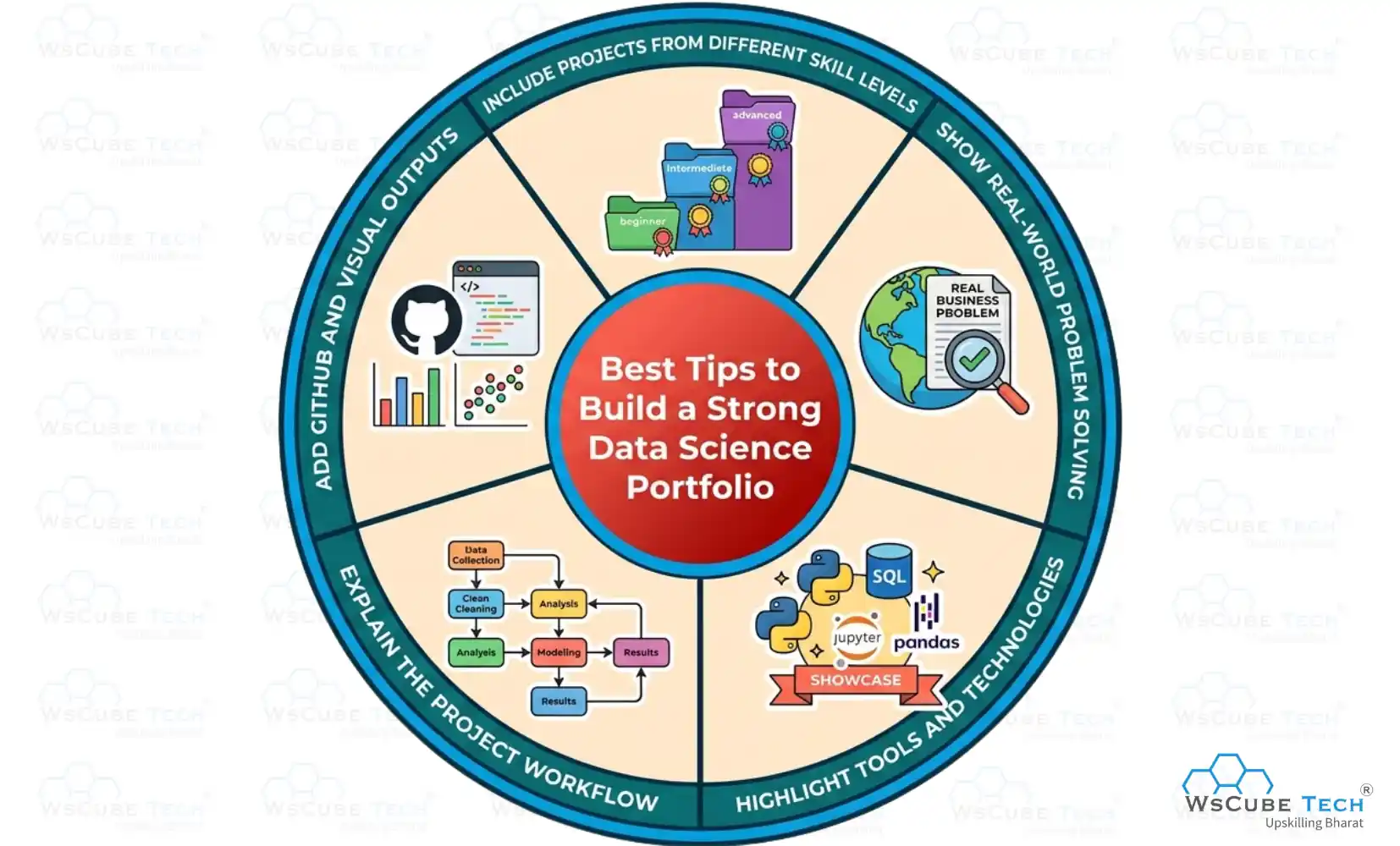
- Include Projects from Different Skill Levels: Add beginner, intermediate, and advanced projects to show your learning journey and technical growth. This helps recruiters understand your progress, versatility, and ability to work with different types of data science tasks.
- Show Real-World Problem Solving: Include projects that solve business, healthcare, finance, or customer-related problems. Real-world use cases strengthen your portfolio and demonstrate how your skills can deliver practical value in professional roles.
- Highlight Tools and Technologies Used: Clearly mention tools like Python, SQL, Tableau, Power BI, Pandas, and machine learning libraries. This helps employers quickly identify your technical expertise and the technologies you are comfortable working with.
- Explain the Project Workflow: Describe the steps followed in each project, such as data collection, cleaning, analysis, model building, and visualization. A clear workflow presentation makes your portfolio easy to understand and more professional.
- Add GitHub and Visual Outputs: Share GitHub links, dashboards, charts, and screenshots of project results. Visual proof of your work improves credibility and makes your portfolio more attractive to recruiters and hiring managers.
Also Read: Data Analyst vs. Data Scientist: Key Differences & Comparison
FAQs About Data Science Projects
Data science project ideas for beginners include data cleaning, sales analysis, customer segmentation, basic dashboards, and simple prediction models. These projects help build strong fundamentals in Python, SQL, data visualization, and problem-solving.
Choose projects based on your current knowledge of Python, SQL, statistics, and machine learning. Start with simple analysis projects first, then gradually move toward predictive models, dashboards, and advanced AI-based applications.
A strong portfolio should include at least 4 to 6 quality projects covering different skill levels. Include beginner, intermediate, and advanced projects to clearly demonstrate learning growth, technical skills, and practical experience.
By working on data science projects, you can learn data cleaning, visualization, statistics, machine learning, feature engineering, problem-solving, and model evaluation. These skills are essential for real-world data science and analytics roles.
Commonly used tools include Python, SQL, Pandas, NumPy, Matplotlib, Tableau, Power BI, Jupyter Notebook, and machine learning libraries like Scikit-learn and TensorFlow for analysis, visualization, and predictive modeling tasks.
You can find real-world datasets on Kaggle, UCI Machine Learning Repository, Google Dataset Search, and government open-data portals. These platforms provide datasets for healthcare, finance, business, and machine learning projects.
Present each project with the problem statement, tools used, workflow, results, and key insights. Add GitHub links, dashboards, charts, and measurable outcomes to make your resume or portfolio more professional and impressive.
A strong project solves real-world problems, uses meaningful data, and delivers clear insights. Creativity, relevance, and clear presentation help it stand out.
No, beginners can start with data cleaning, SQL queries, exploratory data analysis, and visualization projects first. Machine learning knowledge becomes important later when moving toward predictive and advanced analytical projects.
Beginners should first master data analysis and visualization, then move to machine learning, deep learning, and deployment projects. Following a step-by-step learning path helps build confidence and advanced technical skills.

Conclusion
Data science projects play an important role in building practical skills and understanding real-world applications. From beginner to advanced levels, each project helps you improve your knowledge, gain hands-on experience, and develop the problem-solving abilities required in the industry. By working on different projects for data science, you can strengthen your portfolio and showcase your skills effectively. Consistent practice, learning new tools, and exploring real datasets will help you grow and succeed in your data science journey.
Explore Our Free Tech Tutorials
| Python Tutorial | Java Tutorial | JavaScript Tutorial |
| C Tutorial | C++ Tutorial | HTML Tutorial |
| CSS Tutorial | SQL Tutorial | DSA Tutorial |
Practice Coding With Our Free Compilers
| Online Python Compiler | Online HTML Compiler | Online C Compiler |
| Online C++ Compiler | Online JS Compiler | Online Java Compiler |
Join Our On-Campus Data Science Program
Explore Our Free Courses






Leave a comment
Your email address will not be published. Required fields are marked *Comments (0)
No comments yet.