
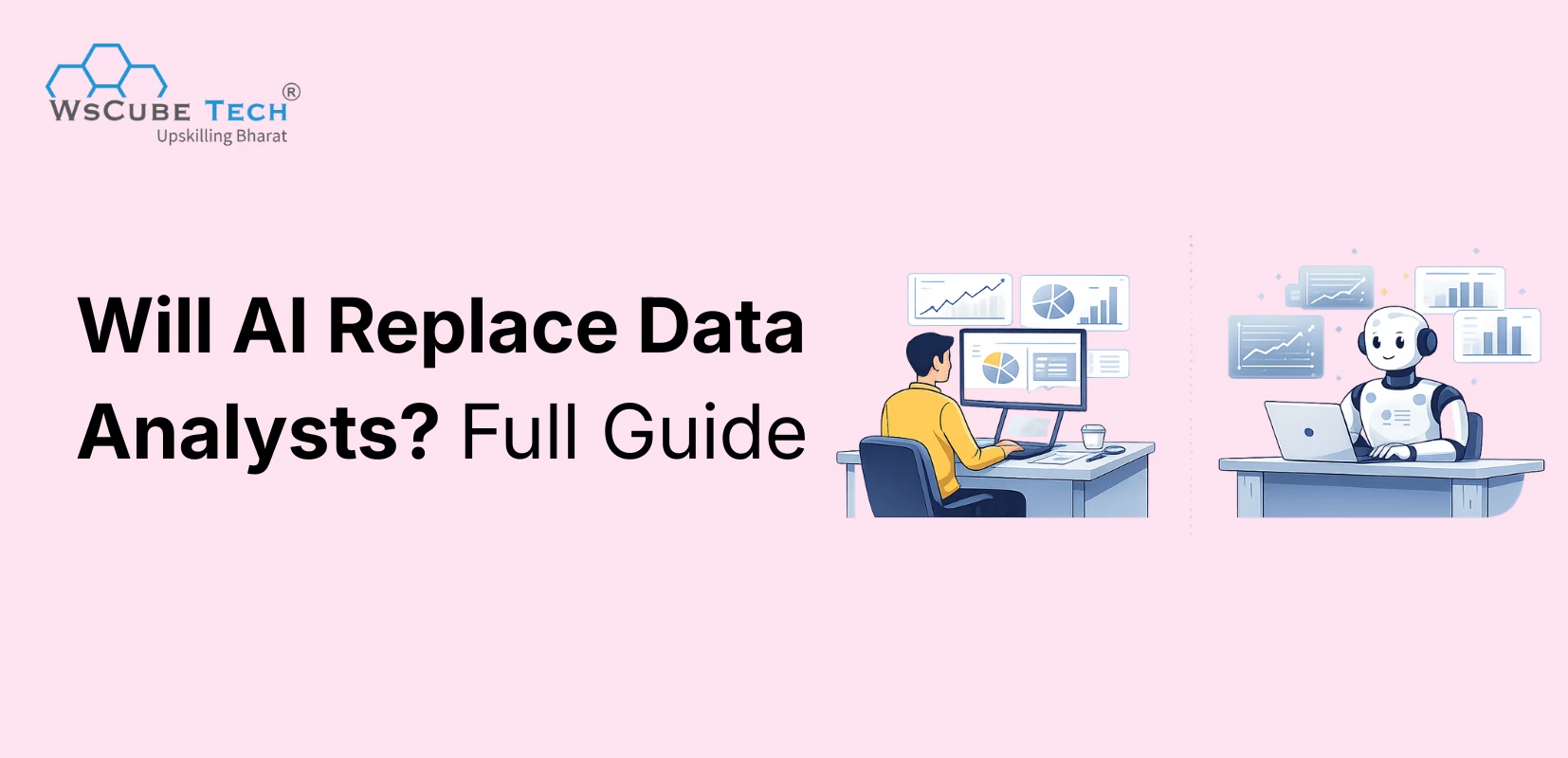
Artificial Intelligence (AI) is rapidly transforming the way businesses collect, process, and analyze data. From automating repetitive tasks to generating insights in seconds, AI-powered tools are becoming an essential part of modern data analytics workflows across industries.
As technology continues to evolve, many professionals and beginners entering this field are starting to wonder, can AI replace data analysts in the future? With machine learning algorithms handling data cleaning, reporting, and even predictive analysis, this concern is becoming more common.
However, while AI is changing how data analysis is performed, it does not mean the human role is disappearing. Instead, it is reshaping the responsibilities of data analysts, pushing them to focus more on decision-making, problem-solving, and business understanding rather than manual data processing tasks. In this guide, you will explore how AI is impacting data analytics and what it means for the future of data analysts.
What Does a Data Analyst Do?
What Does a Data Analyst Do: A data analyst collects, organizes, and analyzes raw data to identify useful patterns and insights that help businesses make better decisions, improve performance, and solve problems effectively using data. Below are the key responsibilities of a data analyst:
- Collect data from various sources such as databases, spreadsheets, websites, and internal business systems for analysis.
- Clean and organize raw data to ensure accuracy, remove errors, and prepare it for meaningful analysis.
- Analyze datasets to identify trends, patterns, and valuable insights that support business strategies.
- Create dashboards and reports using tools like Excel, Power BI, and Tableau to present insights clearly.
- Monitor key performance indicators (KPIs) to track business performance and identify opportunities for improvement.
- Support business teams by interpreting data insights and providing clear recommendations that guide strategic decisions and improve overall organizational performance.
- Present insights using charts, graphs, and visual reports for easy understanding by stakeholders.
What Tools Do Data Analysts Use?
Data analysts use various tools to collect, clean, analyze, and visualize data efficiently. Below are some common tools used in data analytics:
| Tool | Description |
| Excel | Spreadsheet software used for data entry, calculations, analysis, and visualization. |
| SQL | Language for querying, managing, and manipulating data in relational databases. |
| Python | Programming language used for data analysis, automation, and statistical modeling. |
| R | Statistical programming language for advanced analytics, modeling, and visualization. |
| Tableau | A tool for creating interactive dashboards and visual reports from datasets. |
| Power BI | Business intelligence software for reporting and visualizing data insights. |
| Google Analytics | Tool for tracking and analyzing website traffic and user behavior. |
| SAS | Software for advanced analytics, predictive modeling, and statistical analysis. |
Also Read in Detail: Top Data Analytics Tools for Data Analysts
Understanding AI in Data Analytics
Artificial Intelligence (AI) in data analytics refers to the use of smart technologies and automated systems to process large volumes of data quickly and accurately. It helps analysts identify patterns, trends, and insights without manually analyzing complex datasets.
AI-powered tools can perform tasks such as data cleaning, data integration, predictive analytics, and real-time analysis with minimal human effort. These tools use algorithms to detect hidden patterns, make predictions, and generate meaningful insights from structured and unstructured data.
By using AI in data analytics, organizations can improve decision-making, reduce manual workload, and gain faster insights from data. It allows data analysts to focus more on interpreting results and solving business problems rather than spending time on repetitive data processing tasks.
Recommended Professional Certificates
Data Analytics Course with Gen AI
Data Science Course with Internship & Placement Support
How AI Is Changing the Role of Data Analysts
AI is significantly transforming the responsibilities and expectations of data analysts in modern organizations worldwide. Below are the key points:
- Automation of Repetitive Tasks: AI-powered systems now handle repetitive tasks such as data cleaning, sorting, validation, and report generation, reducing manual workload and allowing analysts to focus on deeper analysis and strategic decision-making.
- Faster Data Processing: Advanced AI technologies can process massive volumes of structured and unstructured data within seconds, enabling analysts to generate faster insights and support quicker, data-driven business decisions.
- Enhanced Data Accuracy: AI technologies improve data accuracy by detecting inconsistencies, identifying missing values, and reducing human errors during processing, resulting in more reliable analysis and improved business outcomes.
- Shift Toward Strategic Roles: As AI automates routine data processing tasks, data analysts are increasingly expected to focus on interpreting insights, understanding business needs, solving complex problems, and supporting strategic decision-making across the organization.
- Improved Insight Generation: AI systems help analysts uncover hidden patterns, trends, and correlations in complex datasets, enhancing insight quality and enabling organizations to make more effective data-driven decisions.
Overall, AI is reshaping the role of data analysts by enhancing their efficiency and enabling them to contribute more toward strategic and decision-making processes.
Tasks AI Can Automate in Data Analysis
Artificial Intelligence can automate several repetitive and time-consuming tasks in data analysis, helping organizations improve efficiency and reduce manual effort. Below are the key tasks AI can automate:
- Data Collection: AI tools can automatically gather data from multiple sources such as websites, databases, and business applications without manual intervention.
- Data Cleaning: AI systems can detect errors, remove duplicate entries, and handle missing values to improve data quality before analysis.
- Data Integration: AI can combine data from various sources and formats into a single organized dataset, improving consistency and enabling smoother, faster analysis and more efficient reporting processes.
- Report Generation: AI-powered tools can automatically generate reports and summaries based on analyzed data, saving time for analysts.
- Dashboard Creation: AI can create visual dashboards by transforming complex data into charts and graphs for better understanding.
- Pattern Detection: AI systems can identify patterns, trends, and correlations in large datasets that may not be easily visible through manual analysis.
Overall, AI helps automate routine analytical tasks, allowing data analysts to focus more on interpreting insights and making data-driven decisions.
Tasks That Still Require Human Data Analysts
While AI can automate many technical processes, several important tasks still require human intelligence, analytical thinking, and business understanding. Data analysis is not just about processing numbers; it also involves interpretation, communication, and strategic decision-making. Below are the key tasks that still require human data analysts:
- Business Problem Understanding: Analysts must clearly understand business objectives, define the right questions, and ensure the analysis aligns with organizational goals.
- Interpreting Insights: AI can generate results, but human analysts are needed to interpret findings in the correct business context and explain their real meaning.
- Strategic Decision-Making: Analysts evaluate insights, consider risks, and recommend practical actions that support long-term business growth.
- Critical Thinking and Judgment: Humans assess data quality, question unusual results, and apply logical reasoning before drawing conclusions.
- Communication and Storytelling: Analysts present insights through clear explanations, visual storytelling, and structured reports to help stakeholders understand complex information.
Overall, human expertise remains essential because AI supports analysis, but it cannot replace human judgment, creativity, and business understanding.
Also Read: Data Analyst Roadmap
Limitations of AI in Data Analytics
Although Artificial Intelligence can automate many tasks in data analysis, it still has several limitations that require human involvement for accurate and meaningful insights. Below are the key limitations of AI in data analytics:
- Lack of Business Context: AI may struggle to understand real-world business problems and organizational goals without human guidance and domain knowledge.
- Dependence on Data Quality: AI systems rely heavily on high-quality data, and inaccurate or incomplete data can lead to incorrect analysis results.
- Limited Decision-Making Ability: AI can provide insights but cannot make strategic decisions based on experience, judgment, or business understanding.
- Difficulty Handling Unstructured Data: AI may face challenges when analyzing complex unstructured data such as text, images, or audio without proper training.
- Risk of Bias: AI models can produce biased results if trained on biased or incomplete datasets.
Overall, AI cannot completely replace human data analysts due to its limitations in understanding context, applying judgment, and making strategic decisions.
Upcoming Masterclass
Attend our live classes led by experienced and desiccated instructors of Wscube Tech.




Human Skills That AI Cannot Replace
While AI can automate technical tasks, certain human skills remain irreplaceable in data analytics. These skills involve critical thinking, creativity, emotional intelligence, and strategic understanding that machines cannot fully replicate. Below are the key human skills AI cannot replace:
- Critical Thinking: Humans carefully evaluate results, question unusual findings, analyze different possibilities, and apply logical reasoning before making important and reliable business decisions.
- Business Understanding: Data analysts interpret insights within the context of company goals, industry trends, and real-world challenges.
- Problem-Solving Ability: Analysts address complex business challenges by applying logical thinking, evaluating alternatives, and developing practical, data-driven solutions that improve decision-making and support organizational objectives.
- Communication Skills: Analysts translate technical findings into clear, simple language, ensuring stakeholders understand insights and can take informed, actionable, data-driven decisions.
- Ethical Judgment: Humans consider fairness, bias, and ethical implications when working with data and making recommendations.
Overall, AI can support data analysis, but human intelligence, creativity, and strategic thinking remain essential for meaningful and responsible decision-making.
Also Read: Data Analytics Course Syllabus
Future of Data Analysts in the Age of AI
The future of data analysts in the age of Artificial Intelligence is evolving as AI technologies continue to transform modern data analytics processes across various industries and organizations worldwide. Businesses are increasingly adopting AI-driven tools to improve efficiency and gain faster insights from large volumes of data.
Rather than replacing data analysts, AI is supporting their work by automating repetitive tasks such as data preparation, data cleaning, and basic report generation. This helps analysts reduce manual workload and improve productivity in their daily analytical workflows.
With AI handling routine data processing tasks, data analysts will focus more on interpreting insights, understanding business requirements, and supporting strategic, data-driven decision-making processes. In the future, analysts will play a more important role in solving business problems and guiding organizational growth.
Skills You Need to Stay Relevant as a Data Analyst
To stay relevant in the age of AI, data analysts need to continuously develop both technical and analytical skills to work effectively with modern AI-driven tools. Below are the key skills required to remain competitive as a data analyst:
- Data Analysis Skills: Ability to analyze large datasets, identify trends, patterns, and anomalies, and extract actionable insights to support business decisions effectively.
- SQL Knowledge: Understanding of SQL to manage, query, and manipulate data from databases.
- Programming Skills: Knowledge of Python and R for performing advanced data analysis, statistical operations, data manipulation, and automating repetitive analytical tasks.
- Data Visualization: Skills in tools like Power BI or Tableau to represent complex data through interactive charts, graphs, and dashboards for better understanding.
- Business Understanding: Analysts must interpret data in the context of organizational goals, industry trends, and market conditions to ensure insights are relevant and impactful.
- Problem-Solving Skills: Ability to recognize business issues and create effective data-driven solutions by applying logical reasoning and analytical thinking.
- Communication Skills: Ability to present technical findings in simple and understandable language for stakeholders and decision-makers.
- Knowledge of AI Tools: Familiarity with AI-powered analytics tools such as AutoML platforms and intelligent BI systems to automate routine data analysis tasks.
- Collaboration Skills: Ability to coordinate and work efficiently with different teams such as management, technical staff, and business stakeholders to support data-driven goals and organizational success.
Overall, developing these data analyst skills helps data analysts adapt to industry changes and remain valuable in AI-driven work environments.
Read More Data Related Guides
| What Does a Data Analyst Do? | Data Analyst Job Description |
| Is Data Analyst A Good Career? | In-Demand Data Analyst Skills |
| Top Data Analytics Tools | Top Data Analyst Career Paths |
Will AI Replace Data Analysts Completely?
AI is transforming the way data analysis is performed, but it is unlikely to completely replace data analysts in the future. While AI can automate repetitive tasks such as data cleaning, report generation, and basic analysis, it still lacks human understanding and business context.
Data analysts play an important role in interpreting insights, solving complex problems, and supporting strategic decision-making processes within organizations. These responsibilities require logical reasoning, communication, and business knowledge that AI cannot fully replicate.
Instead of replacing data analysts, AI is expected to work alongside them by improving efficiency and reducing manual workload. In the future, the role of data analysts will evolve toward more strategic and decision-support responsibilities within AI-driven environments.
How to Prepare for an AI-Driven Analytics Career
Preparing for an AI-driven analytics career requires a combination of technical knowledge, analytical thinking, and familiarity with modern data tools and technologies. As AI continues to transform the field of data analytics, it is important for aspiring analysts to upgrade their skills and adapt to new industry requirements.
Start by building a strong foundation in data analysis concepts, SQL, and programming languages such as Python or R. Learning data visualization tools like Power BI or Tableau can help you present insights clearly and effectively.
In addition, gaining knowledge of AI-powered analytics tools, machine learning basics, and real-world business problem-solving can improve your career opportunities. Continuous learning, practical projects, and hands-on experience are essential to succeed in an AI-driven analytics environment.
Career Opportunities in AI and Data Analytics
The fields of AI and data analytics are growing rapidly, offering diverse career opportunities for professionals who combine technical expertise, analytical skills, and business understanding. Below are some prominent roles:
- Data Analyst: Responsible for collecting, cleaning, analyzing, and visualizing data to provide actionable insights, support decision-making, and help organizations improve performance across business operations and strategies.
- Data Scientist: Uses advanced statistical models, machine learning, and AI algorithms to analyze complex datasets, predict trends, and solve high-level business challenges with data-driven solutions.
- AI Engineer: Designs, develops, and implements AI and machine learning models, creating intelligent systems that automate processes, optimize operations, and deliver predictive insights for organizations.
- Business Intelligence (BI) Analyst: Focuses on transforming raw data into meaningful business intelligence reports, dashboards, and visualizations to guide strategic planning and improve organizational decision-making.
- Machine Learning Engineer: Builds and deploys ML models, works with large datasets, and ensures AI systems perform efficiently to generate accurate and actionable predictions.
- Data Engineer: Develops and maintains data pipelines, architectures, and databases to ensure reliable data flow for analysis, modeling, and AI applications within an organization.
Overall, career opportunities in AI and data analytics continue to grow, offering professionals diverse roles in data-driven industries.
Explore Our Data Related Courses
| Online Data Analytics Course | Live Internship + 100% Job Support |
| Online Business Analytics Course | Live Internship + 100% Job Support |
| Online Data Science Course | Live Internship + 100% Job Support |
Frequently Asked Questions (FAQs)
In AI-driven companies, you collect, clean, and analyze data to generate insights that support business decisions. You also interpret AI-generated outputs, create reports, and help teams understand data trends to improve performance and strategy.
AI impacts your data analytics career by automating repetitive tasks like data cleaning and reporting. This allows you to focus more on interpreting insights, solving business problems, and supporting strategic decision-making using meaningful data analysis.
You need skills like Excel, SQL, Python, and data visualization. Analytical thinking, problem-solving, and knowledge of AI basics are also important. Strong communication helps you explain findings clearly to support business decisions.
AI can automate routine data analysis tasks, but it is unlikely to fully replace your data analyst job in the future because human skills like decision-making, problem-solving, and business understanding are still required.
You’ll commonly use tools like Excel, SQL, Python, R, Tableau, Power BI, and Google Analytics. These help you manage, visualize, and analyze data efficiently while supporting AI-driven insights and predictive modeling.
You can earn 3–6 LPA per year as an entry-level analyst. Mid-level roles pay around 6–12 LPA, and senior positions can exceed 12 LPA annually, depending on your experience, skills, and the industry you work in.
In data analytics, you focus on analyzing past data to find insights, while in data science, you work with advanced techniques like machine learning to predict future trends and build intelligent models.
You can start by learning Excel, SQL, Python, and basic statistics. Practice analyzing real datasets and building visualizations. Certifications and online courses help you gain credibility while you gradually move into analytics-focused roles.
Certifications are not always necessary, but they can help you learn structured skills, build credibility, and improve your chances of getting shortlisted for entry-level data analytics job opportunities.
You’ll find opportunities in finance, healthcare, IT, retail, e-commerce, and marketing. Any data-driven industry increasingly relies on analytics and AI, creating roles for professionals who can extract insights and improve business performance.
You can become job-ready in 6–12 months by learning key tools, practicing real projects, and gaining hands-on experience. Full mastery takes longer, but consistent practice helps you confidently handle data and AI-related tasks.
You can start as a data analyst, junior data scientist, business analyst, or reporting analyst. These roles help you learn data manipulation, visualization, and AI basics while preparing you for higher-level positions.
Conclusion
AI is transforming the field of data analytics by automating repetitive tasks and improving the speed and accuracy of data analysis. However, it is not replacing data analysts but changing the way they work in modern organizations and decision-making environments.
While AI can handle data processing and basic reporting, human analysts are still needed to interpret insights, understand business problems, and support strategic decisions. By upgrading your skills and working alongside AI tools, you can build a successful and future-ready career in data analytics.
Join Our On-Campus Data Analytics Programs






Leave a comment
Your email address will not be published. Required fields are marked *Comments (0)
No comments yet.