

Data science is growing rapidly in India as companies across healthcare, finance, e-commerce, banking, and technology use data to make smarter decisions every day. It helps businesses understand customer behavior, improve services, identify trends, and predict future outcomes more effectively.
If you are wondering “what is data science?”, you have come to the right place. In this guide, you will learn everything about data science in a simple, beginner-friendly way, including how it works and why it is important in today’s digital world.
Let’s learn below about the tools used in data science, the skills required, career opportunities, salary in India, real-world applications, and the step-by-step path to become a successful data science professional.
What is Data Science?
Data science is the process of collecting, cleaning, analyzing, and interpreting data to extract useful insights and solve real-world problems. It combines statistics, programming, mathematics, and machine learning to identify patterns, predict future trends, and support better decision-making.
Businesses across industries such as healthcare, finance, e-commerce, and technology use data science to improve services, understand customer behavior, and make smarter strategic decisions.
Why is Data Science Important?
Data science is essential because it helps organizations make better decisions, predict trends, improve efficiency, and solve complex real-world problems; below are the key reasons:
- Better Decision-Making: Data science helps businesses analyze past and present data to make accurate, informed decisions that improve strategies, reduce risks, and support long-term growth in a competitive market.
- Predict Future Trends: By analyzing patterns and historical data, data science helps organizations forecast future trends, customer demands, and market changes, allowing better planning, smarter decision-making, risk reduction, and improved business strategies for long-term growth and success.
- Improves Customer Experience: Companies use data science to understand customer behavior, preferences, and needs, enabling them to offer personalized services, better products, and improved customer satisfaction.
- Increases Business Efficiency: Data science helps automate processes, optimize operations, and identify areas for improvement, saving time, reducing costs, and increasing overall productivity.
- Supports Innovation: Data science helps organizations discover new opportunities, develop smarter solutions, and create innovative products or services using data-driven insights, improving customer experiences and supporting sustainable growth in a competitive market.
- Risk Detection and Prevention: Data science helps detect fraud, identify potential risks, and improve security systems by analyzing unusual patterns and suspicious activities in data.
History and Evolution of Data Science
Below is a table that clearly shows the history and evolution of Data Science:
| Time Period | Stage / Era | Key Developments | Explanation |
| 1960s – 1970s | Early Data Analysis | Statistics and Data Processing | During this time, data analysis mainly focused on statistics. Organizations used basic tools to process structured data for reporting and decision-making purposes. |
| 1980s | Rise of Databases | Relational Databases (SQL) | The introduction of relational databases allowed efficient storage and retrieval of data. SQL became a standard language for managing and querying structured data. |
| 1990s | Data Warehousing & Mining | Data Warehouses, Data Mining | Companies started collecting large amounts of data in warehouses. Data mining techniques were used to discover patterns, trends, and useful insights from stored data. |
| Early 2000s | Emergence of Data Science | Term "Data Science" Popularized | The concept of data science began to take shape as a combination of statistics, computer science, and domain knowledge for analyzing complex data problems. |
| 2010 – 2015 | Big Data Era | Hadoop, Spark, Big Data Tools | With the growth of the internet, massive amounts of data were generated. Technologies like Hadoop and Spark enabled efficient handling and processing of large-scale unstructured data. |
| 2015 – 2020 | Machine Learning Growth | AI & Machine Learning Expansion | Machine learning algorithms became widely used for predictions, automation, and intelligent decision-making across industries. |
| 2020 – Present | AI & Advanced Analytics | Deep Learning, AI, Automation | Data science now includes advanced technologies like deep learning and artificial intelligence. It is used for real-time analytics, automation, and intelligent decision-making. |
| Future | Intelligent Data Science | AutoML, Generative AI | The future of data science focuses on automation, AI-driven insights, and tools that require less manual effort, making data science more accessible and powerful. |
How the Data Science Process Works
Data science works by collecting, processing, and analyzing data to extract useful insights and support decision-making. It starts with gathering data from various sources such as databases, websites, or applications. This data is then cleaned and organized to remove errors and make it suitable for analysis.
After that, data scientists analyze the data using statistical methods and machine learning algorithms to find patterns, trends, and relationships. These insights are then visualized using charts or graphs to make them easy to understand.
Finally, the results are used to make informed decisions, solve real-world problems, and improve business strategies. In many cases, models are also deployed to automate predictions and continuously improve outcomes over time.
Also Read: Data Science Course Eligibility: After 12th, Graduation & More
Is Data Science Hard to Learn?
Many beginners and professionals often ask, Is Data Science Hard to Learn? The answer is that it may seem difficult at the start, especially if you are new to programming, statistics, or data-related concepts. However, with the right learning path and basic understanding, you can gradually overcome these challenges.
In reality, it depends on how you approach learning. If you follow a step-by-step method, practice regularly, and work on small projects, the concepts become much easier. Starting with basics like Python and data analysis helps you build a strong foundation.
Overall, it is not as hard as it seems. With consistency, patience, and proper guidance, you can learn data science successfully and build a rewarding career in this field.
Recommended Professional Certificates
Data Analytics Mentorship Program
Data Science & AI Mentorship Program
Key Components of Data Science
Data science is built on several essential components that help collect, process, analyze, and interpret data effectively; below is the key component:
Data Collection
Data collection is the first and most important component of data science. It involves gathering raw data from sources such as databases, websites, sensors, applications, and user interactions. Accurate and relevant data forms the foundation for meaningful analysis and reliable results.
Data Cleaning and Preprocessing
This component involves removing errors, duplicate values, and missing information from raw data. It also includes transforming and organizing the data into a structured format to ensure it is accurate, consistent, and ready for analysis and model building.
Data Analysis
Data analysis is a key component of data science that involves examining, processing, and interpreting data to identify useful patterns, trends, and relationships. It helps organizations understand information clearly and make informed decisions based on data-driven insights.
This step turns raw data into meaningful knowledge. It helps solve real-world problems and supports better planning and strategy.
Data Visualization
Data visualization is the process of presenting data in graphical formats such as charts, graphs, dashboards, and plots. It helps transform complex data into an easy-to-understand visual form, making it simpler to identify patterns, trends, comparisons, and insights for better decision-making.
Machine Learning and Modeling
Machine learning and modeling are important components of data science that involve using algorithms and statistical methods to train systems on data. This helps identify patterns, make accurate predictions, and solve real-world problems more efficiently.
Interpretation and Reporting
This component focuses on explaining the results in a simple and meaningful way. The insights are presented through reports, dashboards, or summaries so businesses and organizations can make informed decisions based on the findings.
Data Science Process / Life Cycle
The data science life cycle is a step-by-step process used to solve real-world problems using data; below are all the stages explained:
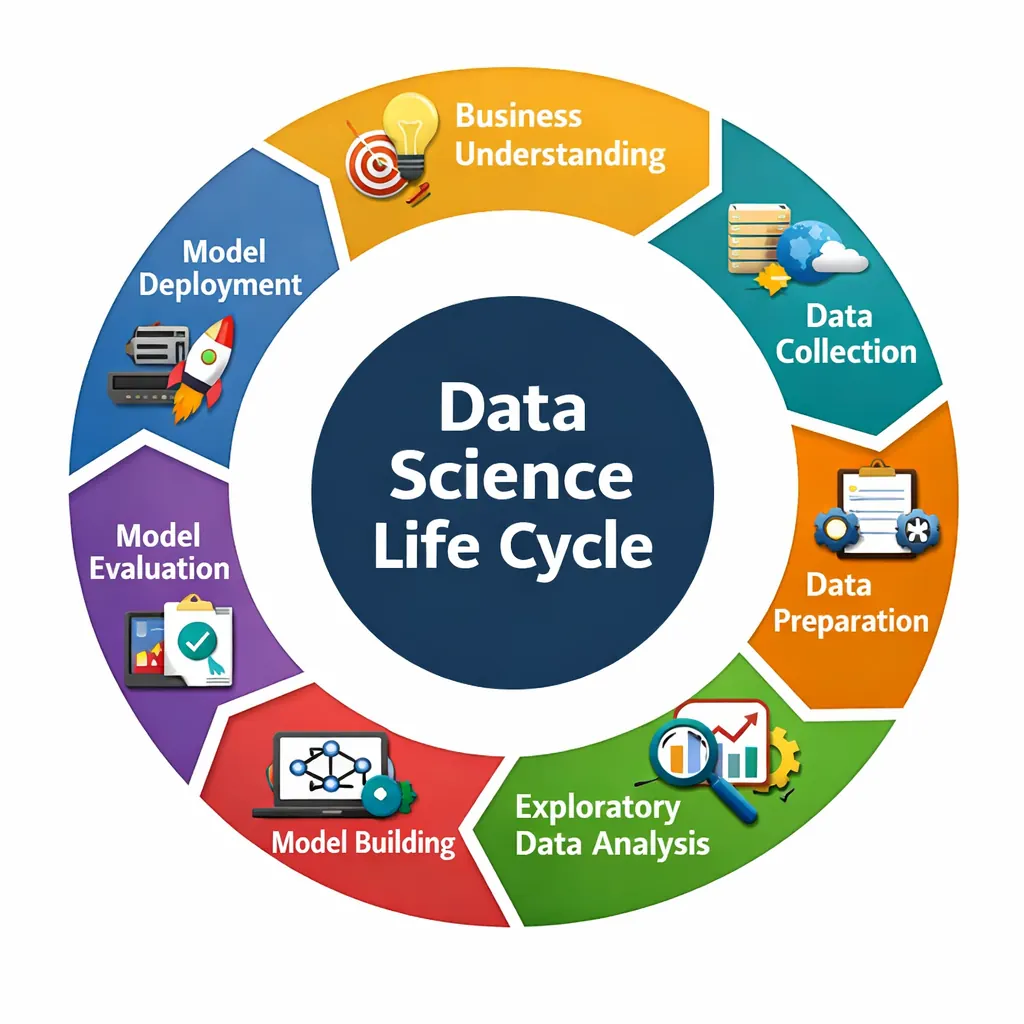
Business Understanding
Business understanding is the first stage of the data science life cycle. In this step, the main problem, business goals, and expected outcomes are clearly identified. It helps define the project scope, understand stakeholder requirements, and decide how data science techniques can be used to solve the problem effectively and achieve meaningful results.
Data Collection
Data collection is the process of collecting relevant raw data from various sources such as databases, websites, sensors, APIs, applications, and user interactions. This step ensures that sufficient, accurate, and useful data is available for analysis, helping data scientists build models, identify patterns, and generate meaningful insights to solve the defined business problem effectively.
Data Preparation
Data preparation is the process of cleaning, organizing, and transforming raw data into a structured and usable format. It includes handling missing values, removing duplicate records, correcting errors, standardizing formats, and converting data types so that the dataset becomes suitable for analysis and model building.
This step improves data quality and ensures accurate, reliable, and efficient results in the later stages of the data science life cycle.
Exploratory Data Analysis (EDA)
Exploratory Data Analysis involves analyzing and summarizing data using statistical methods and visualizations. It helps identify patterns, trends, relationships, and anomalies, making it easier to understand the data and prepare it for model building.
Model Building
Model building is the stage where data scientists use machine learning algorithms and statistical techniques to create predictive or analytical models. In this step, the prepared data is used to train the model so it can identify patterns, make predictions, and solve the defined problem accurately and efficiently.
Model Evaluation
Model evaluation is the process of testing and measuring the performance of the built model using different evaluation metrics. This step helps determine how accurately the model makes predictions and whether it meets the project goals. It also helps identify errors, improve performance, and ensure the model is reliable before deployment.
Model Deployment
Model deployment is the final stage of the data science life cycle where the trained and evaluated model is implemented into a real-world system or application. In this step, the model is made available for practical use so it can generate predictions, insights, or automated outputs for users and businesses.
Tools and Technologies Used in Data Science
Below is the table of tools and technologies used in data science:
| Category | Tools / Technologies | Description |
| Programming Languages | Python, R | Widely used for data analysis, machine learning, and statistical modeling. |
| Data Visualization | Tableau, Power BI, Matplotlib, Seaborn | Used to create charts, graphs, and dashboards for better data understanding. |
| Machine Learning | Scikit-learn, TensorFlow, Keras | Help in building predictive models and implementing machine learning algorithms. |
| Big Data Tools | Hadoop, Spark | Used to process and analyze large-scale data efficiently. |
| Databases | MySQL, PostgreSQL, MongoDB | Used for storing, managing, and retrieving structured and unstructured data. |
| Data Handling | Pandas, NumPy | Used for data manipulation, cleaning, and numerical computations. |
| Cloud Platforms | AWS, Google Cloud, Azure | Provide scalable infrastructure for data storage, processing, and deployment. |
Skills Required to Learn Data Science
Skills required to learn data science include a mix of technical knowledge, problem-solving ability, and practical understanding of data. Below are the skills that are essential:
Technical Skills
- Programming (Python/R): Used for data analysis, automation, and building machine learning models efficiently.
- Statistics & Mathematics: Helps in understanding data patterns, probability, and relationships, which improves analysis quality and increases the accuracy of predictive models.
- Machine Learning: Required to build predictive models and automate decision-making processes.
- Data Visualization: Tools like Tableau, Power BI, and libraries help present insights clearly.
- Database Management (SQL): Used to store, manage, and retrieve structured data efficiently.
- Data Handling Libraries: Knowledge of Pandas and NumPy for data cleaning and manipulation.
- Big Data Tools: Familiarity with Hadoop and Spark for processing large-scale data.
Analytical Skills
- Problem-Solving Ability: Helps you break down complex problems and find data-driven solutions effectively.
- Critical Thinking: Enables you to evaluate data, question assumptions, and make logical decisions.
- Data Interpretation: Ability to understand patterns, trends, and insights from raw data.
- Attention to Detail: Ensures accuracy while analyzing data and helps avoid errors in results.
- Decision-Making Skills: Helps in making informed decisions based on data insights and analysis.
Soft Skills
- Communication Skills: Ability to explain data insights clearly to both technical and non-technical audiences.
- Teamwork: Helps you collaborate effectively with teams such as developers, analysts, and business stakeholders.
- Time Management: Important for handling multiple tasks, meeting deadlines, and managing projects efficiently.
- Adaptability: Ability to learn new tools, technologies, and adapt to changing data environments.
- Business Understanding: Helps you understand real-world problems and align data solutions with business goals.
Read More Data Related Guides
Applications of Data Science
Applications of data science are widely used across industries to solve real-world problems, improve efficiency, and support data-driven decision-making. Below are the applications that are important:
- Healthcare: Data science is used to analyze patient records, predict disease risk, support medical diagnosis, improve treatment plans, and enhance hospital management to deliver better patient care and faster healthcare services.
- Finance & Banking: It is used for fraud detection, risk management, and credit scoring. Banks analyze transaction data to identify suspicious activities, improve security, and make better financial decisions.
- E-commerce: Data science helps understand customer behavior, recommend products, and improve user experience. It uses purchase history and browsing data to personalize recommendations, increase sales, and improve customer satisfaction and marketing strategies.
- Marketing: It is used to analyze customer data, create targeted campaigns, and improve engagement. Businesses use data science to understand audience preferences and optimize marketing strategies effectively.
- Education: Data science helps analyze student performance, personalize learning, and improve education systems. It supports better decision-making by identifying learning gaps and enhancing teaching methods.
- Transportation & Logistics: Data science is used to optimize routes, reduce fuel costs, and improve delivery efficiency. It analyzes traffic patterns, weather conditions, and demand data to ensure faster deliveries, better fleet management, and improved supply chain operations.
- Entertainment & Media: Data science recommends movies and shows based on user preferences and viewing history, improving engagement, personalizing experiences, and delivering relevant content to users.
Challenges of Data Science
Data science also faces several challenges related to data quality, complexity, and implementation. Below are the challenges of data science:
- Poor Data Quality: Data science depends on high-quality data, but incomplete, inconsistent, or inaccurate data can lead to wrong insights. Cleaning and preparing such data requires significant time and effort, affecting overall analysis results.
- Data Privacy and Security: Handling sensitive data creates risks related to privacy and security. Organizations must follow strict regulations and ensure proper data protection to prevent misuse, breaches, and legal issues.
- Complexity of Data: Large volumes of structured and unstructured data make analysis difficult. Managing, processing, and extracting meaningful insights from complex datasets requires advanced tools, techniques, and skilled professionals.
- Lack of Skilled Professionals: There is a shortage of skilled data science professionals who can handle complex data tasks and advanced tools. This makes it difficult for organizations to fully utilize data science capabilities and achieve accurate, effective, and timely results.
- High Cost of Implementation: Implementing data science solutions requires investment in tools, infrastructure, and skilled experts. Small businesses may find it expensive to adopt and maintain data-driven systems.
- Model Accuracy and Bias: Data science models may produce inaccurate or biased results if the data is not properly handled. This can lead to incorrect decisions and negatively affect business outcomes.
How to Overcome Them
- Ensure data quality by regularly cleaning, validating, and updating datasets before analysis.
- Implement strong data security practices and follow privacy regulations to protect sensitive information.
- Use advanced tools and technologies to efficiently manage and process complex data.
- Invest in training and upskilling to reduce the shortage of skilled professionals.
- Start with cost-effective tools and scale gradually based on business needs.
- Continuously test and improve models to reduce bias and improve accuracy.

Career Opportunities in Data Science
After learning about data science definitions and concepts, you can explore many career opportunities in this field. Below is a table of data science career options you can consider:
| Job Role | Description |
| Data Analyst | Collects, analyzes, and interprets data to generate reports and insights that help organizations make informed decisions, improve business performance, and support effective strategic planning. |
| Data Scientist | Works with large datasets, builds predictive models, and uses machine learning techniques to solve complex business and real-world problems. |
| Machine Learning Engineer | Designs, develops, and deploys machine learning models and intelligent systems for automation, prediction, and advanced data-driven applications. |
| Data Engineer | Builds and manages data pipelines, databases, and large-scale systems for efficient data storage and processing. |
| Business Intelligence Analyst | Creates dashboards, reports, and visualizations to help organizations understand performance and make better strategic decisions. |
| Statistician | Uses statistical methods and mathematical techniques to analyze data, identify trends, and support accurate predictions and research-based decisions. |
| Data Architect | Designs and manages the overall structure of databases and data systems to ensure secure, organized, and efficient data flow across the organization for smooth operations and better data management. |
Also Read: Data Analyst vs. Data Scientist: Key Differences & Comparison
Data Science Salary in India
Data science offers excellent career opportunities in India with attractive salary packages across different job roles. Salaries usually depend on skills, experience, location, and the company.
Below is the table that shows the average salary range in India for the major career opportunities in data science:
| Job Role | Average Salary in India (Per Year) |
| Data Analyst | ₹6.5 LPA – ₹7.2 LPA |
| Data Scientist | ₹15 LPA – ₹16.6 LPA |
| Machine Learning Engineer | ₹11.3 LPA – ₹13 LPA |
| Data Engineer | ₹11.4 LPA – ₹12.6 LPA |
| Business Intelligence Analyst | ₹9.2 LPA – ₹10.2 LPA |
| Statistician | ₹6.3 LPA – ₹7.1 LPA |
| Data Architect | ₹32.1 LPA – ₹35.5 LPA |
Note: These are approximate salary ranges and may vary based on experience, city, company, industry type, skill set, job role, and current market demand trends.
Upcoming Masterclass
Attend our live classes led by experienced and desiccated instructors of Wscube Tech.



How to Start Learning Data Science
To learn Data Science effectively, you need a clear roadmap that helps you build skills step by step and understand concepts properly. Below is the step-by-step roadmap:
Step 1: Learn the Basics of Mathematics and Statistics
Start by building a strong base in mathematics and statistics, as these are important for understanding data science concepts. Focus on topics such as probability, mean, median, standard deviation, and basic algebra. These concepts help you understand data patterns, relationships, and how machine learning models work effectively.
Step 2: Learn Programming Languages
The next step is to understand programming languages such as Python or R, which are commonly used in data science. Focus on basic concepts such as variables, loops, and functions, as well as libraries like NumPy, Pandas, and Matplotlib for handling and analyzing data effectively.
If you want a guided and structured approach, you can also join a professional data science course by WsCube Tech, specially designed for beginners. It covers Python, data analysis, machine learning, and real-world projects to help you build practical skills and become job-ready.
Step 3: Learn Data Analysis and Cleaning
Understand how to analyze and clean data using tools like Python, Excel, or SQL. Practice exploring datasets, handling missing values, and removing errors. This helps you find patterns, extract useful information, and improve data quality for better analysis and real-world problem solving.
Step 4: Learn Data Visualization
Understand how to present data using graphs, charts, and dashboards. Tools such as Tableau, Power BI, and Python libraries help convert complex data into simple visual formats that are easy to understand and interpret.
Step 5: Learn Machine Learning Basics
Once you are comfortable with data analysis, start learning machine learning concepts such as supervised and unsupervised learning. Understand basic algorithms like linear regression, decision trees, and classification models to build predictive systems.
Step 6: Work on Real-World Projects
Apply your knowledge by working on real-world projects. This helps you gain practical experience, strengthen problem-solving skills, and develop skills for future career opportunities, which improves your chances of securing a job.
Step 7: Keep Practicing and Stay Updated
Data science is a continuously evolving field, so keep practicing regularly and stay updated with new tools, technologies, and industry trends. Continuous learning helps improve your skills and career growth.
Also Read: Data Scientist Roadmap: A Guide for Beginners
Future Scope of Data Science
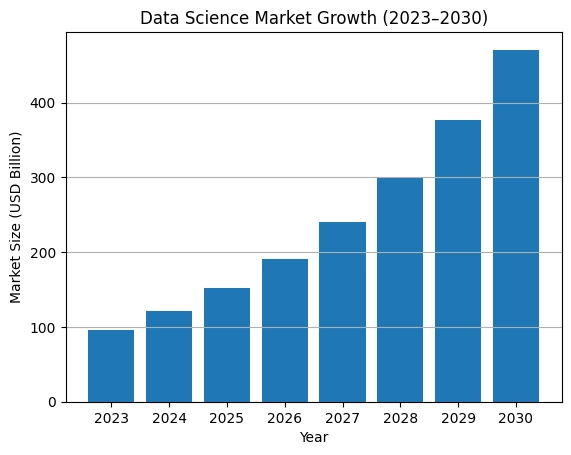
Data science has a highly promising future as the demand for data-driven decision-making continues to rise across industries worldwide. According to market research, the global data science platform market was valued at approximately $96.25 billion in 2023 and is projected to reach $470.92 billion by 2030, growing at a 26% CAGR, which reflects strong career and business opportunities.
In India, the field is expanding rapidly, driven by the increasing use of AI, machine learning, IoT, and big data technologies. The growing adoption of these technologies is creating significant demand for skilled professionals, making data science one of the most promising career fields in the coming years.
FAQs About What is Data Science
Data science is the process of collecting, organizing, and analyzing data to extract useful patterns, trends, and actionable knowledge. It combines programming, statistics, and domain expertise for solving real-world problems.
The main roles include collecting data, cleaning datasets, analyzing trends, building models, creating visual reports, and generating insights that help organizations solve problems and improve performance.
Yes, programming is essential for data science. Languages like Python or R are widely used for data analysis, statistical modeling, automation, and building machine learning models efficiently in real-world projects.
Python and R are the most popular programming languages for data science. Python is beginner-friendly and versatile, while R is excellent for statistical analysis, visualization, and research-focused projects.
Key skills include programming (Python/R), statistics, data visualization, machine learning, SQL, problem-solving, critical thinking, and domain knowledge. Strong communication and analytical abilities are also important for sharing insights effectively.
Learning data science from scratch typically takes 6–12 months, depending on your background, dedication, and learning resources. Consistent practice with projects and real-world datasets accelerates understanding and skill development.
Yes, non-technical individuals can learn data science. Starting with basic programming, statistics, and data visualization helps. Gradually, you can work on projects and gain skills required for professional opportunities in the field.
Data science uses tools like Python, R, SQL, Excel, Tableau, Power BI, Hadoop, Spark, and cloud platforms. These technologies help collect, clean, analyze, visualize, and interpret data efficiently for business decisions.
Data science is broader, involving collection, analysis, and predictive modeling. Data analytics focuses on historical data insights. AI builds intelligent systems to automate tasks, while data science often uses AI techniques for analysis.
A data scientist collects, analyzes, and interprets data, builds predictive models, and helps organizations make data-driven decisions to solve business problems.
Data science offers roles like data analyst, data engineer, machine learning engineer, AI specialist, and business analyst. Growing demand across IT, healthcare, finance, e-commerce, and marketing ensures excellent career opportunities globally.
In India, entry-level data professionals earn around ₹4–7 LPA, mid-level ₹8–15 LPA, and senior data scientists with experience can earn ₹20–30 LPA, depending on skills, company, and location.
Start with learning programming, statistics, and data visualization. Take online courses, practice on projects, build a portfolio, and explore internships. Gradually gain advanced skills in machine learning and big data tools.
Yes, data science continues to grow with high demand for skilled professionals. It offers diverse opportunities, competitive salaries, and scope in AI, machine learning, and big data industries, making it a promising career choice.
Conclusion
Data science has become an essential field for businesses and industries, helping analyze data, make informed decisions, and solve real-world problems effectively. Its combination of programming, statistics, and machine learning drives innovation and efficiency across sectors.
With growing demand and career opportunities, learning data science can lead to rewarding roles, high salaries, and a future-proof career. By mastering its tools, techniques, and applications, you can contribute to impactful data-driven solutions and stay ahead in the evolving tech landscape.
Start Learning With Our Free Tutorials





Leave a comment
Your email address will not be published. Required fields are marked *Comments (0)
No comments yet.