
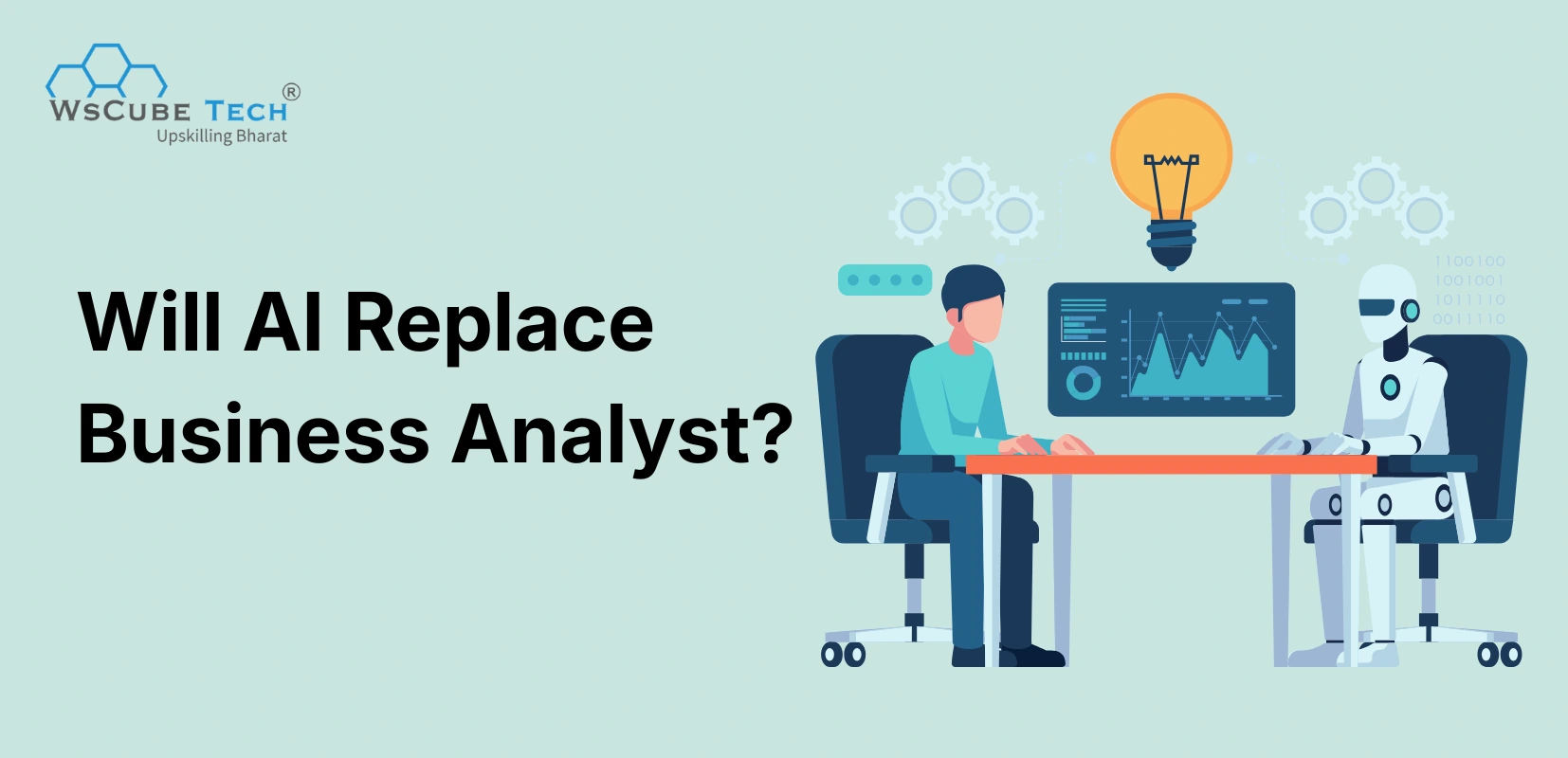
AI tools can now analyze data, create dashboards, prepare reports, and help document business requirements in minutes. This has raised an important question among students, freshers, and working professionals: Will AI replace business analysts in 2027?
The short answer is no, AI is unlikely to replace the entire business analyst role by 2027. However, it will automate many repetitive tasks and change the skills employers expect from analysts.
Business analysts who understand business problems, communicate with stakeholders, use data effectively, and work with AI tools will be better prepared for these changes.
In this guide, we will explore which business analyst tasks AI can automate, which skills still need human judgment, how AI may affect business analyst jobs in India, and what you can do to prepare for the future.
Key Takeaways:
- AI will automate many tasks, but it is unlikely to replace the whole business analyst's role.
- Entry-level work will change the most, so freshers need to upgrade their skills early.
- Communication, judgment, and business context remain strong human advantages.
- New AI-focused analyst roles are already appearing in companies.
- Learning AI tools alongside core analyst skills is the best way to stay ahead.
Will AI Replace Business Analysts in 2027 and the Future?
No, AI is unlikely to completely replace business analysts in 2027 and the future, but it will change how they work. If you are wondering will AI replace business analysts, the better way to see it is that AI will take over routine tasks like data cleaning, simple reports, and basic dashboards. Analysts will spend that saved time explaining results, questioning assumptions, and guiding business decisions.
Demand also looks steady. Jobs for management analysts, a related US role, are projected to grow 9% from 2024 to 2034, which is much faster than the average for all jobs. Analysts who use AI tools well and bring strong thinking will stay in demand.
Recommended Professional Certificates
Data Analytics Course with Gen AI
Data Science Course with Internship & Placement Support
Which Business Analyst Tasks Can AI Automate?
Here are six key business analyst tasks that AI can automate or assist with, helping analysts save time and focus more on business decisions, problem-solving, and stakeholder collaboration.
1. Data Collection and Analysis
AI tools can pull data from many sources, clean it, and spot patterns in seconds. This saves hours of manual work, but analysts still need to check the data for errors.
2. Report Generation
Tools can turn raw numbers into weekly or monthly reports automatically, including a written summary. Analysts now spend less time formatting and more time checking the story behind the numbers.
3. Data Visualization
AI features in Power BI and Tableau can suggest charts and build dashboards from a simple prompt. A person still has to pick the right chart for the real question.
4. Requirement Documentation
AI can write first drafts of user stories, meeting notes, and requirement documents from a call transcript. Still, it can miss unspoken needs, so a human must review and refine every draft.
5. Predictive Analysis
Machine learning models can forecast sales, churn, and demand faster than manual methods. Analysts are still needed to pick up the right question, explain the results, and judge whether the forecast is realistic.
6. Process Analysis
AI can scan workflow logs to find delays, repeated steps, and bottlenecks. It shows where a process is slow, but people must know why teams work that way before changing it.
Which Business Analyst Tasks Cannot Be Easily Replaced by AI?
AI can automate routine tasks, but human skills remain essential in business analysis. Here are four key areas where business analysts continue to add value:
1. Stakeholder Communication and Managing Expectations
Business analysts sit between business teams, tech teams, and leaders. They handle disagreements, explain trade-offs, and say no politely. AI can draft an email, but it cannot build trust in a room or sense tension between two senior managers.
2. Business Decision-Making
Data shows what happened, but a decision needs risk, cost, timing, and company goals in the picture. Leaders want a person to stand behind a recommendation. AI can offer options, yet an accountable human makes the final call.
3. Problem-Solving and Critical Thinking
Real business problems are messy and often poorly defined. A good analyst asks why a number moved, questions weak data, and finds the real problem behind the request. AI answers the question it is given, not always the right one.
4. Understanding Business Context
Every company has its own history, culture, rules, and customers. An analyst learns these over time and knows why a plan that looks perfect on paper may fail in practice. AI lacks this lived, inside knowledge.
Which Business Analyst Jobs Are Most at Risk From AI?
AI may reduce some business analyst jobs by automating repetitive tasks. However, whether AI can replace business analyst jobs depends on the tasks involved, experience level, and ability to use AI tools effectively.
1. Entry-Level and Junior BA Roles
Junior analysts handle the most routine work, so they feel the change first. Tasks like data pulls, simple reports, and meeting notes are the easiest for AI to take over.
What is most exposed:
- Basic data collection and cleaning
- Standard weekly or monthly reports
- First drafts of documents and meeting notes
- Simple dashboards built from clean data
What students can do:
- Learn SQL, Excel, and Power BI well, not just at a basic level
- Practice using AI tools to work faster and check their output
- Build projects that show real thinking, not just tool skills
- Improve how you explain data to non-technical people
2. Senior and Strategic BA Roles
Senior analysts spend more time on strategy, stakeholders, and big decisions. These tasks need experience and trust, so the risk is lower. Their work will still change, with more focus on guiding AI-driven analysis.
Why risk is lower:
- They manage senior stakeholders and tough conversations
- They link business strategy to data and technology plans
- They are responsible for decisions, not just analysis
- They often lead teams that use AI tools
What they should do:
- Learn how AI models work at a basic level
- Lead AI adoption in their teams
- Keep building deep knowledge of one industry
- Mentor juniors on how to work with AI
Here is a quick comparison to make this easier to remember.
| Factor | Entry-Level BA | Senior BA |
| Main tasks | Data work, reports, notes | Strategy, stakeholders, decisions |
| AI exposure | High | Moderate to low |
| Main protection | AI tool skills and strong basics | Experience, trust, domain knowledge |
| Best next step | Build projects and learn to question data | Lead AI use across teams |
What New Business Analyst Roles Are Emerging Because of AI?
AI is not just automating existing tasks; it is also creating new career opportunities. Rather than replacing entire business analyst teams, AI is reshaping their roles and responsibilities. Here are six emerging roles driven by the growing use of AI.
1. AI Business Analyst
This analyst works with data scientists and engineers to turn business needs into AI project requirements. They define success measures, check data quality, and make sure the AI tool solves a real business problem.
2. Prompt and AI Workflow Analyst
This role designs prompts and automated workflows that help teams use AI tools every day. They test outputs, fix errors, and document best practices so the whole company can use AI safely and consistently.
3. Data Storyteller or Insights Analyst
This analyst turns AI-generated findings into clear stories for leaders. The role blends analysis, design, and communication, and it becomes more valuable as dashboards and reports become easier to produce.
4. AI Governance and Responsible AI Analyst
This analyst checks that AI tools follow company rules, privacy laws, and fairness standards. They review bias risks, track how models make decisions, and report problems before they hurt customers or the brand.
5. Automation and Process Improvement Analyst
This role finds repeated tasks across teams and decides which ones should be automated. They map the process, pick the right tool, measure time saved, and make sure staff learn the new way of working.
6. Analytics Translator or AI Product Analyst
This person is the bridge between business leaders and technical teams on AI products. They study user needs, track how features perform, and guide what the product team should build or improve next.
Upcoming Masterclass
Attend our live classes led by experienced and desiccated instructors of Wscube Tech.




Will AI Replace Business Analysts in India?
No, AI is unlikely to replace business analysts completely in India by 2027, but it will change how they work and the skills employers expect.
AI can automate repetitive tasks such as preparing reports, analyzing data, writing SQL queries, and documenting business requirements.
However, business analysts are still needed to understand business problems, gather requirements, communicate with stakeholders, and recommend suitable solutions.
As Indian companies adopt more AI tools, business analysts who rely only on routine tasks may face greater competition. Professionals who develop skills in SQL, Power BI, business communication, critical thinking, and AI tools will be better prepared for the changing job market.
Rather than replacing the entire profession, AI is more likely to become a tool that helps business analysts work faster and make better-informed decisions.
How to AI-Proof Your Business Analyst Career by 2027
AI is changing business analyst roles, making it important to develop the right skills to stay competitive. If you wonder, will AI replace business analysts, focus on learning AI tools and improving your technical, communication, and problem-solving skills. Here are six steps to prepare for the future.
1. Learn the Core Tools Well
SQL, Excel, and a BI tool such as Power BI or Tableau are still the base of the job. Knowing them deeply helps you check what AI produces.
- SQL for pulling and joining data
- Excel for quick analysis and modeling
- Power BI or Tableau for dashboards
2. Add AI Tools to Your Daily Workflow
Use AI assistants to draft documents, summarize meetings, and write queries. The goal is to work faster while you stay in charge of the final result.
- Prompt writing for clear and useful answers
- AI features inside BI and spreadsheet tools
- Simple automation for repeated tasks
3. Build Strong Business and Domain Knowledge
Deep knowledge of an industry is hard for AI to match. The more you understand how a business earns money and serves customers, the more useful your advice becomes.
- Learn the key terms and metrics of one industry
- Study how companies in that field make decisions
- Follow industry news and case studies
4. Strengthen Communication and Storytelling
Great analysis is useless if nobody understands it. Practice explaining numbers in plain words so leaders can act on them with confidence.
- Short, clear presentations
- Simple charts that make one point
- Writing clear emails and documents
5. Sharpen Critical Thinking and Fact-Checking
AI can sound confident and still be wrong. Analysts who test results, question sources, and spot weak logic become the trusted voice in the room.
- Check AI output against source data
- Ask what could be missing or biased
- Test a result with a second method
6. Keep Learning and Stay Flexible
Skills age quickly now. The World Economic Forum expects that 39% of workers' core skills will change by 2030, so steady learning is part of the job.
- A small learning goal every month
- Short courses or certifications in AI and data - look for a business analytics course that teaches SQL, Excel, Power BI, and AI tools together on real projects.
- Joining analyst communities to share ideas
| Explore More Blogs Related to Business Analytics |
| What is Business Analytics? | What does Business Analyst Do? |
| How to Become Business Analyst? | Types of Business Analytics |
| Is Business Analytics Good Career? | Is Business Analytics Hard? |
Advice for Freshers Entering Business Analytics in the AI Era
If you are a fresher, you may wonder whether AI will replace business analyst jobs in the future. The good news is that the field is evolving, creating new opportunities for skilled professionals. Here are six practical tips to help you start your career in business analytics and prepare for the AI era.
1. Start With the Basics
Strong basics matter more than ever because they help you judge AI output. Do not skip the foundation just because tools feel easy to use.
- Excel and spreadsheets
- SQL and databases
- Basic statistics
2. Learn to Work With AI, Not Against It
Treat AI as a smart assistant that still needs supervision. Freshers who show they can use AI responsibly look more valuable to employers than those who ignore it.
- Writing clear prompts
- Reviewing and correcting AI answers
- Using AI features in Power BI or Tableau
3. Build Real Projects
Projects prove you can solve problems, not only follow tutorials. They also give you something real to discuss in interviews.
- Case studies with public datasets
- A dashboard on a business problem
- A simple portfolio page or GitHub profile
4. Practice Soft Skills Early
Communication is one of your best long-term protections. Start practicing now, even before you have a job.
- Presenting your findings out loud
- Asking smart follow-up questions
- Writing short, clear summaries
5. Choose a Domain You Enjoy
A domain gives your analysis meaning. You will understand data better when you know how the business behind it works.
- Banking and finance
- Healthcare
- Retail and e-commerce
6. Look for Internships and Entry Points
Your first role may not carry the title of business analyst, and that is fine. Any role that teaches data and business work is a good start.
- Internships and trainee programs
- Data support or reporting roles
- Networking with working analysts on LinkedIn
| Explore Our Data Related Courses |
| Online Data Analytics Course | Live Internship + 100% Job Support |
| Online Business Analytics Course | Live Internship + 100% Job Support |
| Online Data Science Course | Live Internship + 100% Job Support |
Is Business Analysis Still a Good Career?
Yes, for people who are ready to learn. Even if you worry that will business analyst be replaced by AI is the real question, job data, pay, and demand all point to a field that is changing but still strong.
Here are the main reasons the answer is still positive.
- Steady demand for analysts. The median annual wage for management analysts in the US was $101,190 in May 2024, a sign that companies pay well for this kind of work.
- Related roles grow across finance, healthcare, and tech.
- Skilled analysts have more choices of industry.
- More jobs are created than lost. The reports expect 170 million new jobs and 92 million displaced jobs by 2030, a net gain.
- Data and analysis roles are among the fast-growing ones.
- Reskilling helps you move into new roles.
- A flexible career path. Business analysis opens doors to product management, data analytics, consulting, and project leadership.
- You can change direction without starting over.
- Skills transfer well between industries.
- Pay grows with skill. Analysts who add domain knowledge and AI skills can move into higher-paying roles faster.
- Specialist roles often pay more than general ones.
- Leadership paths open after a few years of experience.
- The human side of the job stays valuable. Listening, explaining, and guiding decisions are skills companies will keep paying for.
- These skills improve with experience.
- They make you harder to replace.
In short, the field rewards people who keep learning. If you build both technical and human skills, the career is still worth pursuing.
If you want a deeper look, read this detailed guide on is business analytics a good career.

FAQs on CAN AI Replace Business Analyst
No, AI is unlikely to replace business analysts fully by 2027. It will automate routine tasks, but companies still need people for communication, judgment, and decisions that depend on business context.
AI can draft documents, summarize meetings, and suggest user stories. However, gathering requirements needs conversation, follow-up questions, and trust with stakeholders, so humans still lead this work and review the AI drafts.
Yes, junior roles face the most change because they involve routine reporting and data tasks. Freshers who learn AI tools, SQL, and communication skills can stay competitive and move up faster.
Roles such as AI business analyst, AI workflow analyst, responsible AI analyst, automation analyst, and analytics translator are growing as companies adopt AI and need people to connect business goals with technology.
Yes, if you build strong skills. Demand for data-driven decisions keeps growing, and analysts who combine business knowledge, SQL, BI tools, and AI skills will have good job and salary prospects.
Not fully. AI will handle more routine work over five years, but the role will shift toward advising, problem solving, and working with AI tools instead of disappearing from companies.
Small companies may use AI tools to do more with fewer people, but they still need someone who understands their goals. Analysts who wear many hats and use AI stay valuable.
AI will automate parts of IT business analyst work, such as documentation and test cases. Still, projects need people to manage requirements, align teams, and handle changes, so the role will evolve.
Communication, critical thinking, negotiation, domain knowledge, and ethical judgment are hard for AI to copy. Strong analysts build these skills alongside technical tools like SQL, Excel, and Power BI.
Yes. Basic skills with AI assistants, prompt writing, and AI features in Power BI or Tableau help you work faster. Employers increasingly prefer analysts who can use these tools and check their results.
| Explore Our Free Tech Tutorials |
| Python Tutorial | CSS Tutorial | Java Tutorial |
| JavaScript Tutorial | SQL Tutorial | C Tutorial |
| C++ Tutorial | DSA Tutorial | HTML Tutorial |
| Practice Coding With Our Free Compilers |
| Online Python Compiler | Online HTML Compiler | Online C Compiler |
| Online C++ Compiler | Online JS Compiler | Online Java Compiler |
| Join Our On-Campus Data Analytics Program |
| Join Our On-Campus Data Science Program |
| Explore Our Free Courses |




Leave a comment
Your email address will not be published. Required fields are marked *Comments (0)
No comments yet.