Java Full-Stack Development is all about building complete web applications from front to back using Java and modern development technologies. A Java full-stack developer works on everything users see on the screen as well as the server-side logic, databases, and application functionality running behind the scenes. From creating interactive user interfaces to managing APIs, business logic, and databases, full-stack developers play an important role in developing smooth, scalable, and fully functional applications.
For beginners, the learning process can feel overwhelming because full-stack development involves multiple technologies, tools, and concepts. This Java Full-Stack Developer Roadmap is designed to make that journey simple, clear, and structured. It helps you understand what skills to learn first, how different technologies connect, and how to move step by step from fundamentals to advanced development. By following this roadmap, you can stay focused, avoid confusion, build practical project experience, and confidently prepare yourself for real-world Java full-stack developer roles.
Who is a Java Full Stack Developer?
A Java Full Stack Developer is a professional who works on both the client-side and server-side of web applications using Java technologies. This role includes building user interfaces, handling server-side logic, and connecting applications with databases.
The developer understands the complete application flow, from design to deployment. Strong problem-solving skills and knowledge of modern tools help deliver secure, scalable, and efficient software solutions.
Key Responsibilities of a Java Full Stack Developer
- Design and develop responsive, user-friendly interfaces using HTML, CSS, JavaScript, and modern frontend frameworks to ensure a smooth user experience across devices.
- Build and maintain backend applications using Java, Spring, and Spring Boot frameworks.
- Create, test, and manage RESTful APIs to enable secure and seamless communication between frontend interfaces and backend services.
- Design, manage, and optimize databases by writing efficient queries, ensuring data integrity, security, and high performance for applications.
- Collaborate with teams, use version control systems, and deploy applications using modern DevOps practices.
Why Follow a Java Full Stack Developer Roadmap?
Following a structured learning path helps you understand what to learn and when to learn it. The java full stack learning path removes confusion, saves time, and helps you build skills in a logical and career-focused order.
- Clear Learning Path: A well-defined roadmap explains what to learn first and what to learn next, helping beginners avoid random topics. It allows learners to build strong fundamentals step by step before confidently moving toward advanced full-stack development concepts.
- Efficient Use of Time: Following a roadmap reduces wasted effort by guiding learners toward relevant technologies, tools, and practices commonly used in real-world Java full-stack development roles.
- Job-Oriented Skill Development: The roadmap aligns learning with real industry needs, making it easier to gain practical experience and meet the expectations of Java full-stack job roles.
- Better Career Preparation: Learning through a roadmap builds confidence, improves problem-solving ability, and prepares developers to handle interviews, projects, and real workplace challenges effectively.
Recommended Professional Certificates
Full Stack Development Course with AI Engineering
WordPress Bootcamp
Java Full Stack Developer Roadmap 2026: Step-by-Step Guide
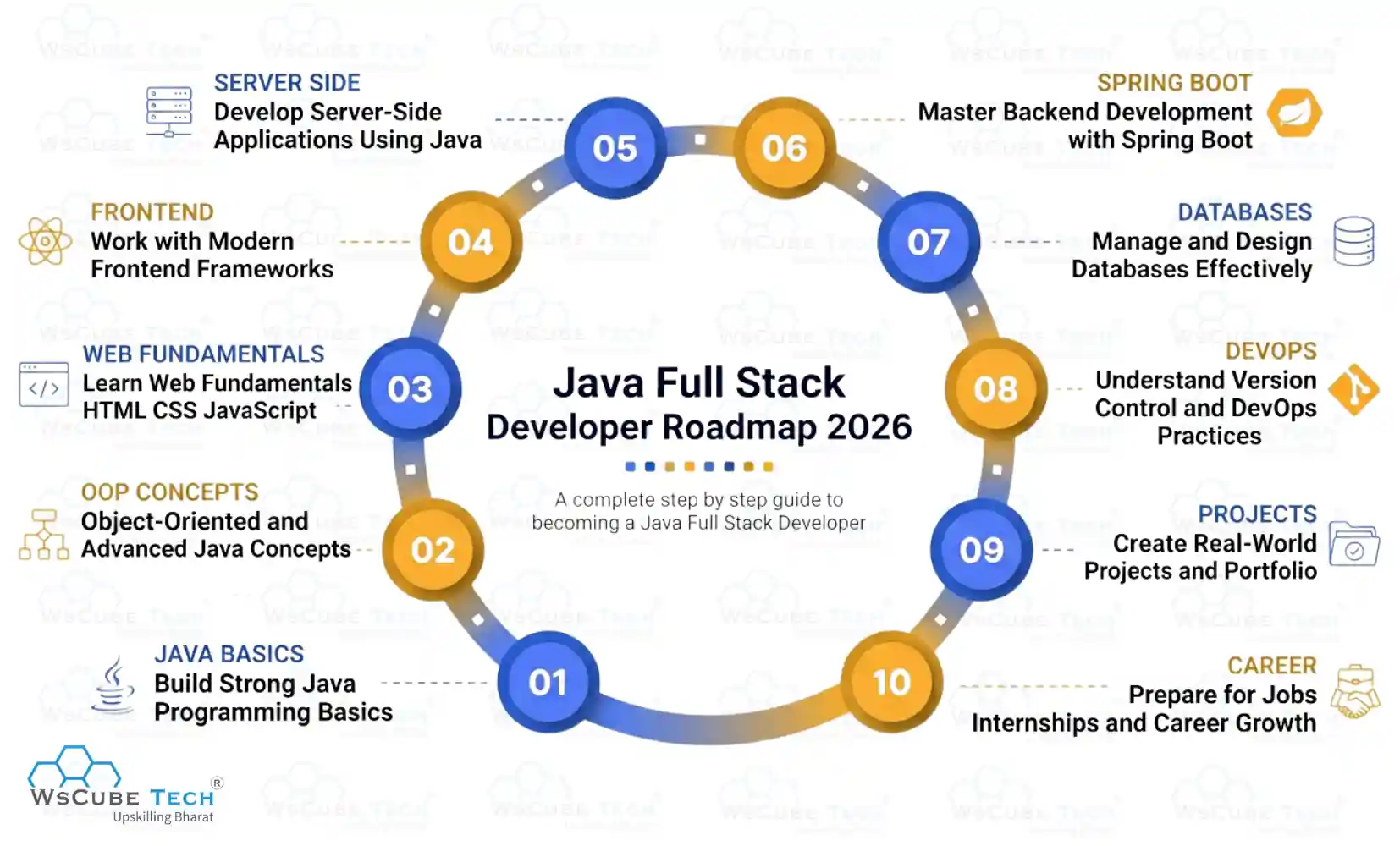
This guide provides the complete full stack java developer roadmap, helping you learn skills in the right order. It covers Java programming, frontend and backend development, databases, tools, and real-world projects to become job-ready.
Below are the steps that help you become a skilled Java Full Stack Developer:
- Build Strong Java Programming Basics
- Understand Object-Oriented and Advanced Java Concepts
- Learn Web Fundamentals (HTML, CSS, JavaScript)
- Work with Modern Frontend Frameworks
- Develop Server-Side Applications Using Java
- Master Backend Development with Spring Boot
- Manage and Design Databases Effectively
- Understand Version Control and DevOps Practices
- Create Real-World Projects and a Professional Portfolio
- Prepare for Jobs, Internships, and Career Growth
Now, we will go through each step one by one to clearly explain what you should learn, which concepts to focus on, and how each step helps you grow as a Java Full Stack Developer.
Step 1: Build Strong Java Programming Basics
This step focuses on learning the fundamentals of Java programming, which form the base of your full-stack journey. You should understand Java syntax, data types, variables, operators, conditional statements, loops, and basic input and output. Learning how the JVM works and how Java programs execute is also important at this stage.
Regular practice helps strengthen logic and problem-solving skills. Writing small programs builds confidence and prepares you for object-oriented programming, Java frameworks, and advanced full-stack development concepts.
You can read more about the Basics of Java Programming here to understand core concepts, syntax, examples, and practical use cases that strengthen your foundation and support your full-stack learning journey.
You can follow our complete Java tutorial to learn Java from scratch.
Step 2: Understand Object-Oriented and Advanced Java Concepts
Now, you move beyond basic syntax and learn how Java applications are structured using object-oriented principles. Java OOPS Concepts, such as classes, objects, inheritance, polymorphism, abstraction, and encapsulation, are essential for building scalable, clean, and maintainable applications.
You should also explore advanced Java topics, including exception handling, the collections framework, multithreading, and Java 8+ features like streams and lambda expressions. Mastering these areas helps you write efficient, high-quality code and prepares you for backend frameworks and real-world Java application development.
Steps 3: Learn Web Fundamentals (HTML, CSS, JavaScript)
As a Java Full Stack Developer, learning web fundamentals helps you build the user-facing part of applications. HTML, CSS, and JavaScript allow you to create page structure, design layouts, and add interactivity. These technologies are essential for developing responsive, user-friendly interfaces and for working smoothly with modern frontend frameworks.
3.1 HTML
HTML structures web pages by organizing content such as headings, text, images, links, forms, and media elements. It creates the basic layout that browsers understand and display. HTML is essential for every web application because it defines how content appears and interacts on the web. Our HTML Tutorial helps you learn HTML step by step, starting from core concepts and moving toward advanced features with clear, practical examples.
3.2 CSS
CSS controls the visual presentation of web pages. It helps with layout design, colors, fonts, spacing, and responsiveness. Learning CSS improves user experience and makes interfaces look professional. You can check our CSS Tutorial to understand styling from basics to advanced concepts.
3.3 JavaScript
JavaScript adds logic and interactivity to web pages. It handles user actions, dynamic content updates, and communication with backend services. Strong JavaScript skills are essential for building interactive and modern web applications. You can check our JavaScript Tutorial to learn core concepts, syntax, and real-world use cases.
Mastering HTML, CSS, and JavaScript builds a strong frontend base, improves UI development skills, and prepares you to work confidently with modern frontend frameworks and full-stack application development.
Step 4: Work with Modern Frontend Frameworks
As a Java full stack developer, working with modern frontend frameworks is essential for building dynamic, responsive, and scalable user interfaces. These frameworks help manage complex UI logic, improve code reusability, and enable smooth integration with Java-based backend services.
- React: A popular JavaScript library used to build reusable, component-based user interfaces with efficient state management, fast rendering, and strong support for creating dynamic and scalable web applications.
- Angular: A full-featured frontend framework that provides structured development, built-in tools, and strong support for large applications.
Working with modern frontend frameworks improves development efficiency, enhances user experience, and prepares you to build production-ready full-stack applications for real-world projects.
Step 5: Develop Server-Side Applications Using Java
Server-side development focuses on building the core logic that powers web applications. At this stage, you learn how to handle client requests, process business rules, manage sessions, and control data flow using Java. These skills are essential for creating secure, reliable, and scalable backend systems.
You also practice connecting server-side code with databases and frontend interfaces. Learning data validation, error handling, and response management improves application stability. Strong server-side Java knowledge prepares you to build APIs and move confidently toward backend frameworks and real-world full-stack projects.
Upcoming Masterclass
Attend our live classes led by experienced and desiccated instructors of Wscube Tech.






Step 6: Master Back-End Development with Spring Boot
Back-end development with Spring Boot focuses on building scalable, secure, and efficient server-side applications. At this stage, you learn how the framework simplifies request handling, manages business logic, and integrates databases and external services. Using Spring Boot improves productivity and follows industry-standard architectural patterns used in professional full-stack development.
- Spring Boot: It is a powerful framework for backend development in Java. It provides auto-configuration, embedded servers, REST API support, and easy integration with databases, security, and other services, enabling faster and cleaner backend development.
Mastering Spring Boot strengthens application structure, improves performance, and prepares you to build production-ready systems. These skills are essential for handling real-world backend responsibilities and developing enterprise-level full-stack applications with confidence.
Step 7: Manage and Design Databases Effectively
This step focuses on storing, organizing, and managing application data efficiently. You learn how to design database schemas, create tables, write queries, and maintain data consistency. Below are some important databases you should learn for Java full-stack development.
- Relational Databases (SQL): SQL databases like MySQL and PostgreSQL store data in structured tables with fixed schemas. They support relationships, constraints, and complex queries, making them ideal for applications that require strong data consistency and reliability.
- NoSQL Databases: Databases like MongoDB handle unstructured or semi-structured data. They offer flexibility, high scalability, and fast performance, making them suitable for modern applications with large data volumes and changing data models.
Learning both SQL and NoSQL databases helps you choose the right storage solution, improves backend performance, and prepares you to handle real-world data management challenges in full-stack applications.
Step 8: Understand Version Control and DevOps Practices
Version control and DevOps practices are essential for managing modern software projects. They help developers collaborate efficiently, track code changes, automate development tasks, and ensure smooth application delivery. Learning these tools improves productivity and prepares you for real-world development environments.
- Version Control (Git & GitHub): Git helps you track code changes, manage branches, and maintain project history. GitHub supports collaboration through code reviews, pull requests, issue tracking, and version management used in professional development teams.
- DevOps Basics: DevOps covers CI/CD pipelines, automation, and deployment processes that streamline software delivery. These practices improve release speed, maintain consistency, reduce manual effort, and ensure applications run smoothly and reliably across development, testing, and production environments.
Practicing these tools improves team collaboration, reduces errors, and prepares you for professional Java full-stack development workflows.
Step 9: Create Real-World Projects and a Professional Portfolio
Building real-world projects helps you apply Java full-stack skills in practical scenarios. You should work on projects like CRUD applications, REST APIs, authentication systems, and full-stack web apps using Java, Spring Boot, databases, and modern frontend frameworks. These projects strengthen problem-solving skills and improve understanding of real application workflows.
Creating a professional portfolio is equally important. A strong portfolio showcases your projects, code quality, documentation, and GitHub activity. It helps recruiters evaluate your skills quickly and increases your chances of landing internships, jobs, or freelance opportunities in Java full-stack development.
Step 10: Prepare for Jobs, Internships, and Career Growth
Preparing for jobs and internships is a key step in becoming a successful Java full-stack developer. This stage focuses on improving problem-solving skills, strengthening core concepts, practicing interview questions, and building confidence. It also covers resume writing, communication skills, and understanding real hiring and interview processes.
Following a clear roadmap for full-stack Java developer helps you revise skills in the right sequence and identify gaps in knowledge. A structured roadmap keeps learning organized, encourages regular practice, and aligns your preparation with current industry needs and job expectations.
To boost your career readiness, explore our online full-stack developer course. This course provides expert-led learning, hands-on projects, interview preparation, and career support, helping you move confidently from learning to professional full-stack development roles.
Explore More Roadmap Guides
Career Opportunities After Learning Java Full Stack Development
After completing the Java full-stack learning journey, many career paths become available in the software industry. Following a clear Java full stack developer roadmap helps you build the right skills in frontend, backend, databases, and frameworks. Below are some key opportunities you can grab after learning full-stack Java development.
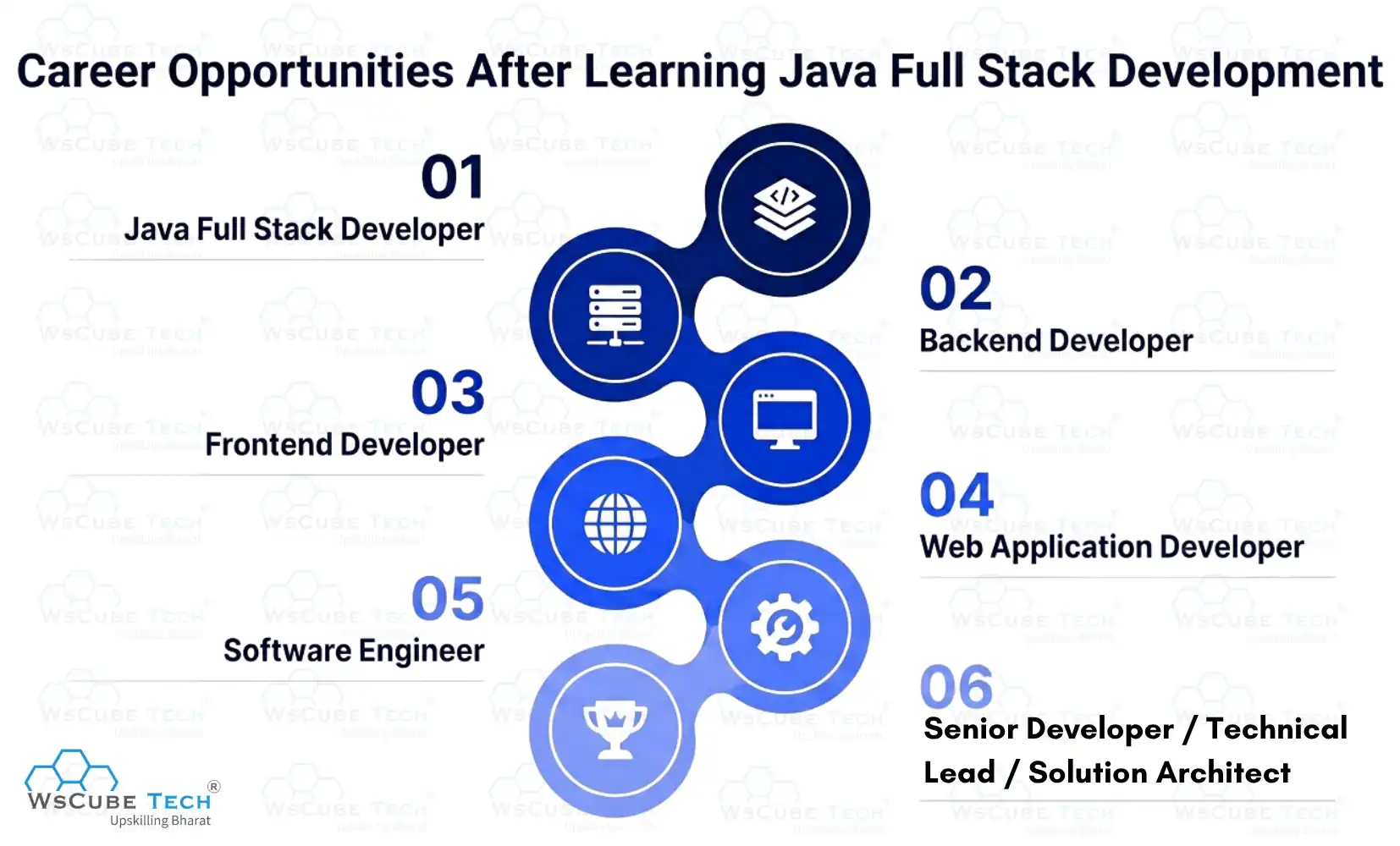
- Java Full Stack Developer: Works on both frontend and backend parts of applications using Java technologies. This role involves building user interfaces, writing server-side logic, managing databases, and ensuring smooth end-to-end application functionality.
- Backend Developer (Java): Focuses on server-side development using Java, Spring Boot, and databases. Responsibilities include building APIs, handling business logic, managing data flow, and ensuring application security, performance, and scalability.
- Frontend Developer: Specializes in creating responsive and interactive user interfaces using HTML, CSS, JavaScript, and frameworks like React or Angular. Java full-stack knowledge helps in better backend integration and API usage.
- Web Application Developer: Builds complete web-based applications by combining frontend design and backend development. This role requires understanding of application flow, database interaction, deployment basics, and maintaining real-world web solutions.
- Software Engineer: Works on designing, developing, testing, and maintaining software systems. Java full-stack skills allow contribution across multiple application layers and support growth into advanced technical roles.
- Senior Developer / Technical Lead / Solution Architect: With experience, you can move into leadership roles where you design system architecture, guide development teams, review code quality, and make key technical decisions for scalable and high-performance applications.
Overall, learning full-stack Java development opens doors to diverse roles across software development. With consistent practice and real-world projects, you can grow faster, switch roles smoothly, and build a stable, long-term career in the tech industry.
Future Scope of Java Full Stack Development
Java full-stack development continues to have strong demand as businesses build scalable, secure, and cloud-based applications. Java’s stability, long-term support, and wide use in enterprises make it a reliable choice for modern web and software development.
With the growth of microservices, cloud platforms, and API-driven systems, Java full-stack developers remain highly relevant. Skills in Spring Boot, modern frontend frameworks, and DevOps tools help developers adapt to changing technologies and long-term career growth.
Explore Our Web Development Related Courses
Java Full Stack Developer Salary in India
Java full-stack developers in India earn competitive salaries that grow with experience and skill level. Demand across startups, enterprises, and product-based companies ensures steady salary growth and strong career stability.
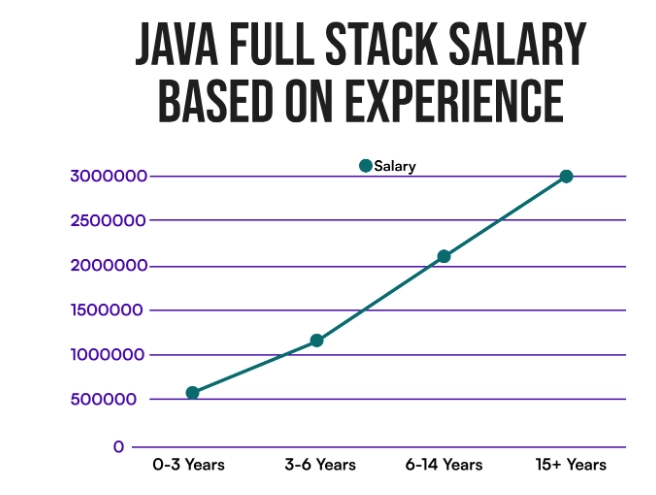
Average Salary by Experience Level (India)
| Experience Level | Average Salary |
| Entry-Level (0–3 years) | ₹3,00,000 – ₹6,00,000 |
| Mid-Level (3–6 years) | ₹6,00,000 – ₹11,60,000 |
| Senior-Level (6–14 years) | ₹10,00,000 – ₹21,00,000 |
| Lead / Architect (15+ years) | ₹30,00,000+ |
Data Source: Glassdoor
These salary figures may vary based on skills, company size, location, and project experience. Continuous learning, hands-on projects, and expertise in modern tools significantly improve earning potential and career growth for Java full-stack developers over time.

FAQs About Java Full Stack Roadmap
A Java Full Stack Developer builds complete web applications by working on both the frontend and backend parts. You design user interfaces, write Java-based server logic, manage databases, and ensure smooth communication between all application layers.
When you follow a roadmap to become a Java full-stack developer, you avoid confusion, save time, and learn skills in the right order. It helps you focus on what companies actually expect from full-stack Java roles.
Yes, a Java full-stack developer roadmap for freshers starts with programming basics and gradually moves to advanced topics. You can learn step by step without prior experience and build strong fundamentals before handling real projects.
The time depends on your learning speed and practice. On average, you may need 8–12 months to complete a full-stack Java developer roadmap if you practice consistently and build projects alongside learning.
A roadmap for a full-stack Java developer usually covers Java, OOP, HTML, CSS, JavaScript, frontend frameworks, Spring Boot, databases, Git, DevOps basics, and project development to prepare you for real-world roles.
Yes, you can learn Java full-stack development without a degree. What matters most is your skills, projects, and ability to solve real problems during interviews and technical assessments.
Basic DevOps skills are important in a Java full-stack developer roadmap 2026. You learn tools such as Git, CI/CD, and deployment basics, which help you understand how applications move smoothly from development to production.
You need a solid understanding of core data structures like arrays, lists, stacks, queues, trees, and hash maps. These concepts help you write efficient code, optimize performance, solve interview problems, and handle real-world application logic confidently.
You should practice by building small projects, writing code daily, using GitHub, and solving problems. This hands-on approach helps you understand concepts deeply and prepares you for interviews and real development work.
Conclusion
Java full stack development is a great career option for anyone who wants to work on both the front-end and back-end parts of web applications. It gives you the flexibility to build complete projects, understand how different technologies work together, and become a more versatile developer. As companies continue looking for developers who can handle complete application development, the demand for Java full stack developers is growing steadily in 2026.
This Java Full Stack Developer Roadmap 2026 helps you understand what to learn and how to move step by step without feeling confused. From Java fundamentals and databases to frontend frameworks, APIs, and deployment, every skill adds value to your overall development journey. The best way to improve is by building real projects and practicing consistently.
Do not worry about learning everything quickly. Focus on understanding concepts properly and improving little by little every day. With patience, regular practice, and hands-on experience, you can become a confident Java full stack developer and build a strong career in the tech industry.
Explore Our Free Tech Tutorials
| Python Tutorial | Java Tutorial | JavaScript Tutorial |
| C Tutorial | C++ Tutorial | HTML Tutorial |
| CSS Tutorial | SQL Tutorial | DSA Tutorial |
Practice Coding With Our Free Compilers
| Online Python Compiler | Online HTML Compiler | Online C Compiler |
| Online C++ Compiler | Online JS Compiler | Online Java Compiler |
Join Our On-Campus Full Stack Related Courses
Free Courses for You





Leave a comment
Your email address will not be published. Required fields are marked *Comments (0)
No comments yet.