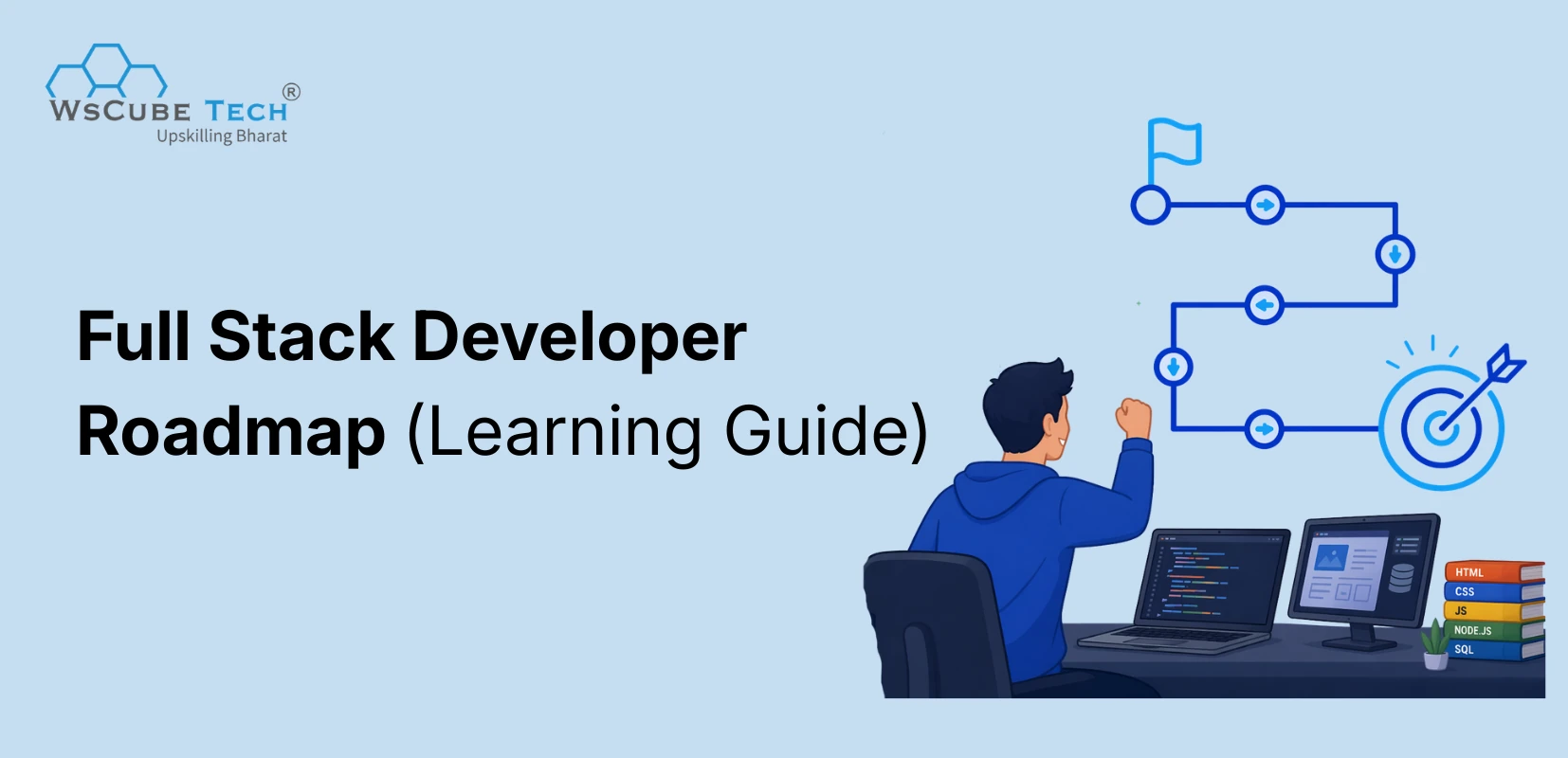
Think about a real-world web application like an online shopping platform. You search for products, view details, place an order, and receive confirmation instantly. This smooth experience happens because the user interface, server logic, and database work together in the background. If any one part fails, the entire application is affected, showing how important it is for all layers to stay connected.
Full-stack development focuses on building and managing all these layers as one complete system. It involves creating interactive frontend interfaces, writing backend logic to handle requests, storing and retrieving data from databases, and connecting everything through APIs. A full-stack developer understands how data flows from the user’s screen to the server and back, ensuring the application works smoothly from end to end.
This full-stack developer roadmap provides a clear learning path to master these skills step by step. It helps you learn technologies in the right order, avoid confusion, and focus on practical knowledge. By following a roadmap, you can build real projects, improve problem-solving skills, and prepare confidently for full-stack developer roles. To take your learning further, you can join the full stack development course by WsCube Tech
Who is a Full Stack Developer?
A full-stack developer is a skilled professional who works on both the frontend and backend of a web application. They create user interfaces, write server-side logic, manage databases, and make sure all parts of the application work together smoothly. This role requires a strong understanding of how different technologies connect to build complete and functional web applications, which is why following a full stack developer roadmap for beginners can be very helpful.
Full-stack developers take part in the entire development lifecycle, from planning and development to testing and final deployment. With knowledge of multiple tools and technologies, they can solve problems efficiently and adapt quickly to changing project requirements. A clear full stack web development roadmap helps them stay focused, learn the right skills, and grow faster in their careers.
Key Responsibilities of a Full Stack Developer
- Build responsive and user-friendly frontend interfaces that deliver a smooth experience across devices and browsers.
- Develop backend logic and server-side applications to handle requests and manage application workflows efficiently.
- Design, manage, and optimize databases to ensure secure data storage and fast retrieval.
- Create and integrate APIs to enable proper communication between frontend and backend systems.
- Implement authentication, authorization, and basic security practices to protect user data and prevent unauthorized access.
- Test, debug, and maintain applications to ensure performance, stability, and scalability.
- Deploy applications and manage basic server or cloud-related tasks in production environments.
Why Follow a Full Stack Developer Roadmap?
Following a structured learning path helps you understand what skills to learn and in what order. The roadmap of a full-stack developer keeps your learning focused, saves time, and helps you avoid confusion while building practical, job-ready skills. Below are some key benefits:
- Clear Learning Path: A well-defined roadmap explains what to learn first and what to learn next. It helps beginners avoid random topics and build strong frontend and backend fundamentals before moving to advanced concepts, especially when following a full stack web developer roadmap 2026.
- Efficient Use of Time: Prevents wasted time by focusing only on relevant technologies and tools required for full-stack development, as outlined in a proper full stack web developer roadmap.
- Strong Practical Foundation: Encourages hands-on learning through projects, helping you apply concepts in real-world scenarios and understand how different technologies work together.
- Better Career Preparation: Learning through a roadmap builds confidence, improves problem-solving skills, and prepares developers for interviews, projects, and real workplace challenges.
A well-defined roadmap keeps your learning structured, builds confidence, and helps you grow into a skilled full-stack developer with clarity and purpose. With the help of our full stack roadmap 2026, you can learn the right skills step by step, build real-world projects, and prepare confidently for full-stack developer job roles.
Demand for Full Stack Developers in Future
The demand for full-stack developers continues to grow as businesses seek professionals who can build complete, scalable, and secure applications. Industry data shows that full-stack–related roles are projected to grow by around 17% by 2033, driven by digital transformation, cloud adoption, and rising cybersecurity requirements. This is why following a full stack web developer roadmap becomes important to stay aligned with industry needs.
In India, rapid IT industry expansion, fueled by startups, SaaS companies, and large enterprises, has increased the need for multi-skilled developers. Companies prefer professionals who can manage frontend, backend, databases, and deployment, keeping full-stack developers in strong demand across industries. To stay competitive, many learners are now focusing on a full stack developer learning roadmap 2026 to build relevant and future-ready skills.
Recommended Professional Certificates
Full Stack Development Course with AI Engineering
WordPress Bootcamp
Full Stack Developer Roadmap 2026: Step-by-Step
This guide covers the complete full stack developer roadmap, helping you learn frontend, backend, databases, deployment, and projects step by step to build practical, job-ready full-stack development skills based on a full stack web development roadmap 2026.
Below are the steps that help you become a skilled Full Stack Developer:
- Choose a Full Stack Technology Stack
- Master HTML, CSS, and JavaScript
- Learn Version Control with Git and GitHub
- Work with Modern Frontend Frameworks
- Learn Backend Programming Languages
- Build Server-Side Applications and APIs
- Work with Databases (SQL and NoSQL)
- Learn Authentication, Authorization, and Security
- Understand DevOps Basics and Deployment
- Work with Cloud Platforms and Full Stack Infrastructure
- Build Real-World Full Stack Projects and Portfolio
- Prepare for Jobs, Interviews, and Career Growth
Now, we will go through each step one by one to clearly explain what you should learn, which key concepts to focus on, and how each step helps you grow as a full-stack developer.
Step 1: Choose a Full Stack Technology Stack
Choosing the right full-stack technology stack helps you learn in a clear and focused way. A technology stack includes frontend tools, backend technologies, databases, and supporting tools used to build complete web applications. Selecting one stack at the beginning prevents confusion and helps you build strong fundamentals before exploring other options.
1.1 MERN Stack
The MERN stack includes MongoDB, Express.js, React, and Node.js. It is commonly used to build modern, scalable, and high-performance web applications using JavaScript for both frontend and backend development.
1.2 MEAN Stack
The MEAN stack consists of MongoDB, Express.js, Angular, and Node.js. It is suitable for building dynamic, full-featured web applications with a structured frontend framework and JavaScript-based backend.
Choosing the right stack depends on your career goals and learning comfort. Start with one stack, practice consistently, and build real projects to gain confidence and practical full-stack development skills.
Step 2: Start with Frontend Development
Frontend development is the foundation of full-stack development because it focuses on the visual and interactive parts of a web application. It involves creating layouts, designing user interfaces, ensuring responsiveness, and managing user interactions. Learning frontend first helps you understand how websites work from the user’s perspective and builds a strong base for full-stack development.
2.1 HTML
HTML (HyperText Markup Language) is used to create the basic structure of web pages. It defines elements such as headings, paragraphs, images, links, forms, and tables that appear on a webpage.
HTML acts as the backbone of any website and is easy for beginners to learn. It helps browsers understand content structure and layout, making it the first and most important frontend technology to master.
2.2 CSS
CSS (Cascading Style Sheets) is responsible for the visual presentation of web pages. It defines styles such as colors, fonts, spacing, layouts, and alignment, helping create well-structured and visually appealing user interfaces.
CSS is also essential for responsive design. It enables websites to adjust smoothly across different screen sizes and devices, ensuring better usability and a consistent user experience.
2.3 JavaScript
JavaScript adds interactivity and dynamic functionality to web pages. It helps handle user actions, validate forms, update content without page reloads, and create interactive features that improve user engagement and overall website functionality.
Mastering HTML, CSS, and JavaScript builds a strong frontend foundation and helps you move confidently toward advanced full-stack development concepts.
Step 3: Learn Version Control (Git & GitHub)
Version control is an essential skill for full-stack developers because it helps you track code changes, manage different versions of a project, and work safely without losing progress. Git allows you to save your work in small commits, switch between versions, and easily fix mistakes. It also helps maintain a clean project history and improves your overall development workflow.
GitHub is a cloud-based platform used to host Git repositories and collaborate with other developers. It makes code sharing, version comparison, and teamwork simple through features like branches, pull requests, and code reviews. Learning Git and GitHub prepares you for real-world development environments and helps you build a professional project portfolio.
Upcoming Masterclass
Attend our live classes led by experienced and desiccated instructors of Wscube Tech.




Step 4: Work with Modern Frontend Frameworks
Modern frontend frameworks help you build fast, scalable, and user-friendly web applications. They simplify UI development by offering reusable components, better code structure, and improved performance. Learning a frontend framework allows you to develop complex interfaces efficiently and prepares you for real-world projects that follow modern development standards. Popular frontend frameworks are:
4.1 React
React is a component-based JavaScript library used to build interactive and dynamic user interfaces. It helps developers design modular UI components and handle user interactions efficiently, which makes it a popular choice for building single-page applications.
4.2 Angular
Angular is a full-featured frontend framework developed by Google that follows a structured architecture. It provides built-in tools and strong architectural support, making it suitable for developing large-scale and feature-rich web applications.
4.3 Vue.js
Vue.js is a lightweight and beginner-friendly framework known for its simplicity and flexibility. It enables you to build interactive user interfaces with minimal setup while maintaining good performance and clean, readable code.
Learning one frontend framework thoroughly is more effective than learning multiple frameworks at once. Focus on core concepts, hands-on projects, and clean coding practices to strengthen frontend skills and move confidently toward full-stack development.
Step 5: Learn Backend Programming Languages
Backend programming languages power the server-side logic of a web application. They handle requests, process data, manage databases, and ensure secure communication between the frontend and server. At this stage, focus on choosing one backend language and learning it deeply instead of switching between multiple options. Mastering a single language helps you understand core backend concepts, frameworks, and real-world development patterns more clearly.
Popular Backend Programming Languages
- JavaScript (Node.js): Used to build fast and scalable server-side applications using JavaScript. It is widely used for real-time applications and works smoothly with modern frontend frameworks.
- Python: Known for its clean syntax and ease of learning. It is commonly used for APIs, backend services, and data-driven applications.
- Java: A stable and powerful language often used in enterprise-level systems that require high performance, scalability, and long-term reliability.
- PHP: A widely used language for web development, especially for content-driven and traditional server-side applications.
Backend Frameworks to Learn
Backend frameworks simplify development by providing ready-made structures, tools, and best practices.
- Express.js (Node.js): A lightweight framework for building APIs and server-side applications quickly.
- Django / Flask (Python): Django offers a full-featured framework for large applications, while Flask is lightweight and flexible for APIs.
- Spring Boot (Java): Used to build enterprise-grade, production-ready backend applications with strong architecture support.
- Laravel (PHP): A popular framework that simplifies routing, authentication, and database management.
Choosing one backend language with its framework, practicing consistently, and building real projects will help you gain confidence and move smoothly toward advanced full-stack development and production-ready applications.
Step 6: Build Server-Side Applications and APIs
Building server-side applications is an important part of full-stack development because it controls the logic behind every web application. You learn how servers handle client requests, process data, apply business rules, and send correct responses to the frontend. Strong backend logic helps applications run smoothly, securely, and efficiently.
APIs play an important role in connecting the frontend with the backend. They help different parts of an application work together by allowing structured data exchange. While learning this step, focus on:
- Creating RESTful APIs to manage data flow between frontend and backend
- Handling requests, responses, and server-side validations properly
- Implementing clear error handling and correct HTTP status codes
- Connecting APIs with databases for storing and retrieving data
Mastering server-side applications and APIs helps you build scalable, maintainable, and production-ready full-stack applications.
Read More Roadmap Blogs
Step 7: Work with Databases (SQL and NoSQL)
Databases help store, organize, and access application data efficiently. In full-stack development, you need to understand how data is saved, updated, and accessed by backend applications. Learning databases helps you build applications that handle user data, records, and transactions in a structured, secure, and dependable way.
There are two main types of databases used in full-stack development: SQL and NoSQL.
- SQL databases: Databases like MySQL and PostgreSQL use structured tables with fixed schemas. They are ideal for relational data, complex queries, and applications that require strong data accuracy, consistency, and well-defined relationships.
- NoSQL databases: Databases like MongoDB store data in flexible formats such as documents. They are suitable for scalable applications that handle large volumes of dynamic or unstructured data.
Working with both SQL and NoSQL databases helps you choose the right database for different project needs and build efficient, data-driven full-stack applications.
Step 8: Learn Authentication, Authorization, and Security
Authentication, authorization, and security are important parts of full-stack development that help protect applications and user data. Authentication is used to verify a user’s identity, while authorization determines what actions a user is allowed to perform. Learning these concepts helps you control user access and prevent unauthorized activity.
Security practices ensure that applications remain safe from common risks and attacks. While learning this step, focus on:
- Implementing secure login and registration systems
- Managing user roles and permissions through authorization
- Protecting passwords using hashing and encryption techniques
- Securing sessions, tokens, and APIs from unauthorized access
Understanding authentication, authorization, and security helps you build safe, reliable, and production-ready full-stack applications that users can trust.
Step 9: Understand DevOps Basics and Deployment
DevOps focuses on improving how applications are built, tested, and released by combining development and operations practices. It helps automate repetitive tasks, reduce deployment errors, and ensure consistent performance across different environments. Learning DevOps basics allows full-stack developers to move applications smoothly from development to production and manage updates efficiently.
While learning DevOps and deployment, focus on the following areas:
- Setting up CI/CD pipelines to automate code testing and deployment processes
- Understanding containerization concepts and using Docker to package applications consistently
- Managing environment variables, configurations, and application versions
- Deploying applications on hosting platforms and monitoring performance
Strong DevOps and deployment skills help you release applications faster, maintain system stability, and handle real-world production challenges with confidence.
Explore our Popular Development Related Courses
Step 10: Work with Cloud Platforms and Full Stack Infrastructure
Cloud platforms help you host, deploy, and scale full-stack applications without managing physical servers. They provide services for computing, storage, databases, and networking, making application management simpler and more efficient. Learning cloud platforms helps you build applications that are reliable, scalable, and accessible to users worldwide.
Popular cloud platforms include:
- AWS (Amazon Web Services): A widely used cloud platform that offers services for application hosting, databases, storage, networking, and scaling. It is suitable for startups as well as large enterprise applications.
- Microsoft Azure: Provides cloud services for application hosting, databases, and DevOps tools. It integrates well with Microsoft technologies and supports enterprise-level full-stack solutions.
- Google Cloud Platform (GCP): Focuses on high performance, data services, and developer-friendly tools. It is commonly used for modern web applications and data-driven projects.
Understanding cloud platforms and full-stack infrastructure helps you manage deployments, handle traffic growth, and build secure, production-ready full-stack applications.
Step 11: Build Real-World Full Stack Projects and Portfolio
Building real-world full-stack projects helps you apply everything you have learned in a practical way. Projects improve problem-solving skills, strengthen frontend–backend integration, and expose you to real development challenges. Working on complete applications builds confidence and practical experience.
You can check Top 10 Full Stack Projects to practice real use cases, improve coding skills, understand project workflows, and build applications that reflect real industry requirements.
Creating a strong portfolio is equally important for career growth. A portfolio highlights skills, projects, and coding ability, shows hands-on experience, and helps you stand out to recruiters, clients, and hiring managers during interviews and professional opportunities.
Step 12: Prepare for Jobs, Interviews, and Career Growth
Preparing for jobs and interviews is the final stage of the full stack developer learning roadmap 2026. At this step, you focus on revising core frontend, backend, database, and security concepts while improving problem-solving and coding skills. This preparation helps you handle technical interviews with confidence.
You should also work on real-world projects, strengthen your portfolio, practice interview questions, and improve communication skills. Understanding how to explain your projects and decisions clearly is just as important as writing correct code for long-term career growth.
If you want to learn full-stack development, check out our full-stack developer online course, which helps you gain structured learning, hands-on projects, expert guidance, and job-oriented skills. It is designed to support beginners and professionals aiming for strong career growth.
Career Opportunities After Learning Full Stack Development
Learning full-stack development opens multiple career paths because you gain skills in both frontend and backend technologies. You can build complete web applications, manage databases, and handle server-side logic, which makes your profile valuable for modern development teams, especially when you follow a full stack web development roadmap for beginners 2026.
Full-stack skills also give you flexibility in choosing roles, industries, and work environments. You can work in startups, established tech companies, digital agencies, or remotely, with strong opportunities for long-term growth and specialization.
- Full Stack Developer: Works across frontend and backend, handling user interfaces, server logic, databases, and APIs. This role is highly valued in agile teams that need developers who can manage end-to-end application development.
- Frontend Developer: Focuses on building responsive user interfaces, layouts, and interactive elements using modern frontend technologies and frameworks.
- Backend Developer: Handles server-side development, database management, APIs, and application performance. This role plays a key part in ensuring data security, scalability, and smooth communication between systems.
- Software Engineer: Designs, develops, and maintains software systems using full-stack knowledge. This role often involves system architecture, problem-solving, and working on complex, large-scale applications.
- Freelance Web Developer: Works independently on client-based projects such as websites, dashboards, and web applications. This career path offers flexibility, remote work opportunities, and exposure to diverse industries.
With strong full-stack skills and the right full stack roadmap, you can grow into senior roles or even specialize in specific technologies. Many learners also choose structured programs like the WsCube Tech full stack developer course to gain practical experience and speed up their career growth.
Salary Expectations for a Full Stack Developer in India
- Entry-Level (0–2 years experience): ₹4 L – ₹5 L per year
- Mid-Level (2–5 years experience): ₹6 L – ₹14 L per year
- Senior-Level (5+ years experience): ₹15 L – ₹30 L+ per year
Salaries vary based on location, company size, tech stack, and practical experience. Major tech cities usually offer higher pay. Following the best full stack developer roadmap 2026 can help you build the right skills and increase your chances of earning better salary packages.
Full Stack Developer Roadmap (Video-Based Guide)
FAQs About Full Stack Roadmap
Full-stack development means you work on both the frontend and backend of a web application. You handle user interfaces, server logic, databases, and APIs, allowing you to build complete, functional applications from start to finish.
Yes, a full-stack developer roadmap for beginners starts with core web technologies such as HTML, CSS, and JavaScript. You then move step by step into backend programming, databases, tools, and deployment, making the learning path clear, structured, and suitable even with little or no coding experience, especially when following a full stack web development roadmap 2026.
The full stack developer learning path usually takes 6 to 8 months if you practice consistently. Your progress depends on learning speed, project work, and how deeply you understand frontend, backend, and deployment concepts.
You should begin with HTML, CSS, and JavaScript to build and style user interfaces. For backend development, choose one main language such as JavaScript (Node.js), Python, Java, or PHP. You should also learn SQL for working with databases.
No, you do not need a degree to follow a full stack web developer roadmap. You can build strong skills through online courses, hands-on projects, and self-learning. Practical experience, problem-solving ability, and a solid portfolio matter more than formal education.
Yes, projects are very important because they help you apply what you learn. Building real projects improves your confidence, strengthens concepts, and makes your portfolio stronger for interviews and job applications.
You stay updated by building new projects, learning modern frameworks, following tech blogs, and practicing regularly. Continuous learning helps you grow, adapt to new tools, and advance your career as a full stack developer.
Yes, the full-stack developer roadmap is suitable even for non-technical backgrounds. If you start from the basics, practice regularly, and follow a structured learning path, you can gradually build strong development skills without prior coding experience.
Learning DevOps basics is helpful for full-stack developers. It helps you deploy applications, manage servers, use CI/CD pipelines, and understand how real-world applications run smoothly in production environments.
You should focus on understanding core concepts, writing clean code, and building practical projects. Consistent practice, problem-solving, and learning how technologies work together are more important than rushing through multiple tools.
Explore Our Free Tech Tutorials
| Python Tutorial | Java Tutorial | JavaScript Tutorial |
| C Tutorial | C++ Tutorial | HTML Tutorial |
| CSS Tutorial | SQL Tutorial | DSA Tutorial |
Start Learning Programming with Our Free Programs
Free Courses for You



Leave a comment
Your email address will not be published. Required fields are marked *Comments (0)
No comments yet.