
Ever wondered what happens the moment you hit "buy now" or send a message online? None of it works without a solid foundation of backend technologies running quietly in the background. While users only see buttons, colors, and smooth animations, an entire engine of logic, servers, and databases is doing the real work behind every click.
This is what separates an average app from a truly powerful digital platform, one that feels fast, stays secure, and scales without breaking. Developers rely on a mix of languages, frameworks, and tools to build this engine, and picking the right combination can make or break a product's success.
If you're still exploring your options, understanding the best backend languages available today is the perfect starting point. This guide breaks down twelve technologies worth knowing in 2026, so you can build smarter from day one.
What are Backend Technologies?
Backend development technologies are frameworks, tools, databases, and languages that build server-side web applications. They work behind the scenes to manage the server, databases, and the application logic that aids communication between the end user’s browser and the server, i.e., the frontend. If you want to learn about frontend and backend development, enroll in an online Full-stack development course led by industry experts.
Recommended Professional Certificates
Full Stack Development Course with AI Engineering
WordPress Bootcamp
Top12 Backend Technologies (2026 List)
A plethora of modern backend technologies are extensively used in the domain. We have compiled a list of backend technologies in 2026 so you can understand the various technologies. To learn more about becoming a back-end developer, check out our blog on Backend Developer Roadmap: Step-by-Step Guide
Let's look at this back-end technologies list for web development, including their pros and cons.
1. PHP
Hypertext Preprocessor, or PHP, is a server-side scripting language. The programs it creates are executed on web servers and are independent of an online browser. PHP is one of the well-known languages developers use to build new apps and is extensively used to develop online applications.
Pros:
- Open-source and free
- Platform-independent
- Quick loading rate
Cons:
- May not be suitable for all more prominent web-based apps
- Lacks debugging tools
- Regarded less secure relative to others
2. Python
Python is an object-oriented, interpreted, high-level, dynamically semantic programming language. It is especially desirable for Rapid Application Development and usage as a scripting language to tie components collectively due to its high-level built-in data structures, robust typing, and dynamic binding. Python's concise syntax prioritizes readability and simplifies learning, lowering program maintenance costs.
Pros
- Open-source and free
- Easy to learn
- A vast collection of libraries
Cons
- Speed limitations
- May have runtime errors
- Consumes a substantial amount of space
3. JavaScript
A robust computer programming language, the implementation of JavaScript enables client-side scripts to interact with end users and create dynamic pages. It is most extensively used as an element of web pages and is an object-oriented, lightweight, interpreted programming language. Many times, it's considered synonymous with Java backend technologies. LiveScript was the original name of JavaScript, but Netscape renamed it to JavaScript in response to the buzz that Java was causing.
Pros
- Language is not complex
- Effortless to implement
- High interoperability
Cons
- Substandard browser support
- Debugging facility is absent
- Functioning is sluggish
4. Laravel

This is a PHP web application framework with expressive and beautiful syntax. Laravel offers the strong capabilities required for large, sophisticated applications and is easily accessible. You have the resources to create whatever application you are entrusted with, such as an excellent inversion of the control container, an eloquent migration mechanism, and closely integrated unit testing assistance.
Pros
- Convenient to learn
- Provides model view controller structure
- Offers swift execution
Cons
- Lesser in-built support
- Community support is low
- The overall process is complex
5. Django
An open-source and Python-based framework, Django follows the model-template-views (MTV) architecture. Django's main objective is to simplify the creation of intricate, database-driven websites. The framework emphasizes component reuse, pluggability, low code, minimal coupling, and quick development.
Pros
- Faster than most frameworks
- High scalability
- Robust security
Cons
- Steep learning curve
- Not compatible with small projects
- Possesses a monolithic framework
6. MongoDB
This most popular backend technology is an open-source and cross-platform document-oriented database application. MongoDB, a NoSQL database application, employs documents that resemble JSON(JavaScript Object Notation is a lightweight format for storing and transporting data) with alternative schemas. It was created by MongoDB Inc. and is distributed under the Server Side Public License, which some distributions consider non-free.
Pros
- Offers high speed
- Provides flexible database
- Has good technical support
Cons
- Faces memory limitation issues
- Joins are not supported
- May lead to the corruption of data
Upcoming Masterclass
Attend our live classes led by experienced and desiccated instructors of Wscube Tech.







7. MySQL
This back end technology is one of the most widely used open-source databases worldwide. Thanks to its demonstrated performance, dependability, and usability, MySQL has established itself as the top database of preference for web-based applications. Popular websites like Facebook, Twitter, YouTube, Yahoo!, and others use MySQL as their primary database. Oracle's new features power next-generation web, cloud, mobile, and embedded applications, enabling MySQL innovation.
Pros
- High data security
- Offers cross-platform compatibility
- Highly versatile
Cons
- Debugging is inefficient
- Prone to data corruption
- It doesn't support large databases efficiently
8. Apache
Apache is an open-source and free framework that supports a large portion of websites across the globe. The name of the server is Apache HTTP Server. The Apache Software Foundation is in charge of its creation and upgrades. Apache enables website operators to serve material across the internet. It is referred to as a web server for this reason.
Pros
- Open-source and free
- Highly reliable
- Has customizable code
Cons
- Incompetent debugging quality
- Time-consuming process
- Security is considered substandard
9. NGINX
NGINX, sometimes recognized as NGIИX, is a reverse proxy, load balancer, mail proxy, and web server capable of handling HTTP cache. This backend development technology provides high performance for web servers with massive scaling. It can operate at high speeds while carrying more weight. The reverse proxy feature allows a single site to present aggregated information sources as if they all come from one page. Through its load balancer, loads can be distributed among various resources, such as servers. NGINX is available for free and open source under the rules of a two-clause BSD license.
Pros
- Highly scalable
- It's lightweight
- Great configurability
Cons
- Low community support
- Lesser modules
- Less compatibility
10. Docker
Docker, a software platform, simplifies the process of building, running, managing, and distributing applications. Using OS-level virtualization, Docker's platform as a service offering distributes software in containers. There are free and premium versions. The Docker Engine program runs the containers.
Pros
- Swift deployment
- Highly secure
- Continuous integration
Cons
- Lesser features
- Low scalability
- Compatibility issues may arise
11. Postman

Developers can easily create, share, test, and document APIs(a software intermediary that allows 2 applications to talk to each other) with Postman, an API platform. Users are given the ability to generate, store, and read both simple and complicated HTTP/s requests and their responses to achieve this. As a result, the work is more effective and less tiresome.
Pros
- Highly user-friendly
- Provides timely support
- The overall process is easy
Cons
- Constrained integration
- Low script reusability
- Limited testing ecosystem
12. Jira
Atlassian, an Australian company, created the JIRA software for project management, problem tracking, and bug tracking. The Japanese word Gojira, which means Godzilla, is where the JIRA full form is named. This tool primarily uses tracking problems and issues with your software and applications.
Pros
- High speed
- Easy bug fixing
- Offers effortless integration
Cons
- Difficult to handle
- Complex than its contemporaries
- Faces support issues
Read More Web Development Related Guides
Quick Facts About the Best Back-end Technologies in 2026
- JavaScript, Python, and Java stand out as the top 3 most popular backend technologies, with a significant number of coders, 65.82%, 49.28%, and 30.49%, respectively, choosing to use them. This widespread adoption reflects the industry's recognition of their capabilities and versatility. Following closely are C# (29.19%), C++ (20.21%), and PHP (19.03%).
- PHP is a dominant force in server-side programming, with a staggering 76.2% of all websites utilizing it. Within the PHP ecosystem, Laravel (8.32%) and Symfony (3.67%) are the most prevalent among professional developers.
- Node.js is the most popular web backend technology, with 42.7% of developers using it. Express is also in demand in the JavaScript tech stack, with a 19.51% share.
- According to the May 2026 benchmark, C# is the fastest backend technology based on average response time (ms) and requests/s. These metrics were measured under a typical workload scenario. Next comes GO, which performed the best in the 90% and 95% response time tests, indicating its strong performance under high load conditions. However, Python Fast API and Node.js are leading in average server CPU usage rates, suggesting their efficiency in resource utilization.
Must have Features of Backend Technologies
Before selecting the best backend technology, it is crucial to understand the features that define these technologies:
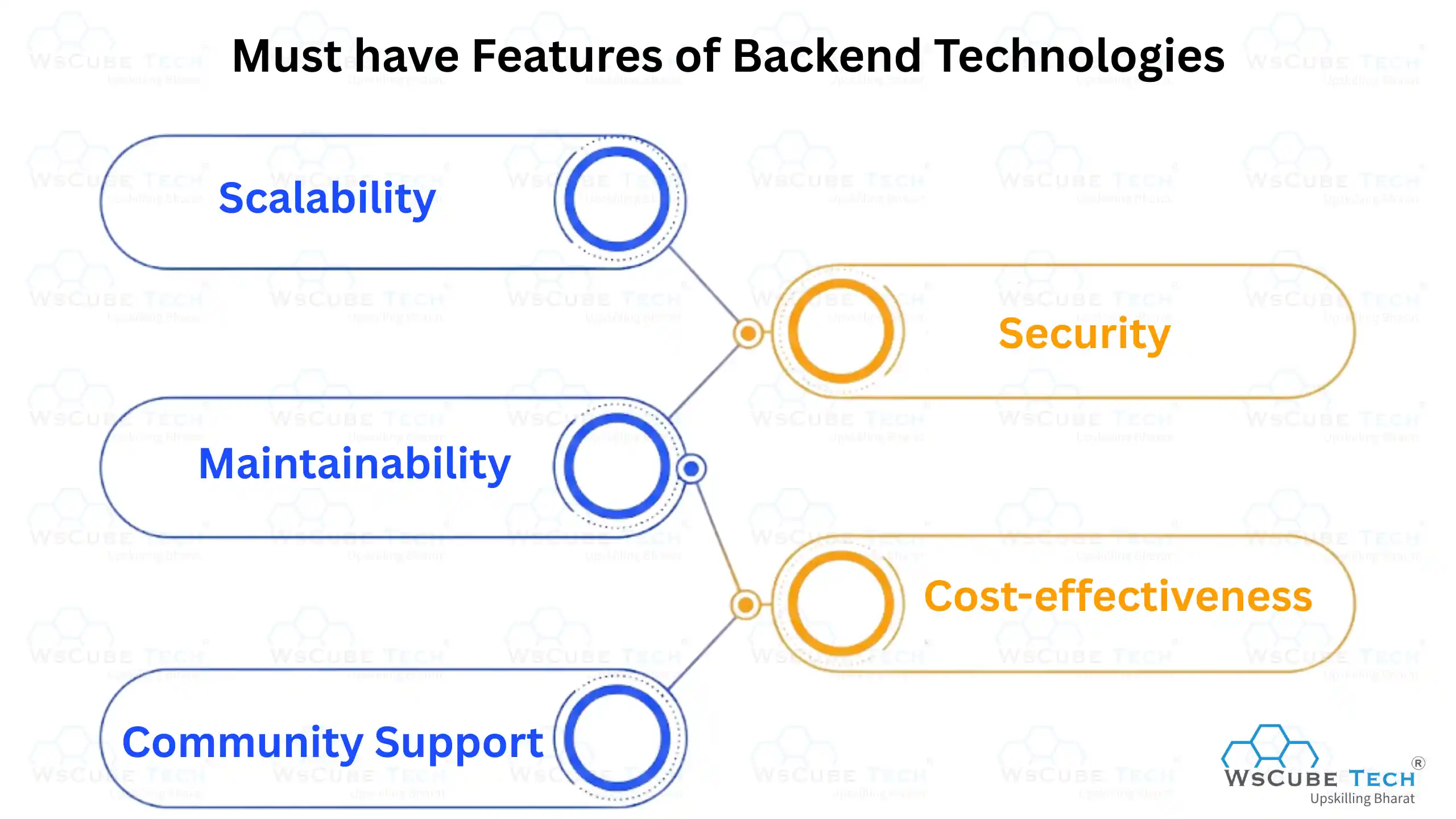
1. Scalability
- Quickly scaling up or down is vital for handling varying project demands.
- Ensures the application is responsive and accessible, even as demand or data storage grows, without compromising performance or security.
2. Security
- Protecting sensitive user information is a top priority for the latest backend language.
- Back end technologies must incorporate strong security measures, including data encryption, secure authentication mechanisms, and protection against common vulnerabilities like Cross-Site Scripting (XSS), SQL injection, and Cross-Site Request Forgery (CSRF).
- Regular security updates and patches too are essential to protect against new vulnerabilities.
3. Maintainability
- The language chosen must support simple maintenance of the codebase. This includes clear documentation, consistent coding standards, and design patterns that simplify understanding and modifying the codebase.
- A maintainable back-end allows teams to quickly adapt to new requirements or technologies without extensive rewrites or refactoring.
4. Cost-effectiveness
- The total cost of ownership, including initial development and ongoing maintenance, is a vital consideration.
- Open-source technologies reduce costs but may need more customization. On the other hand, commercial solutions may provide more out-of-the-box features at a higher cost.
5. Community Support
- Strong community support is crucial for developers.
- Ensures quick access to help when facing coding challenges.
- The availability of tutorials and libraries enhances resources for project development.
Explore Our Web Development Related Courses
FAQs about Backend Technologies
There's no single "best" option, yet Python and Node.js are top picks for beginners, while Java and Go suit large-scale enterprise apps. The right choice from any backend technologies list depends on your project goals.
Frontend technologies control what users see and interact with in the browser, while backend technologies manage servers, databases, and application logic behind the scenes. Both work together to power a functional web application.
Python with Django or Flask is widely considered the easiest entry point due to its simple syntax. It's a common starting pick across most backend development technologies guides for new developers.
A backend tech stack is the combination of a programming language, framework, database, and server used together to build the server side of an application, such as Node.js, Express, MongoDB, and Nginx.
Companies like Netflix, Uber, and Airbnb use a mix of Node.js, Java (Spring Boot), Python, and Go, depending on scalability needs. Most backend technologies on this list are proven at enterprise scale.
Node.js is faster for real-time apps like chat or streaming due to its non-blocking architecture, while Python excels in data-heavy and AI-driven projects. Both remain top choices on any list of backend technologies.
Core components include a programming language, framework, database, server, and APIs. Together, these backend development technologies handle data storage, business logic, and communication with the frontend.
Base your choice on project size, scalability needs, team expertise, and budget. Comparing options from a proper back-end technologies list helps match the right tool to your specific use case.
No, a backend technology is the broader category (languages, databases, servers), while a framework like Django or Laravel is one specific tool within that backend technologies list used to speed up development.
Node.js, Go, and Java (Spring Boot) are known for handling high-traffic, large-scale applications efficiently. They're consistently ranked among the top picks across every major backend tech stack comparison.

Explore Our Free Tech Tutorials
| Python Tutorial | Java Tutorial | JavaScript Tutorial |
| C Tutorial | C++ Tutorial | HTML Tutorial |
| CSS Tutorial | SQL Tutorial | DSA Tutorial |
Practice Coding With Our Free Compilers
| Online Python Compiler | Online HTML Compiler | Online C Compiler |
| Online C++ Compiler | Online JS Compiler | Online Java Compiler |
Join Our On-Campus Full Stack Related Courses
Free Courses for You





Leave a comment
Your email address will not be published. Required fields are marked *Comments (0)
No comments yet.