
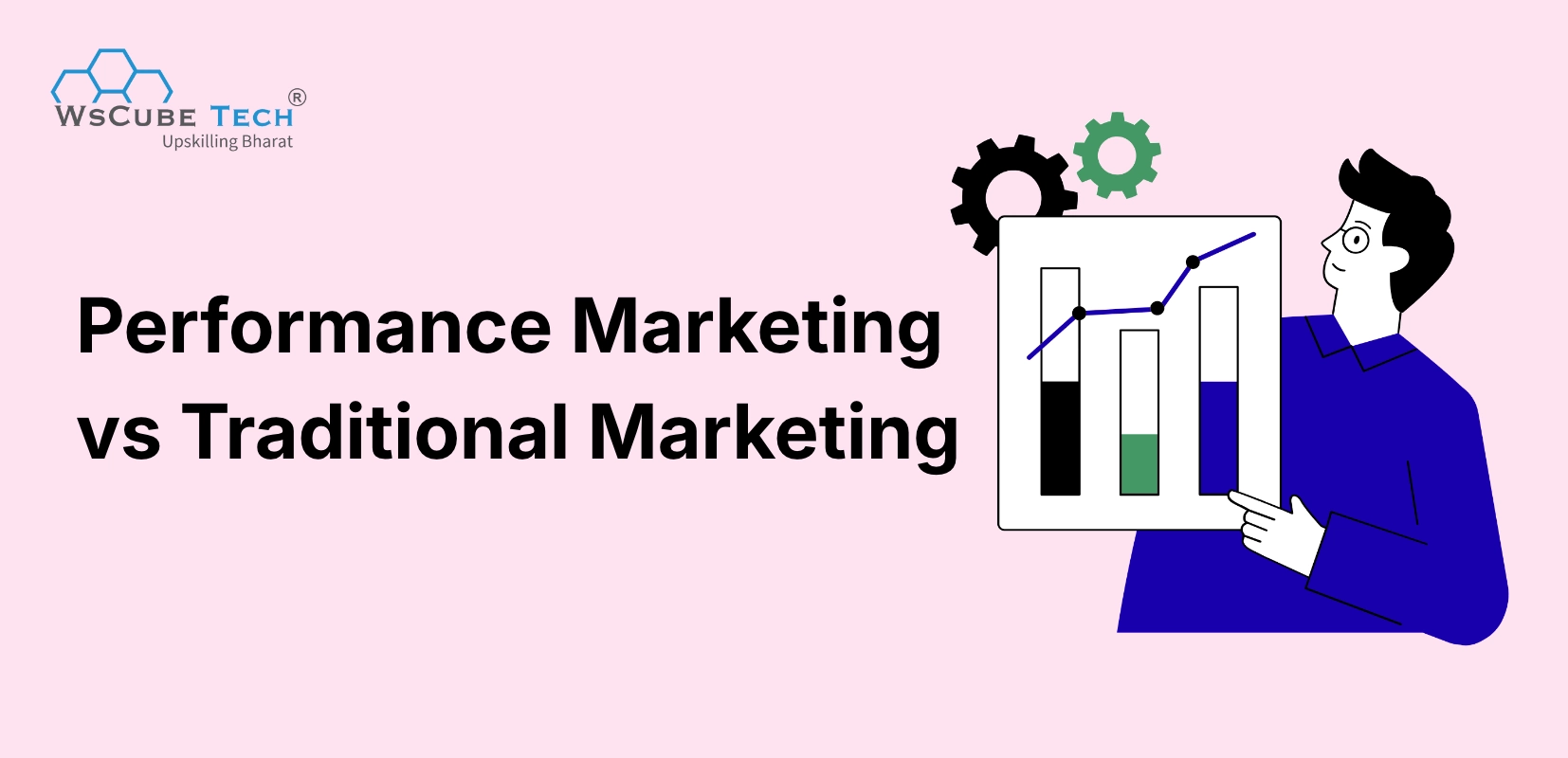
A hoarding and an Instagram ad can promote the same course, but only one gives you much detail about who clicked, who enquired, and what each enrolment costs. That gap sits at the center of performance marketing vs traditional marketing. Traditional marketing buys attention in offline media such as TV, newspapers, radio, and hoardings. Performance marketing ties spend to actions like clicks, leads, and sales, mostly online.
This guide explains the difference in plain terms, compares the two side by side, and shows what the same budget looks like in each. It also clears up a common myth: that offline ads can’t be tracked at all. For the wider picture, see our guide on digital marketing vs traditional marketing.
Recommended Professional Certificates
AI-Powered Digital Marketing Course
Performance Marketing Bootcamp
SEO Specialist Bootcamp
What Is the Difference Between Performance Marketing and Traditional Marketing?
The main difference is what you pay for and what you can prove. Traditional marketing buys exposure in offline media, so it is judged mostly by reach. Performance marketing links spend to actions like clicks, leads, or sales, so it is judged by results.
You may also see it called performance-based marketing or digital performance marketing. It sits inside digital marketing, but not all digital marketing is performance marketing. An organic Instagram post or an SEO article, for example, isn’t bought click by click or sale by sale.
| Metric | Traditional marketing | Performance marketing |
| Where it runs | TV, print, radio, hoardings, direct mail | Search engines, social media, affiliate networks, apps |
| What you usually pay for | Space or airtime, booked in advance | Clicks, leads, sales, or views, depending on the model |
| What you can see | Reach estimates, plus tracking you add yourself | Clicks, leads, and sales per campaign |
| Judged by | Reach and recall | Cost per result and return |
How Traditional Marketing Works
A company books space or airtime, makes the ad, and sends one message to many people at once.
- Examples: newspaper ads, TV commercials, radio spots, hoardings, pamphlets, direct mail
- Reach: many people at once, often limited to an area (a local paper reaches one city)
- Judged by: reach estimates from the media owner, plus surveys or sales trends
Example: A coaching institute books a newspaper ad. It pays for the space whether 10 or 1,000 people respond.
How Performance Marketing Works
- Pick one goal, such as leads or sales.
- Run ads on platforms like Google Ads or Meta Ads.
- Set up conversion tracking so each result is recorded.
- Read the numbers and change the ads.
- Pay by the model the campaign uses: per click, per lead, per sale, or per 1,000 views.
Our guides on what performance marketing is and the types of performance marketing channels go deeper on this.
How Do Performance Marketing and Traditional Marketing Compare?
They differ most in four areas: how you pay, how you measure results, how fast you can change a campaign, and how you target people. This table gives the quick view, and the sections below explain each one.
| Area | Traditional marketing | Performance marketing |
| Payment | Usually upfront for space or airtime | Depends on the model: per click, lead, sale, or view |
| Measurement | Reach estimates, plus tracking you add yourself | Built-in tracking per campaign |
| Speed of changes | Slow once booked or printed | Same day or within days |
| Targeting | Broad, by place or medium | By keyword, location, device, or past visit |
Payment and Risk
A traditional ad is usually paid for when you book it, whether or not anyone acts. Performance marketing spreads the cost over results, but how much risk you carry depends on the billing model.
Example: A ₹50,000 newspaper ad is paid for in full at booking. A ₹50,000 budget on Google Ads is spent as people click, and you can pause it any day.
Not every performance campaign pays per result. In Google Ads, the option to pay per conversion is available only in Display campaigns, and Target CPA bidding sets your bids per click. Affiliate marketing is the clearest pay-per-sale model.
Pro tip: Always ask what is being billed: views, clicks, or results.
Measurement and Proof of Results
- Traditional: A publisher can tell you how many copies were printed. It can’t tell you who read your ad and acted on it.
- Performance: Each campaign shows clicks, leads, and sales. The metrics you’ll see most are CPC, CPL, CPA, and ROAS.
Pro tip: Check platform numbers against your own sales records. Each platform counts sales by its own rules. Meta, for example, counts a sale if it happens within 7 days of a click or 1 day of a view.
Speed of Changes
Once a TV ad is produced or a pamphlet is printed, changing it takes time and money. An online ad can be edited, paused, or given a new budget the same day.
Example: You run two headlines, “Free demo class” and “Book a free trial.” After a few days, you pause the weaker one. Google Ads Experiments lets you split budget or traffic between your original campaign and a test version to compare them.
Pro tip: Fast changes need enough data. Google suggests judging a campaign over 30 days, with at least 30 conversions.
Targeting and Reach
Traditional media targets by place and medium. A local paper reaches one city, a hoarding reaches everyone passing, and a radio spot reaches that station’s listeners. Performance marketing targets by what people search, where they are, what device they use, and whether they visited your site before.
Example: A hoarding near a metro station reaches everyone walking past. A Google ad reaches only people who searched “python course online.”

Performance vs Traditional Marketing Budget: Side-by-Side Comparison
With the same budget, traditional marketing usually gives you reach numbers, while performance marketing gives you results you can count. The example below uses made-up numbers to show the difference.
Side-by-Side Example
An institute spends ₹50,000 on each approach (illustrative numbers):
| Metrics | Traditional (newspaper + hoarding) | Performance (Google + Meta ads) |
| Spend | ₹50,000 | ₹50,000 |
| What the company can report | Estimated reach from the publisher | Clicks, leads, and enrolments |
| Leads | 40 phone calls, source unclear | 100 form leads, source known |
| Cost per lead | Hard to calculate with confidence | ₹500 |
| Cost per enrolment | Hard to say | ₹5,000 (10 enrolments) |
This doesn’t show that performance marketing always wins. It shows what each approach lets you see.
For a coaching institute focused on enrolments, the performance numbers are usually more useful for decisions. For a local retail store or restaurant that mainly wants footfall and brand recall in one area, traditional media can still make sense alongside performance ads.
What the Numbers Do and Do Not Prove
- They show what happened on the platform, not always what the ads caused.
- Platforms can overlap. Each counts sales by its own rules, so two platforms can claim the same sale.
- Offline ads can look like online results. Someone sees the hoarding, searches the institute’s name later, and clicks a Google ad. Google gets the credit.
Pro tip: Check reported leads against real enrolments. For big decisions, marketers run a lift test, which shows how many sales the ads actually caused. Google’s Conversion Lift does this.
Can Traditional Marketing Be Measured Too?
Yes, partly. You can add tracking to offline ads, but it takes extra setup and usually gives a less complete picture than online campaigns.
Simple Ways to Track Offline Ads
| Method | How it works | Example |
| Unique phone number | Each ad shows a different number, and calls are logged by source | One number on the hoarding, another in the newspaper |
| Coupon code | A code in the ad shows where a customer came from | “PAPER10” printed only in the newspaper ad |
| QR code | A scan opens a page you can track | A QR code on a poster |
| Vanity URL or landing page | A short web address used only in that ad | brand.com/radio |
These methods are described by Marcel Digital, G2, and Cometly.
Pro tip: Use a different code or number for each medium. One shared code can’t tell you which ad worked.
Where Offline Tracking Falls Short
- It counts only people who use the code, number, or link. Everyone else is invisible.
- It gets weaker at scale. Cometly notes that codes and similar methods become less effective for large campaigns such as regional TV or national radio.
- Big campaigns use statistics instead. Media mix modelling links spending across channels to business results over time.
Pro tip: Media mix modelling shows patterns over weeks or months. It doesn’t show individual customers or same-day results.
Which Is Better: Performance Marketing or Traditional Marketing?
Both approaches have their place, but performance marketing offers more control over how you spend your advertising budget and measure results. You can track how many people clicked an ad, filled out a form, or purchased a product. You can also identify which campaigns are working and adjust your budget accordingly.
Quick Decision Guide:
- Choose Performance Marketing when your main goal is leads, enrolments, or sales, and you need to know the cost of each result.
- Choose Traditional Marketing when you want broad local or mass awareness, especially in a specific city or area, and tracking every response is less important.
- Use both when you have enough budget: traditional for reach, performance for converting the interest it creates.
Traditional marketing can help businesses reach a large audience, but it is harder to connect that exposure directly to sales. This makes performance marketing a more practical choice when the goal is to generate leads, increase sales, or get measurable returns from advertising spend.
Why Performance Marketing is a Better Choice
- You can measure every important action: Track clicks, leads, purchases, and other conversions to understand what your campaigns are delivering.
- You have better control over your budget: Start with a small budget, test different campaigns, and increase spending on ads that perform well.
- You can reach a more relevant audience: Target people based on their interests, search behaviour, location, demographics, and previous interactions with your business.
- You can improve campaigns while they run: Test different ads, headlines, and audiences. Pause underperforming campaigns and focus on what brings better results.
- You can connect advertising spend to business results: Metrics such as Cost Per Lead (CPL), Cost Per Acquisition (CPA), and Return on Ad Spend (ROAS) help you evaluate campaign performance.
Real case: Bewakoof, an Indian fashion brand, retargeted people who browsed its pyjama range but didn't purchase. According to a Meta case study, the campaign achieved a 10% lower cost per acquisition compared with its traditional advertising. Since this is a Meta-published, undated case study, consider it an example rather than a general performance benchmark.
Traditional marketing still makes sense when a business wants broad brand awareness or needs to reach people through offline channels. However, when you want to track campaign results, control advertising costs, and improve performance based on actual data, performance marketing offers a clear advantage.
For aspiring marketers: These advantages also explain why performance marketing is a valuable skill to learn. Businesses need professionals who can run ad campaigns, track conversions, analyze results, and improve returns on advertising spend.
Upcoming Masterclass
Attend our live classes led by experienced and desiccated instructors of Wscube Tech.







Can Performance and Traditional Marketing Work Together?
Yes, and many companies do. Traditional ads can build awareness, and performance campaigns can capture the people who go looking afterwards.
How Offline Reach Supports Online Results
EMARKETER notes that brand work supports the efficiency of performance spending, since performance campaigns can only convert interest that already exists.
Example: A viewer sees a TV ad for an online course. Later they search the brand’s name, click a search ad, and enroll. The TV ad created the interest, and the search ad captured it.
Planning a Combined Campaign
- Set one clear goal, such as enrolments.
- Pick an offline medium for reach, such as a hoarding or newspaper.
- Add a trackable element: a unique URL, QR code, or coupon code.
- Run performance campaigns to capture searches and retarget visitors.
- Compare results by source, not just by total.
What Skills Does Each Approach Need?
Traditional marketing leans on media planning, buying, and creative work. Performance marketing leans on ad platforms, tracking, and reading numbers. Both start with understanding the audience, but performance marketing is the one you can practice on small budgets and show with real campaign results.
Skills Behind Traditional Marketing
- Media planning and buying
- Creative work and copywriting
- Brand strategy
- Negotiating with media owners
- Coordinating outdoor ads and events
Skills Behind Performance Marketing
Understanding advertising concepts is one thing; learning to manage campaigns is another. Practical experience with ad platforms, conversion tracking, and campaign optimization helps you understand how performance marketing works in a business setting.
The Performance Marketing Course at WsCube Tech is a live online program built around these skills:
| Skill | Where you practice it in the course |
| Conversion tracking with Meta Pixel, Google Tag Manager, and Conversion API | Meta Ads and Tracking Mastery (3 weeks) |
| Custom audiences, lookalike audiences, retargeting | Meta Ads and Tracking Mastery |
| A/B testing and live optimization | Meta Ads and Tracking Mastery |
| Google Ads campaigns | Google Ads Mastery (2 weeks) |
| Amazon and Meesho sponsored ads | Marketplace and Campaign Setup (2 weeks) |
According to the course page, it runs for 8 weeks with 48+ hours of live classes and 12+ projects, ends with a capstone and demo day, and includes career prep such as resume, portfolio, and mock interview support. WsCube's programs suit beginners as well as advanced learners.
Ready to turn this comparison into a skill you can use? See the full curriculum on the Performance Marketing Course or download it and talk to a program advisor from the same page.
Pro tip: Before you choose any course, ask whether you will build real campaigns, track real results, and leave with a portfolio.
For roles and salaries, see the career section in our guide on what performance marketing is.
Wrapping Up!
Performance marketing and traditional marketing differ mainly in what you pay for and what you can prove. Traditional marketing buys reach in offline media. Performance marketing links spend to clicks, leads, and sales, and lets you change a campaign while it runs. Offline ads can be tracked too, but it takes extra setup, and most companies use both.
To keep learning, read the digital marketing vs traditional marketing comparison, see the types of performance marketing, and check how digital marketing ROI is measured.
Explore Digital Marketing Career Guides Blogs
FAQs on Performance Marketing vs Traditional Marketing
The main difference between performance marketing vs traditional marketing is how advertising results are measured. Traditional marketing focuses on reach and brand exposure, while performance marketing tracks measurable actions such as clicks, leads, and sales.
Not always. Performance marketing allows businesses to start with smaller budgets, test campaigns, and pause ads when needed. However, the cost per result depends on competition, targeting, and campaign performance.
Yes, partly. Unique phone numbers, coupon codes, QR codes, and dedicated landing pages help businesses track responses to offline advertisements. However, they don't capture every person influenced by an ad.
Yes. Performance marketing is a results-focused approach within digital marketing. SEO and organic social media are also digital marketing activities, but they don't necessarily follow a pay-per-result model.
Yes. Traditional marketing remains useful for building brand awareness, reaching local audiences, and connecting with people through offline channels. Many businesses combine it with performance marketing.
Performance marketing is a practical starting point because beginners can learn to run campaigns, track conversions, and analyze results. Understanding traditional marketing and brand awareness is useful too.
Performance-based marketing connects advertising costs to measurable actions, such as clicks, leads, or sales, depending on the payment model. Traditional advertising generally charges businesses for media space or airtime.
Common performance marketing channels include Google Ads, Meta Ads, affiliate marketing networks, display advertising, and sponsored marketplace listings. Businesses choose channels based on their campaign goals and target audience.
Traditional marketing mainly uses television, newspapers, magazines, radio, billboards, pamphlets, direct mail, and outdoor advertising to reach audiences.
Traditional marketing mainly uses offline channels such as television, newspapers, and billboards to build awareness. Digital performance marketing uses online platforms to target specific audiences and track actions such as clicks, leads, and purchases.
Performance marketing generally offers more precise targeting through factors such as location, interests, search behavior, demographics, and previous website interactions. Traditional marketing usually targets broader audiences based on media and location.
Performance marketing makes ROI easier to measure because businesses can connect campaign spending with tracked conversions and revenue. However, actual ROI depends on campaign costs, conversion rates, and customer value.
Yes. Small businesses can start with limited advertising budgets, target specific audiences, and increase spending when campaigns generate satisfactory results. They can also pause campaigns when needed.
Businesses commonly evaluate traditional marketing through estimated reach, impressions, brand recall surveys, website traffic changes, sales trends, and responses to trackable promotional codes or phone numbers.
Cost Per Click (CPC) is the amount an advertiser pays for each ad click. Traditional advertising generally charges a fixed amount for media placement or airtime rather than individual customer clicks.
No. Performance marketing helps businesses track and optimize campaigns, but it cannot guarantee sales or leads. Results depend on factors such as audience demand, competition, ad quality, landing pages, and pricing.
No. Offline businesses, including coaching institutes, retail stores, restaurants, and service providers, can use performance marketing to generate enquiries, bookings, store visits, and sales.
Yes. Traditional advertising can build brand awareness, while performance campaigns can reach interested audiences through search ads, retargeting, and social media advertising.
Its biggest limitation is less precise measurement. Businesses can estimate reach and track selected responses, but identifying exactly which advertisement influenced an individual purchase is often difficult.
A performance marketing and traditional marketing comparison highlights differences in cost models, targeting, measurement, and campaign flexibility. Performance marketing offers better tracking and optimization, while traditional marketing remains useful for broad awareness and offline reach.

Join Our On-Campus Digital Marketing Program
Explore Our Free Courses

Leave a comment
Your email address will not be published. Required fields are marked *Comments (0)
No comments yet.