
Say you search for "running shoes under ₹3,000" tonight. An ad shows up, you click it, and you place an order. The brand behind that ad can now see which ad, which search, and which slice of its budget led to your purchase.
That trail of data is what separates performance marketing from putting up a hoarding and hoping for the best.
This guide explains how performance marketing works in practice, whether you're a student, a career switcher or a future freelancer. The examples use rupee numbers, so you can follow along with a calculator.
How Does Performance Marketing Work?
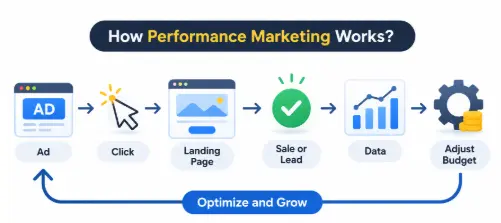
Performance marketing works by running ads, tracking every click, lead and sale they produce, comparing those results with what was spent, and then moving the budget toward what pays back and away from what doesn't.
One thing many articles gloss over: the advertiser doesn't always pay for a sale.
| Setup | What the advertiser pays for | What gets measured |
| Google Ads or Meta | Clicks or impressions | Leads, sales, ROAS |
| Affiliate marketing | A commission when a sale happens | Sales through the affiliate's link |
| Cost-per-acquisition (CPA) deals | A set fee per action, such as a lead or an install | That action |
What makes it "performance" marketing is that every rupee is tied to a result you can see, and the marketer keeps adjusting until the numbers work.
Notice the loop. The data from each sale or lead flows back and changes what happens next. That feedback is the engine of how performance marketing works.
Who Is Involved in Performance Marketing?
Four players are involved: the business that wants customers (the advertiser), the platform or website that shows the ad, the tools that record what happens after the click, and the customer whose action closes the loop.
| Player | Examples | What they do |
| Advertiser | A shoe brand, a coaching institute, a clinic | Sets the goal and budget, supplies the product and the landing page |
| Platform or publisher | Google, Meta, YouTube, a blogger or creator in an affiliate deal | Shows the ad to the right people and charges for clicks, views or actions |
| Tracking tools | Google Analytics, Google Tag Manager, an affiliate network | Record which ad led to which action |
| Customer | The person who searched, scrolled or clicked | Takes the action (buys, signs up, installs) |
Affiliate deals show how performance marketing works in its purest form, because the publisher plays a bigger part. A blogger or creator recommends the product through a special link and earns a commission only if someone buys through it.
Where do you fit in? As a performance marketer, you'd sit between the advertiser and the platform. You take the advertiser's goal and budget, set up the campaigns, and report back on what the money produced.
Recommended Professional Certificates
AI-Powered Digital Marketing Course
Performance Marketing Bootcamp
SEO Specialist Bootcamp
What Is the Performance Marketing Process? Step by Step
The performance marketing process is a loop: set a break-even target, set up tracking, launch a small test, read the numbers, cut what loses, and scale what wins. Then you repeat it every week.
Here's each step of the performance marketing process, with the rule of thumb I'd use at that point. If you want a platform-by-platform learning plan instead, see our guide on how to learn performance marketing.
1. Set a Break-Even Target Before Spending
Start with one number: the most a business can pay to win a customer and still make money.
- How to find it: take the gross profit on an average order (what's left after product costs). That's the ceiling.
- Example: a first order brings in ₹720 in gross profit. Paying ₹500 to get that customer is fine. Paying ₹900 is not.
- Working for a business? Ask for the average order value and the margin. On a practice project, work out a rough version yourself.
- Common mistake: chasing cheap clicks without knowing what a customer is worth. If you can't say, don't spend yet.
2. Set Up Tracking Before Launch
- Install the platform's tracking code on the website.
- Decide which actions count as a conversion: a purchase, a form fill or a phone call.
- Place a test order and check that it appears in the dashboard.
The tool most marketers use for this is Google Tag Manager, and WsCube Tech has a free Google Tag Manager course if you want to learn it. A campaign without working tracking is just spending.
3. Match the Goal to the Buyer's Stage
- A stranger won't buy a ₹40,000 product on the first click. Show them a short video or a useful guide.
- Someone who added the product to the cart yesterday is ready. A reminder ad does the job.
Match the ad to the stage and you stop wasting money asking strangers to commit. Our guide to the digital marketing funnel breaks the stages down.
4. Test a Few Things, One at a Time
- Launch with a few different ads rather than one big bet. For example: three creatives (the images, videos, and text of your ads), two audiences, and one landing page.
- Change only one thing at a time, or you won't know what caused the difference.
- Keep the budget small enough that a wrong guess won't hurt.
5. Launch, Then Leave it Alone for a Few Days
Ad platforms learn who is most likely to convert from your first batch of conversions. If you edit the ad, budget or audience every few hours, that learning restarts and your data gets muddy. Check in, but don't fiddle.
6. Read the Numbers from Top to Bottom
Look at how many people saw the ad, how many clicked, how many converted, and what each conversion cost. The weakest link tells you what to fix:
- Few clicks: look at the ad.
- Plenty of clicks, few sales: look at the landing page or the offer.
- Plenty of sales at a bad cost: look at the audience or the bidding.
The failure table later in this guide goes through each case.
7. Cut, Fix and Move Money Every Week
Once a week:
- Pause the ads that clearly lose.
- Fix the ones that are close.
- Shift budget to the ones that win.
- Give each ad enough data before you judge it. Ten clicks tell you almost nothing.
This weekly habit is where most of the gains in the performance marketing process come from.
8. Scale in Steps, and Bring Back the People Who Left
- Raise the budget in steps rather than doubling it overnight. A common rule of thumb is about 20 to 30 percent at a time, while watching the cost per customer.
- Set up retargeting for people who visited but didn't buy. They're usually cheaper to convert than strangers.
- If the cost per customer jumps, go back to the last budget that worked and refresh the ads. Then the loop starts again.
How Does Performance Marketing Work Behind the Scenes?
Three things run under every campaign: an auction that decides whose ad gets shown, tracking that records what people do after they click, and attribution that decides which ad gets credit for a sale. You don't control them directly, but knowing them explains how performance marketing works under the hood, and most of the "why is this happening?" moments.
1. The Ad Auction Decides Who Sees the Ad
Every time someone searches or opens an app, the platform runs a quick auction for that one ad slot. The winner isn't simply the highest bidder.
- Google Ads: an ad's position depends on the bid and on how relevant and useful Google thinks the ad and landing page are.
- Meta: it weighs the bid, how likely the person is to take the action the advertiser wants, and the quality of the ad.
In plain words, a better ad can beat a bigger budget. On Google the advertiser also usually pays less than their maximum bid, because they pay roughly what it takes to win the spot. For more on how this plays out in search, see our guide to Google Ads.
2. Tracking is How the Platform Knows a Sale Happened
| Method | What it does |
| Pixel or tag | A small piece of code on the website. When someone buys, it tells the ad platform, "that click turned into a sale." |
| UTM tags | Short labels added to links, so Google Analytics knows which campaign sent each visitor. |
| Server-side tracking | The business's own server sends the sale straight to the platform (Meta calls its version the Conversions API). It keeps working when a browser blocks the pixel. |
| Affiliate link and cookie | Credits the sale to the affiliate whose link the buyer came through, so they earn the commission. |
Our guide to affiliate marketing covers that last method in more detail.
3. Attribution decides who gets the credit
Picture one customer:
- Monday: she sees an Instagram ad.
- Wednesday: she searches the brand name on Google.
- Thursday: she buys.
Which ad earned the sale? A last-click view gives all the credit to Google. Meta may count the sale too, because the person saw its ad first.
That's why Google Ads and Meta can each claim the same order, and why the totals in the ad dashboards can add up to more than the orders actually received. Treat platform numbers as a guide, and check them against real orders in the store or CRM (the tool where a business keeps its leads and customer records).
4. AI Automation and Privacy Rules Change the Controls, Not the Logic
- Automation: platforms now offer automated campaign types, such as Google's Performance Max and Meta's Advantage+. You give them a goal, a budget, and your creatives, and they decide where to show the ads and to whom.
- Privacy: Apple's 2021 tracking limits on iPhones and the move away from third-party cookies mean platforms see less of what people do.
- What matters more now: sending accurate conversion data back to the platform, and having strong creatives, since that's the main thing you control.
So how does performance marketing work with less data? The loop stays the same, with more weight on accurate conversion data and good creatives.

How Do You Know If a Campaign Is Making Money?
Compare its ROAS with its break-even ROAS. Break-even ROAS is 1 divided by the gross margin, so if the margin is 40%, the campaign needs ₹2.50 back for every ₹1 spent just to break even.
Four numbers do most of the work:
- CTR (click-through rate): clicks ÷ impressions. Tells you if the ad grabs attention.
- Conversion rate: conversions ÷ clicks. Tells you if the page and offer work.
- CPA (cost per acquisition): spend ÷ conversions. What one customer or lead costs.
- ROAS (return on ad spend): revenue ÷ spend. How many rupees come back for each rupee spent. Our guide to ROAS goes deeper, and Facebook Ads metrics covers the Meta-specific ones.
The thinner the margin, the higher the ROAS you need:
| Gross margin | Break-even ROAS |
| 20% | 5 |
| 25% | 4 |
| 40% | 2.5 |
| 50% | 2 |
Now a worked example. Imagine you're running ads for an online store:
- Monthly ad spend: ₹50,000
- Cost per click: ₹10
- Average order: ₹1,800
- Gross margin: 40%, so each order leaves ₹720 before ad costs
- Break-even ROAS: 1 ÷ 0.40 = 2.5
The only thing that changes between the two columns below is the conversion rate.
| Metric | Conversion rate 2% | Conversion rate 1% |
| Ad spend | ₹50,000 | ₹50,000 |
| Clicks | 5,000 | 5,000 |
| Orders | 100 | 50 |
| Cost per order (CPA) | ₹500 | ₹1,000 |
| Revenue | ₹1,80,000 | ₹90,000 |
| ROAS | 3.6 | 1.8 |
| Gross profit before ads (40%) | ₹72,000 | ₹36,000 |
| Profit after ads | ₹22,000 | −₹14,000 |
Same ads, same clicks, same spend. Because the conversion rate halved, the campaign went from a ₹22,000 profit to a ₹14,000 loss. A ROAS of 1.8 might look decent on a dashboard, yet it's below the 2.5 this store needs. That's why you work out break-even first, and why a good landing page matters as much as a good ad. It's also how performance marketing works in real life: small shifts in the numbers can flip a campaign from profit to loss.
Two caveats:
- These figures are made up for illustration.
- They ignore returns and repeat purchases. If the store's customers reliably buy again, a lower first-order ROAS can be fine, but only once the business has checked that they actually come back.
For the wider picture, see our guide on digital marketing ROI.
Explore Digital Marketing Learning Guides
| Digital Marketing Roadmap | How to Learn Digital Marketing |
| Digital Marketing Course Syllabus | Best Digital Marketing Books |
| Digital Marketing Course Eligibility | Digital Marketing Learning Time |
How Does Performance Marketing Work in Digital Marketing?
Performance marketing is the paid, trackable layer of digital marketing. SEO, content, and email build interest over time, while performance campaigns reach people ready to act and win back those who left without buying.
So how does performance marketing work in digital marketing day to day? Follow one customer:
- She finds a brand’s blog post through Google (that’s SEO) and leaves without buying.
- Two days later, a retargeting ad reminds her about the product.
- She clicks and buys.
- A follow-up email brings her back for a second order.
Organic channels earned the attention, the paid campaign closed the sale, and the email kept the customer.
Brands run performance campaigns at every stage of the buyer’s journey:
| Stage | Who | Typical ads | Judged on |
| Top | People who don’t know the brand | Video or social ads aimed at new audiences | Quality visitors and cost per visitor |
| Middle | People comparing options | Search ads on problem-focused keywords, lead forms | Cost per lead |
| Bottom | People ready to buy | Retargeting, cart reminders, ads on the brand’s own name | CPA and ROAS |
The two sides feed each other:
- Search terms that bring paid clicks show what people want to read about.
- The best organic posts and videos often make the best ad creatives.
If you’re learning, don’t study paid ads alone. A bit of SEO and email shows you where paid traffic fits and where organic does the job more cheaply.
Related reading: how to learn performance marketing(includes a comparison table), performance marketing types and digital marketing.
What Does Performance Marketing Look Like in Real Campaigns?
It usually takes one of three shapes: selling products online (revenue measured against spend), collecting leads (the cost of a customer, not a lead), and getting app installs (the users who stick around). The numbers below are made up, but they show how performance marketing works in each case.
| Shape | What you measure | What to watch out for |
| Selling products | ROAS against break-even | A dip in conversion rate |
| Collecting leads | Cost per enrolment or customer | Cheap leads that never convert |
| App installs | Users still active after a week | Installs that don't stay |
Selling Products Online
This is the store from the example above. The marketer checks ROAS against the break-even of 2.5. When the conversion rate dropped to 1%, the next move wouldn't be a bigger budget. It would be checking that tracking still works, then looking at page speed, the offer and the checkout.
Collecting Leads
Say a coaching institute spends ₹1,00,000 on two lead campaigns:
| Metric | Campaign A | Campaign B |
| Spend | ₹1,00,000 | ₹1,00,000 |
| Cost per lead | ₹250 | ₹150 |
| Leads | 400 | About 667 |
| Share who enrol | 5% | 2% |
| Students enrolled | 20 | About 13 |
| Cost per enrolment | ₹5,000 | ₹7,500 |
Our article on lead generation covers this in more detail.
Getting App Installs
- An app company pays ₹60 per install and gets 1,000 installs for ₹60,000.
- Only 10% are still using the app after a week. That's 100 active users.
- The cost works out to ₹600 per user who stuck around.
The same ₹60,000 on a different channel might bring fewer installs but more people who stay, and that channel would win. Installs are the easy number; retention is the honest one.
Why Do Performance Marketing Campaigns Fail?
Most campaigns fail for one of four reasons: tracking that's broken or missing, no break-even target, a weak landing page, or scaling before enough testing. Each one leaves a pattern in the numbers, and you can read it.
| What you see | Likely cause | First fix |
| Very few clicks | Weak ad, audience too narrow, bid too low | Test new creatives, widen the audience |
| Many clicks, few sales | Landing page or offer doesn't match the ad; slow page | Fix the page, then check the bounce rate |
| Cost per customer rises after scaling | Audience tiring out, or budget raised too fast | Refresh creatives, step the budget back |
| Good ROAS but no profit | Margin ignored, or many returns | Recalculate break-even ROAS |
| Platform shows more sales than the store | Attribution overlap or broken tracking | Compare with real orders |
| No conversions at all | Tracking tag isn't firing | Place a test order, check the tag |
Patience matters too. Judging a campaign after one day, or after a handful of clicks, usually leads to bad decisions. The better you understand how performance marketing works, the easier these patterns are to spot.
What Does a Performance Marketer Actually Do?
A performance marketer plans, runs and improves paid ad campaigns, and reports whether the money earned its keep. Day to day, that means setting up tracking, building ads, checking numbers and moving budget.
A typical week follows the loop from earlier:
- Start of the week: compare last week's numbers with the break-even target.
- Early week: launch new ads or refresh tired ones, changing one thing at a time.
- Mid-week: check that tracking still works and that spend is on pace.
- End of the week: pause the losers, move the budget to the winners, and send a short report on what happened and what's next.
You'll see this work under job titles like:
- PPC specialist
- Media buyer
- Growth marketer
- Paid ads manager
- Performance marketing executive
Some people do the same work as freelancers for a few small clients. Digital marketing salary in India covers all your questions regarding the pay range.
How Can You Practice Performance Marketing on a Small Budget?
Run a small real campaign you can measure: for your own blog or page, for a friend's shop, or for a local business that agrees to let you try. Spend only what you can afford to lose, and write down every result.
A simple way to start:
- Pick one platform (Google Ads or Meta) and one goal, such as leads or sales.
- Work out the break-even number with the owner, even if it's rough.
- Set up tracking and test it with a dummy order or form fill.
- Run two or three ads for a week or two on a small daily budget, changing one thing at a time.
- Keep a simple log of what you changed, why, and what happened.
If the money belongs to someone else, get their permission and agree the budget in writing before you spend anything.
Free ways to learn the tools:
- Google Skillshop: teaches Google's ad tools.
- Meta Blueprint: teaches Meta's ad tools.
- WsCube Tech's free Google Tag Manager course: covers tracking.
That log also becomes the start of a client report, which is what the next section is about. Employers like seeing that kind of record too.
Upcoming Masterclass
Attend our live classes led by experienced and desiccated instructors of Wscube Tech.




How Does Performance Marketing Work for a Freelancer?
It works the same way, just on smaller accounts and with a client to answer to. You agree the goal and budget, set up tracking, run and improve the ads, and send a simple monthly report showing what was spent, what came back and what you'll change next.
Here's what that looks like on a small account. Say you run ads for a local gym in a smaller city. The owner gives you ₹20,000 a month, and the goal is new memberships. These numbers are made up:
- The ads bring 80 enquiries, at about ₹250 each.
- 24 people visit the gym, and 8 of them join.
- That works out to ₹2,500 for each new member.
If a new member is worth around ₹6,000 to the gym over their first three months, ₹2,500 is a good result. If they're worth only ₹2,000, it isn't, and you'd change the ads or the offer. The owner doesn't need to know what CTR means. They need to see those three lines and hear what you'll try next month.
A few habits keep freelance work smooth:
- Agree how results are counted before you start: a form fill, a phone call or a walk-in.
- Set up the ad account so the client owns it and you have access. It usually works better for everyone, and the client keeps their data if you part ways.
- Promise a process and a monthly report, not results. Nobody can promise a number in advance.
- Keep the log from the practice section. With the client's permission, it can become a short case study for your next client.
Where Can You Learn How Performance Marketing Works Hands-On?
The fastest way is to run real campaigns with someone checking your work. At WsCube Tech, you have options to give you real world experience.
| Option | Length | What it covers |
| Performance Marketing Bootcamp | 8 weeks | Paid ads, analytics and return on investment |
| AI-Powered Digital Marketing Course | 20 weeks | The wider picture: SEO, social media and email alongside paid ads |
| Free Google Tag Manager course | Free | Tracking, the foundation of everything above |
Not ready to commit? Start with the free course.
Final Thoughts!
Performance marketing means paying to reach people, tracking what they do, and putting more money behind what makes a profit. The performance marketing process stays the same whatever the platform:
- Know your break-even number.
- Track properly.
- Test small.
- Read the data.
- Scale slowly.
That's really all there is to how performance marketing works. Once that loop makes sense, every channel, from search ads to affiliates, is just a different place to run it. To practise it on real campaigns, take a look at our performance marketing course.
FAQs About Performance Marketing
No. PPC is one type of performance marketing where advertisers pay for clicks. Performance marketing also includes affiliate marketing, CPA campaigns, influencer marketing and other trackable advertising models.
No. Affiliate marketing is a type of performance marketing. It involves paying publishers or creators a commission when their referral generates a sale or another agreed action.
Performance marketing focuses on measurable actions such as clicks, leads and sales. Brand marketing focuses on building awareness, recognition and trust over time. Businesses often use both to attract and convert customers.
CPC: Cost per click.
CPM: Cost per 1,000 impressions.
CPL: Cost per lead.
CPA: Cost per acquisition or completed action.
Each model measures advertising costs differently, depending on the campaign objective.
A landing page is a webpage visitors reach after clicking an advertisement. It encourages them to take a specific action, such as purchasing a product or submitting an enquiry. A relevant, well-designed landing page can improve conversion rates.
Retargeting means showing ads to people who have previously visited your website or interacted with your brand. It helps bring back interested visitors who didn't complete a purchase or enquiry. Its effectiveness depends on audience quality, timing and ad relevance.
Start with Google Ads if you want to reach people actively searching for products or services. Choose Meta Ads if you want to learn social media advertising, audience targeting and creative testing. Master one platform before moving to the other.
Instagram performance marketing uses Meta Ads Manager to run targeted advertisements across Feed, Stories and Reels. Advertisers set campaign objectives, audiences and budgets, then track clicks, leads and sales to measure performance.
Businesses collaborate with influencers to promote products or services through sponsored content, referral links or discount codes. They track clicks, leads and sales generated through each collaboration to measure its performance.
B2B companies use platforms such as Google Ads and LinkedIn Ads to reach business decision-makers. They track enquiries, qualified leads, demo bookings and customer acquisitions to measure campaign performance.
No. You can collect leads through social media forms or direct people to messaging platforms. However, a website gives you more control over landing pages, conversion tracking and the customer journey.
You can start with a small budget that you can afford to lose. Choose one advertising platform, set a clear objective and run a few test ads. You can also practise using a friend's business or a personal website.
Yes. Poor targeting, weak advertisements, ineffective landing pages and high acquisition costs can lead to losses. Always calculate your break-even target before spending money on campaigns.
There is no universal benchmark because CTR and conversion rates vary by industry, platform and campaign objective. Compare your results with previous campaigns and business goals rather than relying on a single industry average.
You can receive clicks within hours of launching a campaign, but meaningful results take longer. Most campaigns need a few weeks of data to identify patterns and make informed optimisation decisions.
Beginners can start with Google Ads, Meta Ads Manager, Google Analytics 4, Google Tag Manager and Google Sheets. These tools help you run campaigns, track conversions and monitor advertising performance.
Freelancers generally charge a fixed monthly fee, a percentage of advertising spend or a performance-based fee. Some also charge a separate setup fee. The pricing depends on campaign complexity and agreed responsibilities.
You don't need professional design or copywriting skills, but basic knowledge helps. Understanding ad creatives, headlines and calls to action makes it easier to create, test and improve advertising campaigns.

Join Our On-Campus Digital Marketing Program
Explore Our Free Courses





Leave a comment
Your email address will not be published. Required fields are marked *Comments (0)
No comments yet.