
AI is not just chatbots anymore. Behind the scenes, AI agents book meetings, manage support tickets, run trading strategies, and even work with other AI agents to finish complex projects.
If you have ever wondered about the types of AI agents and how they work, you are not alone. This guide breaks down the types of agents used today, with simple explanations and real examples, so you can spot which one is at work in almost any AI tool you use.
If you are new to the topic, you may also check out this video on AI agents explained for a quick visual overview before diving into the details below.
How Many Types of AI Agents Are There? Quick Answer
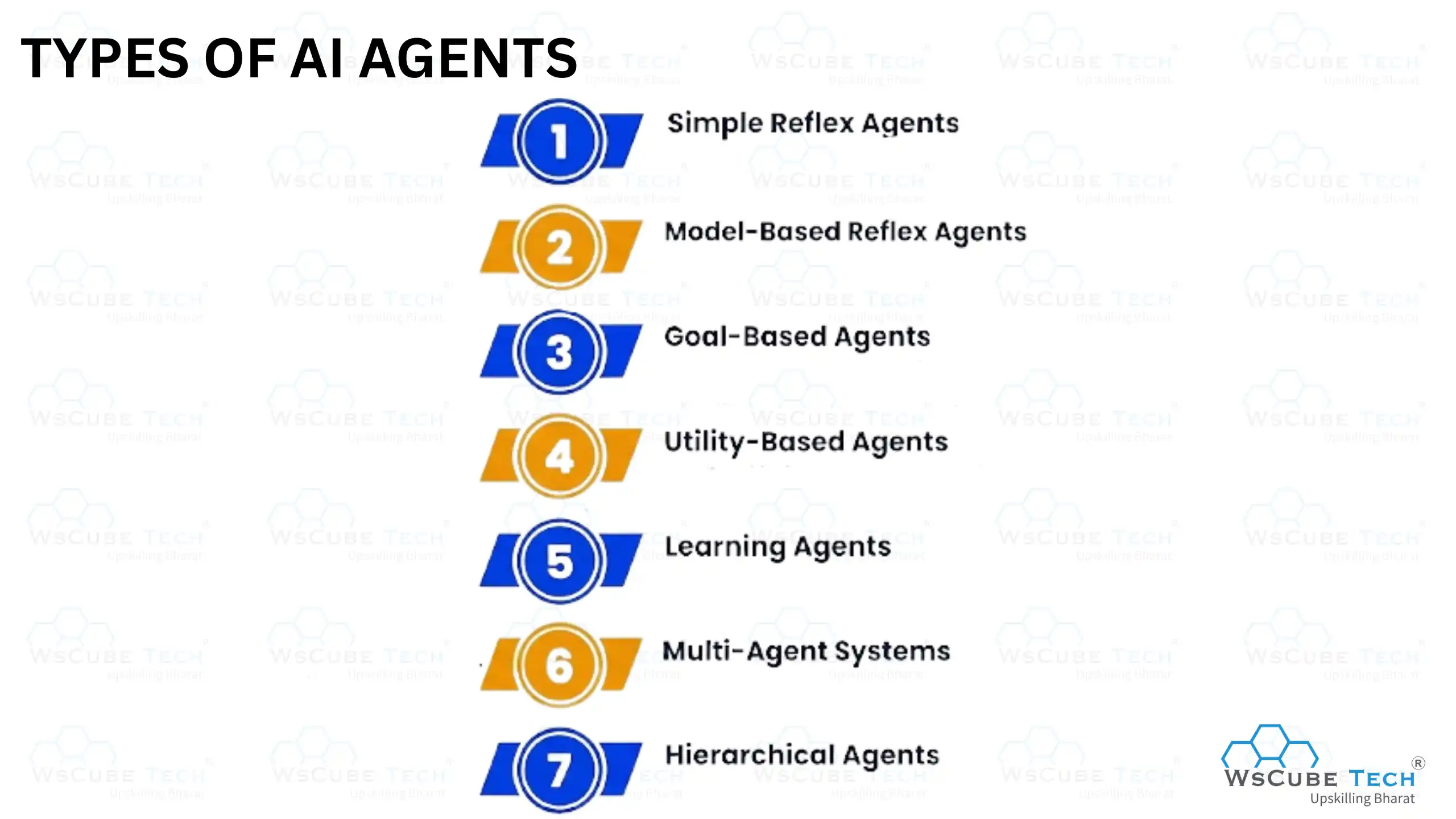
The answer to the most popular question, how many types of AI agents are there depends on the framework you follow. Traditional AI identifies five core types of intelligent agents:
- Simple Reflex Agents
- Model-Based Reflex Agents
- Goal-Based Agents
- Utility-Based Agents
- Learning Agents
Modern AI has expanded this list with two additional categories widely used in real-world applications:
- Multi-Agent Systems
- Hierarchical Agents
This brings a total of seven types of AI agents commonly discussed today. Their growing adoption reflects the rapid rise of AI across industries, with businesses increasingly using AI agents to automate tasks, improve decision-making, and enhance customer experiences.
Understanding these AI agent types is easier when you combine theory with hands-on practice. A structured AI Course can help you learn how these agents are designed and used in real-world applications.
Recommended Professional Certificates
AI-Powered Digital Marketing Course
Performance Marketing Bootcamp
SEO Specialist Bootcamp
Types of AI Agents (With Examples, Working, and Pros and Cons)
Let's go through each of the types of agents in AI one by one. Each section explains the agent in simple words, gives a real example, and lists the pros and cons in an easy table.
1. Simple Reflex Agents
A simple reflex agent is the most basic kind of AI agent. It works purely on "if this happens, then do that" rules. It does not remember the past, and it does not think about the future. It only looks at what is happening right now and reacts.
- How it works: The agent receives an input from its environment (called a percept), checks it against a fixed rule, and takes the matching action. There is no memory or learning involved. This makes it fast but also limited.
- Example: Automatic hand sanitizer dispenser detects your hand under the sensor; it immediately dispenses sanitizer. If no hand is detected, it does nothing.
| Pros | Cons |
| Very fast response time | Cannot handle situations outside its programmed rules |
| Simple and cheap to build | No memory of past events |
| Easy to understand and debug | Fails in complex or changing environments |
| Works well for narrow, repetitive tasks | Cannot learn or improve over time |
2. Model-Based Reflex Agents
A model-based reflex agent is a step up from the simple reflex agent. It keeps an internal model of the world, which means it can remember relevant information about things it cannot currently observe. This helps make better decisions than an agent that only reacts to the present moment.
- How it works: The agent maintains an internal state that tracks how the world has changed based on past actions and observations. It updates this model continuously and combines it with rules to decide the next action. This lets it handle partial information, something a simple reflex agent cannot do.
- Example: A robot vacuum cleaner is a good model-based reflex agent. It remembers which parts of the room it has already cleaned, even though it cannot see the whole floor plan at once. Self-driving car systems also use this approach at a basic level, tracking nearby vehicles and lane positions even when a lane marking is temporarily out of camera view.
| Pros | Cons |
| Handles partial or hidden information well | Still limited to pre-set update rules |
| More reliable in dynamic environments | Internal model can become outdated or wrong |
| Better decision-making than simple reflex agents | Requires more computing power and memory |
| Good for tasks with changing surroundings | Cannot set or pursue long-term goals |
3. Goal-Based Agents
A goal-based agent does more than react. It thinks ahead. This type of agent has a specific goal in mind and chooses actions that move it closer to that goal, even if it takes several steps to get there.
- How it works: The agent evaluates different possible actions and picks the one most likely to help it reach its defined goal. This often involves search and planning, where the agent considers multiple future scenarios before deciding what to do next.
- Example: GPS navigation apps are a well-known goal-based agent. The goal is to reach a destination, and the agent plans a route, adjusting when traffic or road closures appear. Customer service chatbots designed to resolve a specific issue, like helping a user reset a password, also work as goal-based agents since every response is aimed at completing that one task.
| Pros | Cons |
| Can plan several steps ahead | Needs more processing power for planning |
| Adapts route or approach when conditions change | Can be slower than reflex-based agents |
| Useful for tasks with a clear, defined outcome | Struggles when goals conflict or are unclear |
| More flexible than reflex agents | Does not weigh how "good" different paths are |
4. Utility-Based Agents
A utility-based agent goes one step further than a goal-based agent. Instead of just reaching a goal, it tries to find the best possible way to reach it. It measures different outcomes using a "utility function," which is basically a score of how happy or satisfied the outcome makes the agent.
- How it works: The agent compares multiple paths that all lead to the goal, but it picks the one that gives the highest utility score. This could mean the fastest option, the cheapest option, the safest option, or a balance of several factors, depending on how the utility function is designed.
- Example: Ride-hailing apps like Uber use utility-based logic to match drivers and riders in a way that balances wait time, cost, and distance. Investment and trading algorithms are also utility-based agents, since they weigh risk against potential return before making a trade.
| Pros | Cons |
| Chooses the best outcome, not just any working one | Designing a good utility function is difficult |
| Balances multiple competing factors | Requires more data and computation |
| Useful in situations with trade-offs (cost, time, risk) | Can produce unexpected results if the utility function is flawed |
| More sophisticated decision-making | Harder to explain why a decision was made |
5. Learning Agents
A learning agent is designed to improve its performance over time by learning from experience. Unlike the earlier types, this agent is not stuck with fixed rules. It adjusts its own behavior based on feedback from its environment.
- How it works: A learning agent typically has four parts: a learning element that improves performance, a performance element that selects actions, a critic that gives feedback on how well the agent is doing, and a problem generator that suggests new actions to try. Over time, the agent gets better at its task through this feedback loop.
- Example: Recommendation systems on platforms like Netflix and YouTube are learning agents. They study what you watch and adjust future suggestions accordingly. Modern AI models used in coding assistants and content generation tools also fall into this category, since they improve their responses based on ongoing training and feedback.
| Pros | Cons |
| Improves automatically with more data and experience | Needs large amounts of training data |
| Adapts to new situations without manual reprogramming | Can be unpredictable during the learning phase |
| Well suited for personalization | Requires ongoing monitoring to avoid biased outcomes |
| Scales well across different users and tasks | Higher cost to build and maintain |
6. Multi-Agent Systems
A multi-agent system involves several AI agents working together, or sometimes competing, within the same environment to complete a larger task. Each agent may have its own specific role, and they communicate with each other to reach a shared outcome.
- How it works: Instead of one agent trying to handle everything, the work is divided among specialized agents. One agent might handle research, another might handle writing, and a third might handle quality checks, all coordinating through shared communication protocols.
- Example: Modern AI coding tools that use one agent to write code, another to test it, and another to review it are multi-agent systems in action. Supply chain management software that coordinates separate agents for inventory, shipping, and demand forecasting is another real-world example. In fact, research shows that the single-agent systems segment still holds the largest share of the market today, at 59.2% in 2025, but multi-agent systems are the fastest growing segment as companies scale up automation.
| Pros | Cons |
| Can handle much larger and more complex tasks | Coordination between agents adds complexity |
| Specialized agents perform better at narrow tasks | Higher infrastructure and monitoring cost |
| More resilient, since one agent failing does not stop everything | Harder to debug when something goes wrong |
| Mimics how human teams divide work | Requires strong governance to avoid errors compounding |
7. Hierarchical Agents
A hierarchical agent system organizes agents in layers, similar to a company org chart. Higher-level agents handle broad strategy and decision-making, while lower-level agents handle specific, detailed tasks and report back up the chain.
- How it works: A top-level "manager" agent breaks a big task into smaller sub-tasks and assigns them to lower-level agents. Those agents complete their piece and send results back up. This structure keeps complex projects organized and prevents any single agent from being overloaded.
- Example: Large enterprise automation platforms often use a hierarchical structure, where one manager agent oversees the entire customer support workflow, while separate agents underneath handle ticket sorting, response drafting, and escalation decisions. Autonomous drone swarms used in logistics also follow this pattern, with a central controller directing individual units.
| Pros | Cons |
| Keeps large, complex systems organized | Complex to design and set up initially |
| Clear division of responsibility | A failure at the top level can affect the whole chain |
| Scales well for enterprise-level automation | Needs strong communication between layers |
| Easier to manage than a flat multi-agent setup | Slower to adapt if the hierarchy is too rigid |
Upcoming Masterclass
Attend our live classes led by experienced and desiccated instructors of Wscube Tech.




AI Agent Types Use Cases
Knowing the various AI agents types is useful only when you can connect each one to a real job; it can do well.
Different types of artificial intelligence agents fit different real-world jobs, and once you know the different types of AI agents available, matching them to a task becomes much easier. Here is a quick look at where each type shows up in daily business and life:
- Simple reflex agents are used in basic automation, like thermostats, motion-sensor lights, and rule-based spam filters.
- Model-based reflex agents power robot vacuums, basic driver-assist features in cars, and warehouse robots that track their surroundings.
- Goal-based agents run GPS navigation, task-focused chatbots, and automated booking systems.
- Utility-based agents are behind ride-sharing matching, financial trading bots, and dynamic pricing engines used by airlines and e-commerce sites.
- Learning agents drive personalized recommendations, fraud detection systems, and voice assistants that improve with use.
- Multi-agent systems are used in AI coding platforms, supply chain coordination, and large-scale content production pipelines.
- Hierarchical agents appear in enterprise workflow automation, customer support platforms, and logistics networks with layered decision-making.
Adoption of these systems is no longer experimental. A recent industry report found that nearly 88% of organizations have integrated autonomous agents into their core business workflows, and companies using these systems have seen meaningful gains in efficiency.
Moreover, if you want to start experimenting yourself, this video tutorial on how to build your first AI agent without coding is a great beginner-friendly starting point.
Types of AI Agents: Comparison
Here is a side-by-side comparison table covering the types of agents in artificial intelligence discussed above, along with their best use cases and main benefits.
| Agent Type | Best For | Key Benefit |
| Simple Reflex Agent | Basic automation, rule-based tasks | Fast and low-cost |
| Model-Based Reflex Agent | Tasks with partial visibility | Handles hidden information |
| Goal-Based Agent | Tasks with a clear end goal | Plans multiple steps ahead |
| Utility-Based Agent | Tasks with trade-offs (cost, time, risk) | Chooses the optimal outcome |
| Learning Agent | Personalization and evolving tasks | Improves automatically over time |
| Multi-Agent System | Large, multi-part projects | Divides work across specialists |
| Hierarchical Agent | Enterprise-scale automation | Keeps complex systems organized |
Read More AI-Related Guides
How to Choose the Right AI Agent Type
Picking the right agent depends on your task, not on what sounds most advanced. Here are a few simple questions to guide your choice:
- Is the task simple and repetitive: Go with a simple reflex agent. There is no need to overbuild something for a basic rule-based job.
- Does the task involve information that changes but is not always visible: A model-based reflex agent will serve you better.
- Do you have one clear end goal?: A goal-based agent will plan the steps to reach it.
- Are there multiple good outcomes, and you need the best one: A utility-based agent weighs the trade-offs for you.
- Does the task need to improve with more data and usage over time: A learning agent is the right fit.
- Is the project too large for one agent to handle alone: Consider a multi-agent system.
- Do you need structured oversight across many moving parts: A hierarchical agent setup keeps things organized.
Businesses evaluating this decision should also factor in cost and maturity. Analysts note that agentic systems can cut operational expenses by around 45% while also boosting overall productivity by close to 25% when implemented well.
At the same time, Gartner has warned that over 40% of agentic AI projects are at risk of cancellation by 2027, often due to unclear goals or weak governance. Choosing the right agent type from the start, matched to a real and specific problem, is one of the best ways to avoid becoming part of that statistic.
For those exploring this as a side income opportunity, it is also worth watching this video on how to make money from home using AI agents to see practical, real-world applications.
Explore Our Popular Courses
FAQs about AI Agent Types
There are five classic types: simple reflex agents, model-based reflex agents, goal-based agents, utility-based agents, and learning agents. Modern AI adds two more widely used categories: multi-agent systems and hierarchical agents.
Traditional AI theory lists five types. When you include modern enterprise setups like multi-agent and hierarchical systems, the total commonly discussed today is seven.
Simple reflex agents include thermostats, model-based reflex agents include robot vacuums, goal-based agents include GPS apps, utility-based agents include ride-sharing platforms, learning agents include recommendation engines, multi-agent systems include AI coding platforms, and hierarchical agents include large enterprise automation tools.
Intelligent agents are usually grouped by how much reasoning and memory they use, ranging from simple reflex behavior all the way up to agents that learn and improve on their own. This scale covers simple reflex, model-based reflex, goal-based, utility-based, and learning agents.
Learning agents and multi-agent systems are seeing the fastest growth right now because businesses want automation that keeps improving and can handle bigger, multi-step projects without constant human input.
Not exactly. A chatbot can be a type of goal-based or simple reflex agent, but not every AI agent involves conversation. Many agents work entirely in the background, handling tasks like data analysis or scheduling without any chat interface at all.
It depends on the type. Simple reflex agents are easy to build with basic rules. Learning agents and multi-agent systems require more technical skill, data, and testing, but many no-code tools now make even these more accessible to beginners.
ChatGPT mainly works as a language model and can power conversational AI agents. When connected to tools, memory, or workflows, it can also function like an advanced AI agent for completing tasks.
AI agents are used in customer support, healthcare, finance, education, marketing, software development, e-commerce, and manufacturing. They automate tasks, answer questions, analyze data, and improve productivity across industries.
Yes. Multiple AI agents can work together by sharing information and dividing tasks. This multi-agent approach helps solve complex problems faster and improves overall efficiency and decision-making.
AI agents will automate many repetitive tasks, but they are more likely to support people than fully replace them. Human creativity, critical thinking, and decision-making remain valuable in most industries.
Building AI agents requires programming knowledge, machine learning basics, prompt engineering, API integration, problem-solving, and understanding of AI frameworks, automation tools, and data handling for real-world applications.

Join Our On-Campus Courses
Explore Our Free Courses





Leave a comment
Your email address will not be published. Required fields are marked *Comments (0)
No comments yet.