
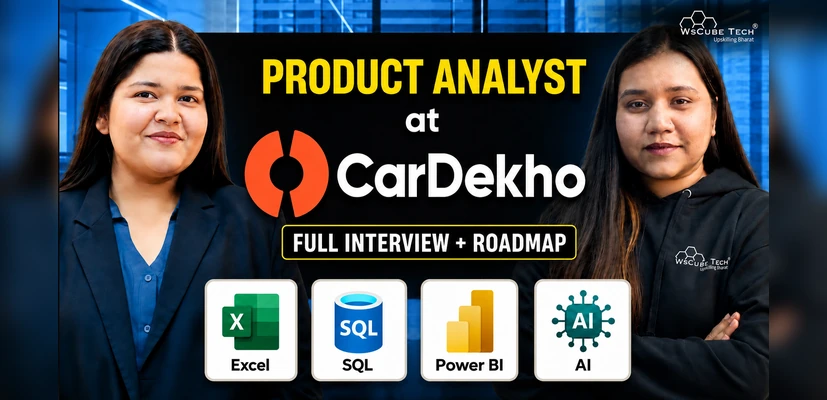
Anshika Tejwani, a final-year Computer Science student and learner from the WsCube Tech Data Analytics Mentorship Program, shares her journey from learning analytics tools and building projects to securing a Product Analyst opportunity at CarDekho.
In this interview, she discusses her background, learning routine, projects, interview rounds, use of AI, internship experience, and advice for freshers.
Key Highlights of the Interview
In this podcast, Anshika shares:
- Her journey from a Computer Science student to a Product Analyst Trainee at CarDekho.
- Why she chose Data Analytics and WsCube Tech.
- The skills she learned, including Excel, SQL, Python, and Power BI.
- How practical projects helped her prepare for job interviews.
- Her experience with the CarDekho interview process.
- How she uses AI for automation and productivity.
- Her learning routine and approach to continuous improvement.
- Advice for freshers starting a career in Data or Product Analytics.
Watch the Full Interview
Want to hear it directly from Anshika? Watch the complete interview below.
Student Highlight
| Metric | Detail |
| Student Name | Anshika Tejwani |
| Current Role | Product Analyst Trainee |
| Company | CarDekho |
| Previous Background | Final-year CS student, also built her own startup |
| Key Tools Used | Excel, SQL, Python, Power BI, BigQuery, GA4, Looker Studio |
| Learning Path | WsCube Tech Data Analytics Mentorship Program |
| Projects Built | 10 to 11, including an Uber capstone |
| Learning Duration | 4 months |
| Interview Rounds Cleared | 3 (HR, Excel and SQL, Python) |
| Time to Job | Course ended October, hired by February |
Anshika's Background: Why a CS Student Chose Analytics
Anshika was in her final year of Computer Science when she started the Data Analytics course. She already knew some Python and SQL. What she did not know was how any of it connected to real business decisions.
She had also built her own startup, and that changed how she looked at data. Running something of her own meant paying attention to customers, website traffic, and what was actually working. It made her want to understand the reasons behind the numbers, not just the numbers themselves.
That curiosity turned into questions she wanted to answer:
- Why is this happening?
- What do customers actually want?
- How are users moving through a website?
- Which data helps a business make a better decision?
Analytics was where those questions had answers.
Recommended Professional Certificates
Data Analytics Course with Gen AI
Data Science Course with Internship & Placement Support
Why Anshika Chose Data Analytics and WsCube Tech
Most Computer Science students head straight into software development. Anshika did not.
She wanted work that sat between technology and business. Analytics gave her that mix: writing code, understanding user behaviour, and solving problems that actually affect how a company performs.
Once she had picked the field, she started comparing courses. A friend recommended WsCube Tech, and she went in for an offline program rather than a self-paced one.
Here is why offline worked better for her:
- A fixed routine. Set class timings meant she showed up instead of postponing.
- Direct mentor access. Doubts got cleared in the room, not in a comment section.
- Peer learning. Classmates to compare work with and learn from.
- A competitive but supportive setup. Enough pressure to keep moving, enough support to not feel stuck.
- Real accountability. The hardest part of self-paced learning is staying consistent, and offline removed that problem.
She also read reviews online and heard directly from a friend who had finished another WsCube Tech course. That was enough to make the decision.
Skills and Tools the Student Focused On
During the program, Anshika worked on the core skills required for analytics roles:
- Excel: Used for data cleaning, spreadsheet formulas, quick analysis, and reporting.
- SQL: Used to query databases, filter information, and extract meaningful insights.
- Python: Used for data analysis, problem-solving, and automating repetitive tasks.
- Pandas: Used in Python to clean, transform, and analyze structured datasets.
- Power BI: Used to create interactive dashboards and present data visually.
- Sentiment Analysis: Used to identify opinions, emotions, and patterns in text data.
- Artificial Intelligence: Explored AI tools to support analysis, coding, and workplace productivity.
- Machine Learning: Learned basic concepts for understanding patterns and making predictions from data.
- Data Visualization: Focused on presenting complex data through clear charts, dashboards, and reports.
- Business and Product Analytics: Learned to connect data insights with customer behavior, product performance, and business decisions.
Anshika considers SQL and Excel especially important for aspiring analysts. Python supported her analysis and automation work, while Power BI helped her present insights through dashboards.
Her recommendation is to understand the fundamentals first and use AI as a support tool after building a strong foundation.
Learn the Same Skills Anshika Did
Anshika built her entire skill set in one structured program, then turned it into a portfolio that got her hired.
The Data Analytics Course at WsCube Tech covers the same ground, and more.
What the 18 week program includes:
- 106+ hours of live classes across 5 milestones, starting from Excel basics
- The full stack: Advanced Excel, MySQL, Power BI, Tableau, Python and Pandas
- AI built into every module, including prompt engineering, AI-assisted SQL, and automation with n8n and Make.com
- 10 projects and case studies on real company data from Amazon, Swiggy, Myntra, Tata Power and Apollo
- Mentors from Microsoft, Amazon, Google, KPMG and Rapido
- A 4 week internship as a Data Analytics Intern at WsCube Tech
- Bonus modules in statistics, machine learning, Microsoft Fabric and Google Analytics 4
No coding background needed. You start from the basics and build up, exactly the way Anshika did.
Internship Experience: From Learning to Real Work
After completing the course, Anshika began her professional journey through a three-month internship at CarDekho. She received an increment after the internship and was working toward a Product Analyst position.
During the internship and early role, she worked with:
- Website and lead tracking data.
- Google Analytics 4.
- BigQuery.
- SQL-based internal tools.
- Python automation.
- Excel formulas.
- Google Sheets.
- Reporting and product-related analysis.
Her earlier preparation helped her adjust more quickly because she already understood SQL, Python, Excel, and analytics concepts. She explained that strong fundamentals made it easier to learn new tools and contribute to automation tasks.
Building Products Through Data at CarDekho
Anshika joined CarDekho as a Product Analyst Trainee, where she works with website and product data to support business decisions and improve analytical processes.
Her key responsibilities and learning areas include:
- Tracking and analyzing leads generated through the website.
- Working with Google Analytics 4 (GA4) data.
- Querying and analyzing data using BigQuery and SQL.
- Automating repetitive tasks with Python.
- Using Excel and Google Sheets for calculations and reporting.
- Preparing reports and sharing actionable insights.
- Creating and interpreting visual reports through Looker Studio.
- Supporting the development of AI-based internal tools.
Although she also received an opportunity to explore Business Analytics, Anshika’s goal is to continue growing in Product Analytics and progress from her trainee position to a full-time Product Analyst role. Her journey reflects how strong fundamentals in SQL, Excel, Python, and data visualization can help students transition into real-world analytics roles.
Upcoming Masterclass
Attend our live classes led by experienced and desiccated instructors of Wscube Tech.
Interview Process: How She Got Selected at CarDekho
Anshika had already attended five interviews before appearing for the CarDekho selection process. She was nervous at first, but practice and mock interviews gradually helped her build confidence.
Her interview rounds:
- HR round for basic introduction and fit, covering her background, learning journey and interest in the role.
- Excel and SQL round, focused equally on both:
- Five SQL questions and five Excel questions
- Practical problem solving, not theory
- Around one hour to complete
- Power BI was not directly tested. The interviewer said visualization knowledge helps, but accurate numbers and analytical ability matter more
- Python round, completely practical. She had to solve problems and explain her logic. The interviewer also asked her to use ChatGPT to find an output, then explain the code and prove she understood the solution instead of copying an AI generated answer.
Key takeaways from her interview experience:
- CarDekho used direct problem solving. A brief introduction, then around 10 questions in one hour.
- Formats differ by company. Another interview she attended started with theoretical Excel and SQL questions before moving to practical Python, so prepare both concepts and hands-on practice.
- Communication matters as much as the answer. You need to explain what you are doing, why you chose that approach, how you reached the answer, and what insight it gives.
- Mock interviews helped her spot her mistakes and improve before the real thing.
Importance of Communication
Anshika considers communication one of the most important skills in an interview. Candidates need to explain:
- What they are doing.
- Why they are using a particular approach.
- How they reached an answer.
- What insight their analysis provides.
She also mentioned that mock interviews helped her identify mistakes and improve her performance before the actual interview. [14:02]
How Anshika Uses AI in Product Analytics
Anshika views AI as a productivity tool that helps analysts reduce repetitive work and complete tasks more efficiently. She believes AI can support an analyst’s work, but it cannot replace human understanding, business context, and decision-making.
In her current role at CarDekho, she uses AI for:
- Automating repetitive communication and manual processes.
- Supporting SQL and Python tasks.
- Speeding up routine analysis and coding.
- Creating and improving internal tools.
- Reducing time spent on repetitive work.
However, Anshika believes analysts remain essential because they need to understand the product, verify AI-generated results, maintain tools, and adapt them to changing business requirements.
Her Take on AI:
“AI can make an analyst’s work easier, but it cannot replace the person who understands the business context and validates the result.” [6:52]
She also advises beginners to first learn the fundamentals of SQL, Excel, Python, and analytical thinking before relying on ChatGPT or other AI tools. According to her, students should use AI as a support system, not as a substitute for independent learning and problem-solving.
Learning Routine
Anshika followed a disciplined routine during the course. On days without classes, she dedicated approximately the same amount of time to self-study as she would have spent in class.
She also preferred studying at night and regularly studied from approximately 12:00 a.m. to 4:00 a.m.
Her routine included:
- Attending scheduled classes.
- Completing practical projects.
- Revising concepts.
- Practicing Excel, SQL, and Python.
- Working on her portfolio.
- Preparing for interviews.
- Continuing to learn after joining the company.
She realized after starting her job that learning must continue. After the first month, she initially felt that formal learning was complete, but by the second month she recognized that continuous learning was necessary for career growth.
WsCube Tech Student Success Story: Placed at CarDekho (Full Interview)
Ayushi: Can you briefly explain your background and learning journey?
Anshika: I was a final-year Computer Science student and began the Data Analytics course during my last year. I knew some Python and SQL but did not have a clear understanding of analytics. During the course, I worked on Excel, SQL, Python, Power BI, and multiple projects.
Ayushi: Why did you choose Analytics instead of software development?
Anshika: I was interested in understanding why things happen and what customers want. Building my own startup also made me realize the importance of analyzing business performance, website traffic, and customer behavior.
Ayushi: Why did you choose WsCube Tech and an offline program?
Anshika: A friend recommended WsCube Tech. I preferred offline learning because it created accountability, offered regular classroom interaction, and provided a competitive and supportive environment. I felt that attending classes in person would help me stay consistent.
Ayushi: Which tool was the most difficult to learn?
Anshika: Python was the most difficult tool for me during the course.
Ayushi: How much time did you dedicate to studying?
Anshika: On days without classes, I studied for approximately the same amount of time as the class schedule. I also had a habit of studying at night, usually from around 12:00 a.m. to 4:00 a.m.
Ayushi: How did your projects help you get the job?
Anshika: My portfolio was noticed by a professor, who recommended me for an opportunity. During the CarDekho interview, the interviewer remembered my Uber capstone project and sentiment analysis project. These projects helped me demonstrate practical knowledge and made a strong impression.
Ayushi: How many projects did you build?
Anshika: I built around 10 to 11 projects, including:
- Two Excel projects
- Four SQL projects
- Four Python projects
- Pandas-based work
- Sentiment analysis
- AI and machine learning projects
- A Power BI project
- An Uber capstone project
Ayushi: What was the weightage of Excel, SQL, Python, and Power BI in the interview?
Anshika: Power BI was not directly asked. The first round included five Excel questions and five SQL questions, giving both tools equal weightage. The second round was completely focused on Python.
Ayushi: Were the questions theoretical or practical?
Anshika: The CarDekho interview focused mainly on direct practical problem-solving. I was asked to solve around 10 questions within one hour. The interviewer did not begin with many theoretical questions.
Ayushi: How important was communication during the interview?
Anshika: Extremely important. Clear communication creates a positive impression and helps you explain your knowledge and approach. Mock interview sessions helped me improve this skill.
Ayushi: How many interviews did you attend before CarDekho?
Anshika: I attended five interviews before being selected by CarDekho.
Ayushi: How did you deal with delayed responses from companies?
Anshika: I used LinkedIn to contact professionals, recruiters, and interviewers. Before the CarDekho interview, I contacted my interviewers through LinkedIn to understand the company environment, requirements, and possible interview expectations.
Ayushi: What tools do you use most often in your current role?
Anshika: SQL, Excel, Python, BigQuery, Google Analytics 4, Google Sheets, Looker Studio, and internal tools. SQL and Excel are particularly important, while Python is valuable for automation.
Ayushi: How much AI do you use in your current role?
Anshika: AI helps automate manual work, support communication, and build internal tools. It improves productivity but does not eliminate the need for employees who understand, maintain, and update those tools.
Ayushi: How long after completing the course did you start working?
Anshika: I completed the course in October, began applying in January, and started working with CarDekho in the last week of February. I received the opportunity before completing my graduation, and my portfolio played an important role.
Ayushi: What advice would you give to aspiring analysts?
Anshika: Focus on tools, logic, fundamentals, and projects during the initial stage. Keep your dependence on AI low while learning, and use AI later as a productivity support tool.
Explore Our Data Related Courses
| Data Analytics Course | Live Internship + 100% Job Support |
| Business Analytics Course | Live Internship + 100% Job Support |
| Data Science Course | Live Internship + 100% Job Support |
Anshika’s Advice for Freshers Starting in This Role
Anshika’s advice for freshers is:
- Learn SQL and Excel thoroughly.
- Understand the logic instead of memorizing code.
- Practice practical questions.
- Build a portfolio with multiple projects.
- Learn Python for analysis and automation.
- Develop communication skills.
- Participate in mock interviews.
- Use LinkedIn for networking.
- Do not become dependent on AI during the early learning stage.
- Continue learning even after getting the first job.
- Understand the business or product before presenting an insight.
- Treat rejection as part of the job-search process.
- Focus on becoming job-ready rather than only completing a course.
Her journey shows that a strong portfolio, practical skills, communication, and consistent preparation can help a fresher enter Product Analytics, even before completing graduation.
Become a Data Analyst Like Anshika With WsCube Tech's 100% Placement Support
Anshika got her offer before she even graduated. Her portfolio did the talking.
The Data Analytics Course at WsCube Tech is built to get you to the same place.
- Learn every tool you need: Excel, SQL, Python, Power BI, BigQuery and AI tools
- Live classes taught by mentors from Microsoft, Amazon and KPMG
- 10 real projects plus a 4 week internship to build your portfolio
- 1:1 mock interviews and interview prep, the exact thing Anshika credits
- 100% placement support: resume building and referrals to 350+ companies
280+ students placed. 90% median hike. Rated 4.9 by 1,032 learners.
Enroll in the Data Analytics Course Today!
Join Our On-Campus Data Analytics Course





Leave a comment
Your email address will not be published. Required fields are marked *Comments (0)
No comments yet.