
Every marketer feels the same pressure: too many campaigns, too many leads, not enough hours in the day. This is the gap marketing automation was built to close, letting software handle repetitive jobs like emails and lead tagging so teams can focus on strategy and creativity.
This guide covers what it means, how it works, why it matters in 2026, and the skills you need to build a career around it. You don't need a technical background either. Marketing software automation platforms are built for marketers, not developers, with simple drag-and-drop tools to get started.
What is Automation?
Before we dive into marketing specifically, let's understand automation itself. Automation simply means using technology to perform tasks with little or no human effort. Think of a washing machine.
You load the clothes, press a button, and the machine handles washing, rinsing, and spinning on its own. You do not need to stand there and do each step manually. In the business world, automation works the same way. Software takes over repetitive, rule-based tasks such as sending reminder emails, updating spreadsheets, or sorting customer data.
This saves time, reduces human error, and lets people spend their energy on work that actually needs a human touch, like creativity, judgment, and relationship building.
What is Automation in Marketing?
In simple words, it is the use of software to handle repetitive marketing tasks such as sending emails, posting on social media, segmenting audiences, and tracking customer behavior, without a person doing it manually every single time.
If someone asks you what is marketing automation in one line, you can say this: it is technology that helps marketing teams plan, execute, and measure campaigns automatically, based on rules and triggers that are set up in advance.
For example, when a new visitor signs up for a newsletter, the system can automatically send them a welcome email, add them to a specific list, and notify the sales team, all without anyone lifting a finger.
This is different from just using software to create content. Automation is about the workflow, the sequence of actions that happen once a trigger takes place. It connects data, timing, and messaging into one smooth system.
People often search for what actually is marketing automation expecting a complicated technical answer, but the concept is actually straightforward once you break it down. It is simply a set of instructions, written once, that a computer follows every time a certain condition is met.
The complexity comes later, once businesses start building dozens of these instructions to cover every stage of the customer journey, from the first website visit to becoming a repeat, loyal customer.
Recommended Professional Certificates
AI-Powered Digital Marketing Course
Performance Marketing Bootcamp
SEO Specialist Bootcamp
How Does Marketing Automation Work?
Marketing automation works on a simple idea: trigger, action, and result. Here is a breakdown of the process:
- Data collection: The system gathers information about visitors and customers, such as their email address, browsing behavior, purchase history, or how they interact with your website and emails.
- Segmentation: Based on this data, contacts are grouped into segments. For example, "people who abandoned their cart" or "customers who bought once in the last 90 days."
- Trigger setup: Marketers define triggers, like a form submission, a page visit, or a specific date, that start an automated action.
- Automated action: Once a trigger fires, the marketing automation software carries out the next step. This could be sending an email, showing a targeted ad, or alerting a sales rep.
- Tracking and optimization: The platform tracks results such as open rates, click rates, and conversions, so marketers can improve the sequence over time.
If you are wondering what is a marketing automation workflow, this is exactly it: a connected series of triggers and actions that guide a customer from one stage to the next without manual effort at every step.
A simple workflow might look like this: someone downloads an ebook, gets added to a nurture sequence, receives three follow-up emails over two weeks, and then gets flagged for the sales team if they click a pricing link.
Moreover, if you are still not sure what is marketing automation used for in day-to-day operations, think of it as the engine running quietly in the background of a business: sending the right message, to the right person, at the right time, without someone manually clicking send every single time.
Marketing Automation vs Manual Marketing: Comparison
Many small businesses still rely on manual marketing, where emails, social media posts, and follow-ups are handled individually. While this works for smaller audiences, it becomes time-consuming and difficult to scale. The table below compares manual marketing with marketing automation to show the key differences.
| Factor | Marketing Automation | Manual Marketing |
| Time required | Low, tasks run automatically once set up | High, tasks repeated manually every time |
| Consistency | Consistent, follows the same rules every time | Depends on the person doing the work |
| Personalization at scale | Easy, even with thousands of contacts | Difficult beyond a small list |
| Human error | Lower, since the system follows set triggers | Higher risk of missed follow-ups |
| Data tracking | Centralized dashboards and reports | Often scattered across spreadsheets |
| Cost over time | Software cost, but scales without added staff | Labor cost grows with volume |
| Speed of response | Instant, works 24/7 | Slower, depends on availability |
This comparison shows why automation for marketing has become the standard approach for growing businesses. Manual marketing is not wrong, and it works fine for very small operations, but it becomes hard to manage the moment your audience grows past a few hundred contacts.
Why Marketing Automation Matters in 2026
The numbers tell a clear story about where marketing is headed. The global marketing automation software market is projected to grow from around $8.14 billion in 2026 to roughly $20.12 billion by 2034, a compound annual growth rate close to 12 percent. Other estimates place the market even higher when AI-driven tools are included, with global AI in marketing spending expected to reach around $41 billion in 2026.
Adoption is rising just as fast. Research shows that at least 76 percent of businesses now use some form of marketing automation, and companies that adopt it report earning an average of $5.44 for every $1 spent over three years, a return of more than 500 percent. The same research found that automated emails generated 37 percent of all email-based sales despite making up only a small share of total email volume.
In 2026, marketing automation in digital marketing is no longer a nice-to-have. Customers expect fast, personalized responses, and businesses that cannot deliver this at scale risk falling behind competitors who can. With AI now built into most platforms, automation has also become smarter, capable of predicting the best time to send a message or the type of content a specific customer is most likely to respond to.
There is also a competitive pressure at play. When one business in an industry starts using automation to respond faster, follow up more consistently, and personalize offers, customers begin to expect that same level of service everywhere else. This creates a ripple effect, pushing even traditional, offline-first businesses to adopt some form of digital automation just to keep up.
Add to this the rising cost of manual labor and the shrinking attention span of online audiences, and it becomes clear why automation has shifted from an experiment to a core part of business strategy in 2026.
Upcoming Masterclass
Attend our live classes led by experienced and desiccated instructors of Wscube Tech.


Key Benefits of Marketing Automation
Understanding the marketing automation benefits helps explain why so many businesses are investing in it. If you have ever asked what is the main goal of marketing automation, the honest answer is that different businesses use it for different reasons, but the benefits below are usually why they stick with it long term. Here are the biggest advantages:
- Saves time on repetitive work: Nearly half of marketers, 49 percent, say automation saves them meaningful time on repetitive tasks like sending follow-up emails or updating contact lists.
- Improves lead nurturing: Automated workflows follow up with leads consistently, so fewer prospects fall through the cracks.
- Boosts personalization: Instead of sending the same message to everyone, automation lets you tailor content based on behavior, location, or purchase history.
- Increases revenue efficiency: With an average return of $5.44 for every dollar spent, the financial case for automation is strong.
- Better data and reporting: Everything is tracked in one place, making it easier to see what is working and what needs improvement.
- Improves team alignment: Sales and marketing teams can work off the same data, reducing confusion about who should follow up with which lead.
These benefits of marketing automation are one reason why demand keeps rising across industries, from e-commerce to education to B2B software.
Types of Marketing Automation
Not all automation looks the same. Depending on the goals of a business, a marketing automation platform can be used in several ways:
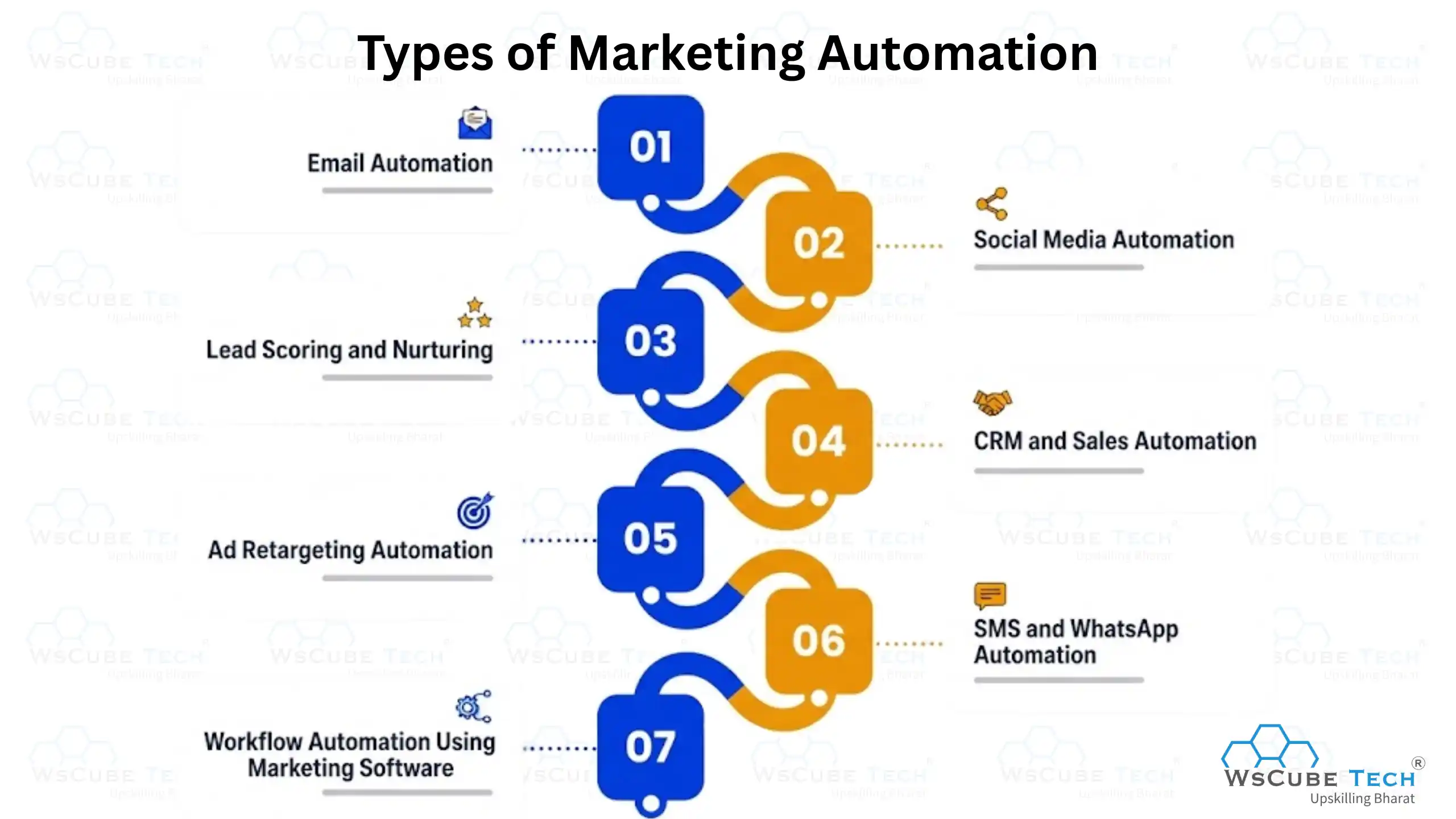
- Email automation: Welcome sequences, cart abandonment reminders, birthday offers, and newsletters sent automatically based on triggers.
- Social media automation: Scheduling posts in advance, auto-responding to comments or messages, and tracking engagement across platforms.
- Lead scoring and nurturing: Assigning points to leads based on their activity, so sales teams know who is most ready to buy.
- CRM and sales automation: Automatically updating customer records, assigning leads to sales reps, and sending reminders for follow-ups.
- Ad retargeting automation: Showing ads to people who already visited your site or interacted with your brand.
- SMS and WhatsApp automation: Sending order updates, reminders, or promotional messages through text-based channels.
- Workflow automation using marketing software automation tools that connect multiple apps, such as your website, email platform, and CRM, so data flows between them without manual entry.
Each type solves a different problem, and most businesses end up combining several of them into one connected system. A well-built marketing software automation setup usually blends two or three of these types together, so a single trigger, like a purchase, can kick off an email, update the CRM, and remove that contact from an ad retargeting list all at once. This connected approach is what separates basic automation from a truly efficient marketing engine.
Real-World Marketing Automation Examples
Seeing marketing automation examples in action makes the concept easier to understand. Here are a few common ones:
1. Netflix – Personalized Content Recommendations
Automation Used: AI-driven email and in-app recommendations
Netflix automatically analyzes users' viewing history, watch time, ratings, and browsing behavior. It then sends personalized emails like "Continue Watching" or "New Shows You May Like" and customizes the homepage for each user.
Result:
- Higher user engagement
- Increased watch time
- Better customer retention
2. Amazon – Abandoned Cart Email Automation
Automation Used: Trigger-based email campaigns
When a customer adds products to the cart but leaves without purchasing, Amazon automatically sends reminder emails. These emails often include the abandoned products, similar recommendations, and sometimes limited-time discounts.
Result:
- Recovers lost sales
- Improves conversion rates
- Encourages repeat purchases
3. Spotify – Wrapped Campaign
Automation Used: Automated data collection and personalized content generation
Every year, Spotify automatically collects listening data from millions of users and creates personalized "Spotify Wrapped" summaries showing top artists, songs, genres, and listening habits. Users receive these reports through the app and email.
Result:
- Massive social media sharing
- Increased app engagement
- Strong brand awareness
4. Starbucks – Rewards App Personalization
Automation Used: Loyalty marketing automation
Starbucks automatically tracks customer purchases through its Rewards app. Based on buying behavior, location, and visit frequency, customers receive personalized offers, birthday rewards, and product recommendations.
Result:
- Higher repeat purchases
- Improved customer loyalty
- Increased average order value
5. Duolingo – Learning Reminder Notifications
Automation Used: Behavioral push notification automation
Duolingo monitors users' learning streaks and lesson completion. If a learner misses a session, the app automatically sends personalized push notifications and emails encouraging them to continue their streak.
Result:
- Better user retention
- Increased daily active users
- Higher course completion rates
These marketing automation examples show how automation is not about replacing marketers; it is about handling the repetitive parts so teams can focus on strategy and creative work.
Read More Important Digital Marketing Guides
Popular Marketing Automation Platforms/Tools
There are many marketing automation tools available today, each suited to different business sizes and needs:
- HubSpot: A widely used all-in-one platform combining CRM, email marketing, and automation workflows, popular with small to mid-sized businesses.
- Mailchimp: Known for its simplicity, often the starting point for small businesses moving from manual email marketing to automation.
- ActiveCampaign: Strong for email and CRM automation with detailed customer journey mapping.
- Marketo (Adobe Marketo Engage): A robust marketing automation platform built for larger enterprises with complex B2B needs.
- Zoho Marketing Automation: A budget-friendly option that integrates well with other Zoho business tools.
- Salesforce Marketing Cloud: A powerful enterprise-grade solution often paired with Salesforce CRM.
- Zapier: While not a full marketing suite, it connects different apps and automates workflows between them.
Choosing the right marketing automation tools depends on your budget, team size, and how complex your customer journeys are. Small businesses often start simple and upgrade to more advanced platforms as their needs grow.
How to Set Up Marketing Automation (Beginner Roadmap)
If you are new to this, here is a simple roadmap for setting up your first automation system. You do not need to build everything at once. Most successful automation setups start with one small workflow, prove that it works, and then grow from there.
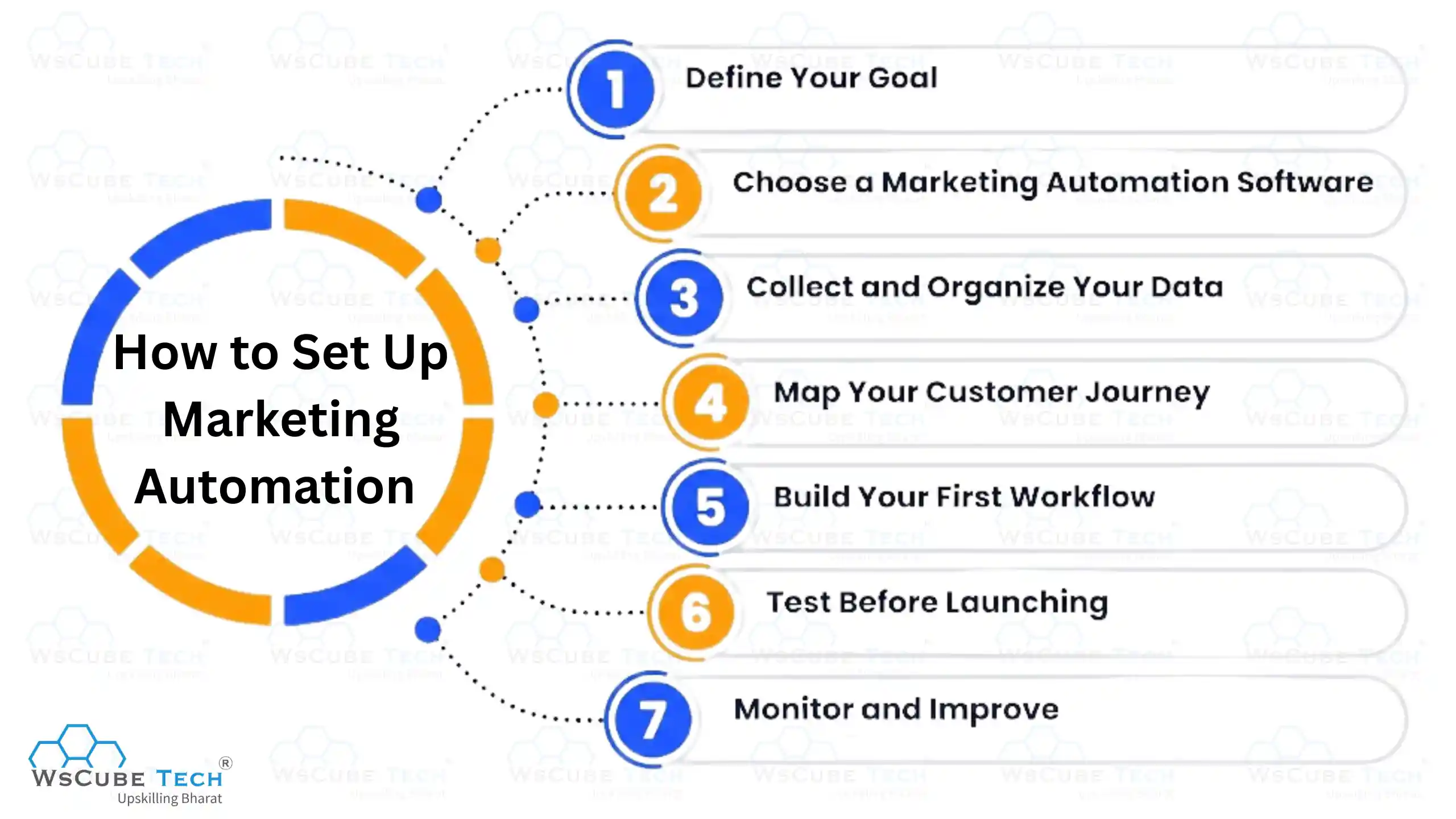
- Define your goal: Decide what you want automation to achieve, whether it is more sign-ups, better lead nurturing, or higher repeat purchases.
- Choose a marketing automation software: Pick a tool that fits your budget and technical comfort level. Beginners often start with simpler platforms before moving to advanced ones.
- Collect and organize your data: Make sure your contact list, website tracking, and CRM data are clean and connected.
- Map your customer journey: Sketch out the stages a customer goes through, from first visit to purchase to loyal customer, so you know where automation should step in.
- Build your first workflow: Start small, such as a welcome email series or a cart abandonment sequence.
- Test before launching: Send test emails to yourself, check the timing, and make sure triggers fire correctly.
- Monitor and improve: Track open rates, click rates, and conversions, then adjust your workflows based on real results.
Furthermore, if you are researching what is a marketing automation software before buying one, most platforms now offer free trials, so you can test features before committing to a paid plan.
AI's Role in Marketing Automation (2026 Trends)
Artificial intelligence has become deeply woven into marketing automations in 2026. AI-driven automation adoption is expected to exceed 90 percent among enterprises, and about 70 percent of marketers say they plan to invest more in AI-powered automation tools this year.
Here are the biggest AI trends shaping automation for marketing right now:
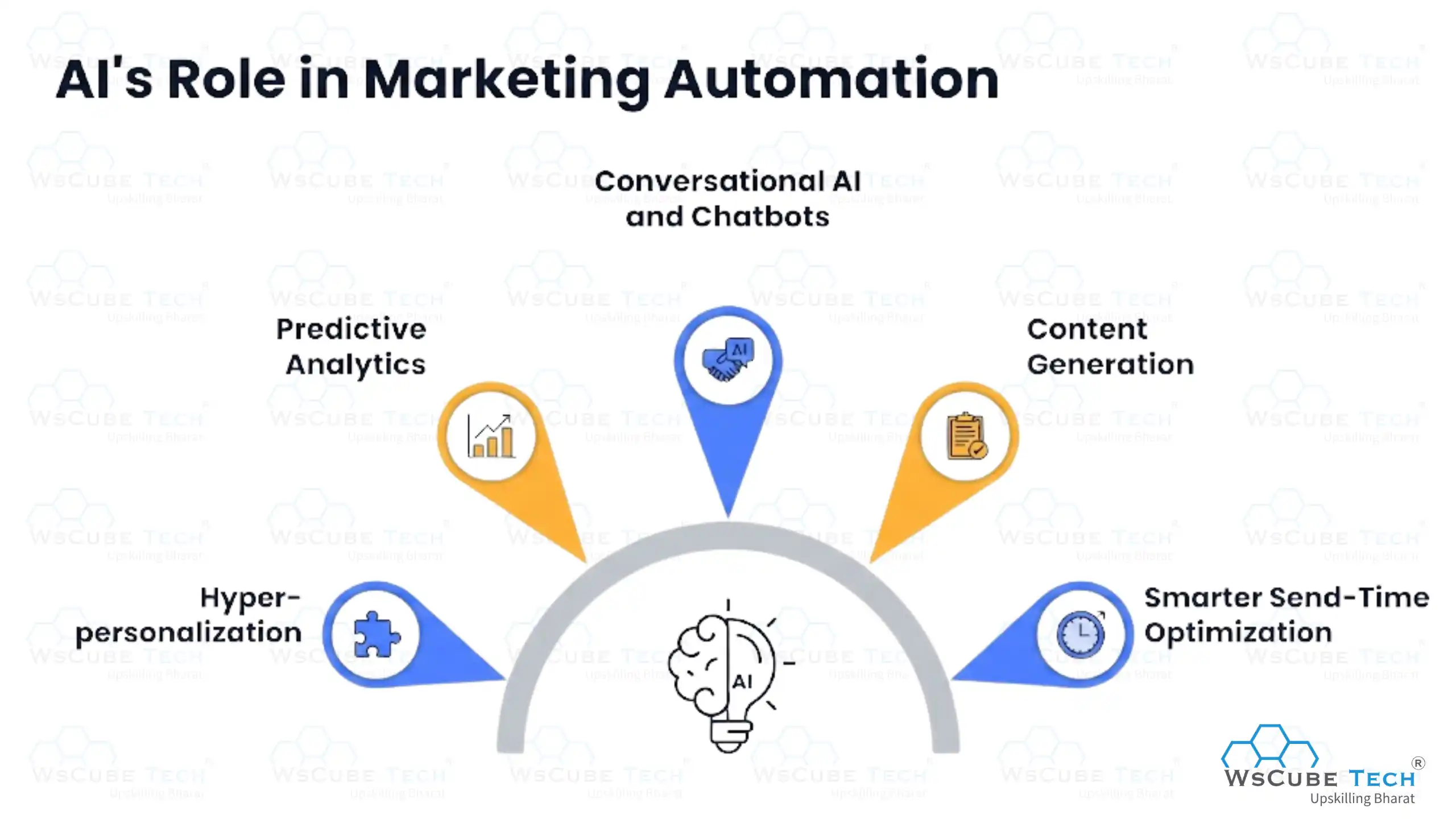
- Hyper-personalization: AI analyzes customer behavior in real time to deliver highly tailored content, which the same research links to conversion rate gains of around 30 percent.
- Predictive analytics: AI models forecast which leads are most likely to convert, helping teams prioritize their time and budget more accurately, with reported improvements in decision accuracy of up to 40 percent.
- Conversational AI and chatbots: Voice and chat-based automation is growing quickly, handling customer questions instantly instead of making people wait for a human reply.
- Content generation: AI tools help marketers draft emails, ad copy, and social posts faster, which then get slotted into automated workflows.
- Smarter send-time optimization: Instead of a fixed schedule, AI decides the best time to reach each individual contact based on their past behavior.
This shift means marketers today need to understand not just how to build a workflow, but how to work alongside AI tools that make those workflows smarter. If you want to build these practical skills, enrolling in a online AI Course can help you understand how AI models, automation tools, and machine learning are transforming modern marketing.
Explore Our Most Popular Marketing Courses
Common Marketing Automation Mistakes to Avoid
Even with the best marketing automation software, mistakes can hurt results. Automation amplifies whatever you build into it, so a small mistake in a workflow can quickly turn into hundreds or thousands of poor customer experiences before anyone notices. Here are the most common ones to watch out for:
- Automating too soon: Setting up complex workflows before understanding your audience often leads to irrelevant messaging.
- Ignoring segmentation: Sending the same automated message to your entire list defeats the purpose of personalization.
- Ignoring maintenance: Automation is not "set and forget." Broken links, outdated offers, and old triggers need regular review.
- Overloading customers with messages: Too many automated emails or notifications can annoy people and increase unsubscribes.
- Not testing workflows: Skipping the testing phase can lead to embarrassing errors, like sending a "Hi [First Name]" email with the placeholder still showing.
- Choosing the wrong marketing automation tools: Picking a platform that is too complex or too limited for your business can waste both time and money.
- Forgetting the human touch: Automation should support relationships, not replace all personal interaction. Some conversations still need a real person.
Avoiding these mistakes helps businesses get full value from their automation investment instead of creating frustration for their audience.
Skills Needed to Work in Marketing Automation
If you are considering a career in this field, the good news is that most of these skills can be learned through practice, free tutorials, and hands-on experience with real platforms. Employers are usually more interested in whether you can build and troubleshoot a working workflow than in formal certifications alone. Here are the core skills employers look for:
- Understanding customer journeys: Knowing how to map out the stages a customer moves through before and after a purchase.
- Familiarity with automation platforms: Hands-on comfort with tools like HubSpot, Mailchimp, or ActiveCampaign.
- Basic data analysis: Reading reports and dashboards to understand what is working and what needs adjustment.
- Email marketing and copywriting: Writing clear, engaging messages that perform well in automated sequences.
- CRM knowledge: Understanding how customer data moves between marketing and sales systems, especially important when working in b2b marketing automation environments where sales cycles are longer and more relationship driven.
- A/B testing: Knowing how to test subject lines, timing, and content to improve results over time.
- Basic understanding of AI tools: Since AI is now central to marketing automation in digital marketing, comfort with AI-assisted content and prediction tools is increasingly valuable.
These skills are useful whether you plan to work in-house at a company or as part of a marketing agency handling automation for multiple clients.

FAQs about Marketing Automation
The main goal of marketing automation is to save time and improve consistency by handling repetitive marketing tasks automatically, while delivering more personalized and timely communication to customers.
A marketing automation workflow is a connected sequence of triggers and actions, such as a sign-up followed by a welcome email, a follow-up message, and a sales notification, that runs automatically once it is set up.
It is a tool or platform, such as HubSpot or Mailchimp, that businesses use to build, run, and track automated marketing tasks like emails, social posts, and lead scoring.
B2B marketing automation refers to using automation tools specifically for business-to-business marketing, where sales cycles are longer; decision-making involves multiple people, and lead nurturing over time matters more than quick, one-time purchases.
It is used for tasks like sending automated emails, scoring and nurturing leads, scheduling social media posts, retargeting website visitors with ads, and tracking customer behavior across the buying journey.
No. Small businesses can also benefit, often starting with simple tools like Mailchimp before moving to more advanced platforms as they grow.
No. It handles repetitive tasks, but strategy, creativity, and relationship building still need human input.
Many businesses start seeing measurable results, such as better open rates or more consistent lead follow-up, within the first few months of setting up basic workflows.
Beginners often start with tools like Mailchimp, HubSpot, and Zoho Marketing Automation because they are easy to use and offer templates, drag-and-drop workflow builders, and free or affordable plans. As your business grows, you can move to more advanced platforms with additional features.
Yes. Marketing automation helps capture, qualify, and nurture leads automatically through landing pages, forms, email sequences, and lead scoring. This ensures prospects receive the right content at the right time, increasing the chances of conversion.
Choose a marketing automation software based on your business size, budget, marketing goals, and integration needs. Look for features such as email automation, CRM integration, analytics, workflow automation, and scalability to support future growth.
Yes. Marketing automation helps small businesses save time, improve customer engagement, and automate repetitive tasks without hiring additional staff. Many platforms also offer free or low-cost plans, making automation accessible even for startups.
Conclusion
Marketing automation has moved from being an optional advantage to a core part of how modern businesses operate. From small startups automating their first welcome email to large enterprises running AI-powered, cross-channel campaigns, the goal remains the same: save time, reduce errors, and connect with customers in a more personal, timely way.
As AI continues to shape this space through 2026 and beyond, businesses that learn to combine smart automation with genuine human strategy will be the ones that build the strongest customer relationships and see the best returns on their marketing spend.
Join Our On-Campus Digital Marketing Program
Explore Our Free Courses





Leave a comment
Your email address will not be published. Required fields are marked *Comments (0)
No comments yet.